

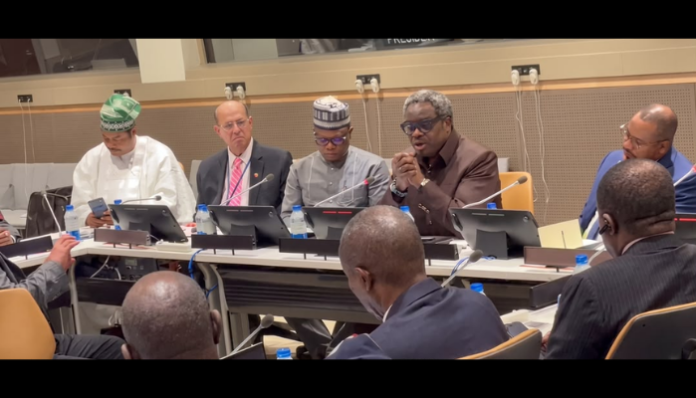
Sahara Group has called for greater mobilisation of climate finance and sustainable investment to accelerate Africa’s development and strengthen the continent’s capacity to withstand economic and climate-related pressures.
Kola Adesina, group managing director of Sahara Power Enterprise Group, made the call on the sidelines of the ongoing United Nations General Assembly (UNGA) in the United States.
Speaking during a roundtable focused on sustainable global investment, economic resilience and climate financing, Adesina said African countries need sustained investment across energy, infrastructure, agriculture, industry and enterprise development to expand productive capacity.
He said the three areas of sustainable investment, economic resilience and climate finance should be treated as interconnected priorities as African countries continue to contend with infrastructure, energy and food security challenges.
Almost 600 million people in sub-Saharan Africa lack access to electricity, while the continent faces an estimated annual infrastructure financing gap of between $68 billion and $108 billion.
“Africa’s most pressing challenge is expanding its productive capacity at scale. We need sustained investment in energy, infrastructure, industry, agriculture, and enterprise development to create jobs, strengthen competitiveness, and support long-term resilience,” Adesina said.
According to Adesina, the global investment environment offers an opportunity to channel more capital towards Africa. He noted that foreign direct investment (FDI) reached about $1.6 trillion in 2025, while assets linked to sustainable investment strategies stood at $16.7 trillion globally.
He also identified climate finance as essential to protecting Africa’s development gains as countries across the continent become increasingly exposed to droughts, floods, extreme heat and other climate-related risks.
Although Africa contributes less than four percent of global greenhouse gas emissions, Adesina said the continent needs substantial investment to safeguard infrastructure, businesses, food systems and communities from the effects of climate change.
“Africa requires substantial investment not only to grow but also to protect the infrastructure, businesses, food systems, and communities that underpin development,” he said.
Adesina said African countries need an estimated $277 billion annually to implement their climate commitments, against climate finance flows of about $30 billion each year.
He consequently called for innovative financing mechanisms capable of narrowing the funding shortfall and unlocking additional capital for climate mitigation and adaptation projects.
He also urged stronger project preparation, greater mobilisation of African institutional capital, deeper local-currency financing markets and enhanced regional cooperation in energy, transport and logistics infrastructure.
Adesina said Sahara’s investments in liquefied natural gas (LNG), liquefied petroleum gas (LPG), gas-to-power infrastructure and logistics are part of the group’s broader strategy to support energy development.
He added that the company is targeting net-zero emissions by 2060 through the development of gas infrastructure, integration of renewable energy and the use of nature-based solutions.
“Africa’s opportunity lies in building resilient prosperity, where investment translates into productive capacity, jobs, reliable infrastructure, and sustainable economic growth that endures for generations,” Adesina added.
Source TheCable
Do you want to share your impact stories or pitch the coverage of your CSR event to us? E-mail: editor@impactwatch.net or *Phone +234-806-795-0250 (Whatsapp &Text)


