

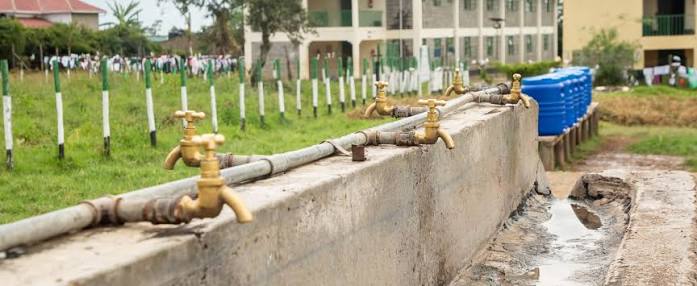
The African Development Fund has approved a $9.82 million grant to strengthen climate-resilient water, sanitation and hygiene (WASH) services across Eritrea.
Approved by the Fund’s Board of Directors on September 21, 2026, the Enhancing Water, Sanitation and Hygiene Adaptation Project will support rural water infrastructure, health centres, schools and catchment protection across all six administrative regions.
The project will be implemented in coordination with the Government of the State of Eritrea and UNICEF, with completion scheduled for December 2030. Funding will come through the Climate Action Window, a specialised mechanism of the African Development Fund, the concessional financing arm of the African Development Bank Group.
The investment targets water-security challenges linked to climate variability, including declining rainfall, drought and pressure on groundwater resources. Previous African Development Bank analysis identified frequent and severe droughts, declining groundwater recharge and reduced rainfall as factors affecting water availability, particularly in rural areas.
Under the project, 21 complete rural water-supply systems will be constructed, while 38 non-functional rural systems will be rehabilitated and modernised. WASH facilities will also be upgraded in 10 health centres and 12 schools.
The infrastructure programme includes boreholes, rural water systems, retention dams and earthworks. Tree planting in catchment areas will support the sustainability of water resources.
Mtchera Johannes Chirwa, Director of the African Development Bank Group’s Water and Sanitation Department, said the project is expected to reduce the distance communities travel to obtain drinking water by tenfold, bringing the distance down to about 500 metres.
He also said the programme would improve WASH facilities in health centres and schools while strengthening communities’ resilience to climate shocks.
Chirwa was appointed to lead the Bank’s Water and Sanitation Department in 2025 after previously serving as acting director and coordinator of the African Water Facility. The Bank says he has more than 30 years of development experience, including work in water and sanitation and development finance across more than 20 countries.
The project is also intended to address the wider effects of water insecurity on rural livelihoods. Eritrea’s dependence on agriculture and livestock means water shortages can affect crop production, livestock productivity and household incomes.
The African Development Bank’s country strategy for Eritrea has identified climate-smart agriculture, productivity, food security and livelihoods among its areas of engagement.
The project combines physical infrastructure with institutional and human capacity development. This is intended to support operation, maintenance, monitoring and climate-informed planning so that the water systems remain functional as climate pressures increase.
The environmental component will include catchment protection through tree planting, retention dams and earthworks. The approach recognises that the long-term performance of water infrastructure is linked to the condition of surrounding landscapes and ecosystems.
The project will cover Debub, Maekel, Anseba, Gash Barka, Northern Red Sea and Southern Red Sea.
The African Union’s Agenda 2063 identifies environmentally sustainable and climate-resilient economies and communities as a continental goal, including priorities around water security, sustainable natural-resource management, resilient infrastructure and access to basic services.
For Eritrea, the immediate focus will be delivering the 21 new water systems and rehabilitating the 38 existing systems while ensuring that local institutions can maintain the infrastructure and protect water resources over time.
The $9.82 million grant connects climate adaptation with water security, public health, education, rural productivity and environmental management, highlighting the role of basic infrastructure in strengthening resilience to climate-related pressures.
Source: africasustainabilitymatters
Do you want to share your impact stories or pitch the coverage of your CSR event to us? E-mail: editor@impactwatch.net or *Phone +234-806-795-0250 (Whatsapp &Text)


