

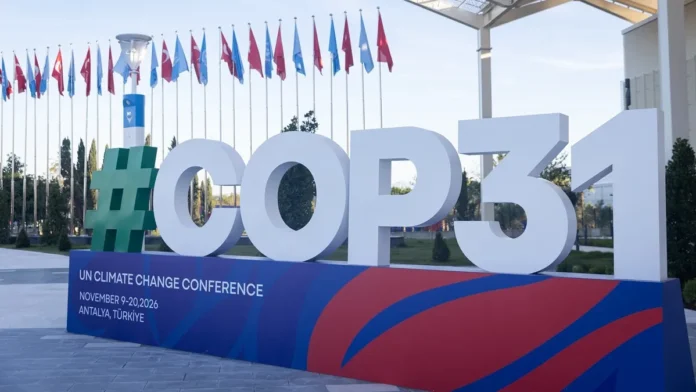
The 31st Conference of the Parties (COP31) to the United Nations Framework Convention on Climate Change (UNFCCC) begins in Antalya, Türkiye, from 9 to 20 November, bringing together governments, climate scientists, development institutions, businesses and civil society organisations to determine the next steps in the global response to climate change.
The summit takes place amid growing pressure on countries to cut greenhouse gas emissions, increase investment in clean energy and strengthen protection for communities already experiencing the effects of rising temperatures.
However, several longstanding disagreements remain unresolved, particularly over who should finance climate action, how quickly countries should reduce their dependence on fossil fuels and how developing economies can achieve economic growth while protecting vulnerable populations and lowering emissions.
These concerns are especially significant for Nigeria and other African countries, where climate change is increasingly affecting communities through flooding, drought, extreme heat and declining agricultural productivity.
The negotiations also have far-reaching implications for electricity access, public health, food security, employment and the ability of developing economies to attract investment in cleaner technologies.
COP31 is not expected to deliver a single landmark agreement comparable to the Paris Agreement. Instead, negotiations will focus largely on implementing existing commitments, addressing disagreements carried over from previous conferences and establishing clearer financing pathways for climate action.
The central challenge will be translating repeated international commitments into practical interventions that produce measurable results.
An unusual leadership arrangement
One of the distinguishing features of COP31 is the joint leadership arrangement between Türkiye and Australia, following competing bids by both countries to host the conference.
Türkiye will host the summit, with its Minister of Environment, Urbanisation and Climate Change, Murat Kurum, serving as COP president. Australia’s Minister for Climate Change and Energy, Chris Bowen, will oversee the formal negotiations as president of negotiations.
Under the compromise, Türkiye will manage the presidency and action agenda, while Australia will take responsibility for leading the negotiations.
The arrangement brings together two countries with different economic circumstances and approaches to climate policy. Türkiye is an emerging economy seeking to expand industrial development and strengthen energy security, while Australia is a developed economy with substantial fossil fuel production and exports.
Their joint leadership will face familiar disagreements that have affected previous climate conferences, particularly those involving fossil fuel dependence, climate financing and the respective responsibilities of developed and developing nations.
The Turkish presidency has identified implementation, electrification, green industrial development and resilient infrastructure as major priorities.
A central initiative is the 35-by-35 Global Electrification Pledge, which aims to raise electricity’s share of global final energy consumption to 35 per cent by 2035, from slightly above 20 per cent.
The initiative seeks to accelerate the use of electricity across transportation, buildings and industrial activities. Achieving this will require cleaner electricity generation, upgraded power grids and expanded energy storage capacity.
However, the pledge belongs to the presidency’s voluntary action agenda and is not a binding commitment negotiated by all participating countries. Announcements introduced by summit organisers do not automatically become obligations under the UN climate framework.
The World Leaders Climate Action Summit, scheduled for 11 and 12 November, is expected to provide an early indication of the level of political backing for these priorities.
Climate finance remains a major sticking point
Financing is expected to feature prominently in negotiations throughout COP31.
Developing countries have consistently argued that meaningful emissions reduction and climate adaptation cannot happen without substantial financial assistance from wealthier nations, which have historically contributed more to greenhouse gas emissions.
This responsibility is recognised under Article 9 of the Paris Agreement, which requires developed countries to provide financial resources to support climate mitigation and adaptation efforts in developing countries.
At COP29 in Baku, Azerbaijan, in 2024, countries agreed that developed nations should lead efforts to mobilise at least $300 billion annually in climate finance for developing countries by 2035.
The agreement also established a broader ambition to increase financing from public and private sources to at least $1.3 trillion annually by the same year.
Although the figures are related, they represent different commitments. The $300 billion target is the new collective finance goal led by developed countries, while the $1.3 trillion ambition is expected to involve a wider range of funding sources, including private investment.
For developing economies, the major concern is whether the promised resources will be accessible, affordable and directed towards communities and sectors facing the greatest climate risks.
Disagreements persist over the financial obligations of developed countries under the Paris Agreement. Developing nations want negotiations to prioritise these responsibilities, particularly the delivery of public finance. Some wealthier countries, however, favour a broader financing approach that improves access to funds and expands the number of contributing countries and institutions.
Nigeria’s financing requirements are considerable. The country needs substantial investment in renewable energy, electricity infrastructure, climate-resilient agriculture, flood management and early-warning systems.
Many of these projects will require concessional financing and public investment, as private capital alone may not be sufficient to deliver the necessary interventions.
Consequently, an important measure of progress at COP31 will be whether countries can agree on the scale, accessibility and quality of climate financing instead of simply repeating existing funding commitments.
Fossil fuels and the just transition
The future of fossil fuels is another contentious issue expected to shape discussions in Antalya.
At COP28 in Dubai in 2023, countries reached a landmark agreement to transition away from fossil fuels in energy systems in a just, orderly and equitable manner. The final decision also called for global renewable energy capacity to triple and the rate of energy-efficiency improvements to double by 2030.
The decision represented a significant development in international climate negotiations. However, disagreements over implementation have continued, and countries have yet to establish an agreed global roadmap for moving away from coal, oil and gas.
At COP30 in Belém, Brazil, in 2025, negotiations failed to produce a formal roadmap for the transition away from fossil fuels. The outcome highlighted the persistent divide between countries advocating faster climate action and those whose economies depend heavily on fossil fuel production.
For Nigeria, the debate presents competing economic and environmental considerations.
Oil and gas remain significant sources of government revenue and foreign exchange, while millions of Nigerians still lack reliable electricity. At the same time, gas flaring, pollution and energy poverty continue to affect communities.
A transition that overlooks these challenges could worsen existing inequalities. Conversely, maintaining heavy dependence on fossil fuels without a credible strategy for cleaner energy could expose Nigeria to economic and environmental risks as the global energy system evolves.
The just transition mechanism agreed at COP30 will therefore be an important part of discussions at COP31, with countries expected to consider its structure and implementation.
The mechanism is designed to promote international cooperation, technical assistance and capacity-building to support countries and workers navigating the shift towards lower-carbon economies.
For Nigeria, a successful just transition must involve more than replacing one energy source with another. It needs to address affordable and reliable electricity, employment opportunities for workers in fossil fuel-dependent industries, the growth of local clean-energy businesses and the needs of communities affected by environmental degradation.
Adaptation remains an urgent priority
Although emissions reduction dominates many international climate discussions, adaptation is equally important for countries already experiencing the effects of a changing climate.
Across Africa, flooding, prolonged dry periods and rising temperatures are disrupting livelihoods and damaging infrastructure.
In Nigeria, recurring floods have displaced residents, destroyed homes and agricultural land, interrupted transportation and placed additional pressure on public services.
The consequences extend beyond immediate physical damage. Extreme heat affects workers’ health and productivity, while disruptions to agricultural production increase the risk of food insecurity. Low-income households are particularly vulnerable because they often have fewer resources to recover from climate-related shocks.
At COP30, countries agreed on 59 indicators to monitor progress towards the Global Goal on Adaptation. These measures are intended to assess improvements in resilience across critical areas, including water, food systems, healthcare and infrastructure.
However, establishing indicators does not guarantee that countries will receive the resources required to implement their adaptation plans.
Developing economies continue to call for more predictable financing, particularly for projects that may not generate sufficient returns to attract private investors.
COP30 also called for efforts to at least triple adaptation finance by 2035. However, questions remain about how this commitment will be measured and delivered.
Nigeria’s climate commitments and targets
Nigeria will participate in COP31 with an updated climate commitment outlining specific targets for reducing its greenhouse gas emissions.
Under its third Nationally Determined Contribution (NDC 3.0), submitted in 2025, the country has set an absolute emissions reduction target of 168.2 million tonnes of carbon dioxide equivalent by 2030 and 184.9 million tonnes by 2035, using 2018 as the baseline year.
These targets represent reductions of approximately 29 per cent and 32 per cent, respectively, against Nigeria’s 2018 net emissions. The country has also retained its ambition to achieve net-zero emissions by 2060.
The updated climate plan covers several sectors, including energy, industry, agriculture, land use and waste management.
For the oil and gas industry, Nigeria has committed to ending routine gas flaring by 2030 while reducing fugitive emissions associated with leaks and venting.
Despite these commitments, implementation remains a significant challenge. Delivering the targets will require sustained investment in renewable energy, improved electricity infrastructure, effective regulation and stronger coordination between government agencies and private-sector investors.
These requirements also connect directly with COP31’s proposed 35-by-35 electrification target.
A narrowing window for global climate action
COP31 comes as the international community prepares for the second Global Stocktake under the Paris Agreement, a process designed to evaluate collective progress towards the treaty’s climate objectives.
The first Global Stocktake, concluded in 2023, established that existing international efforts were insufficient to keep the world on course to limit global warming to 1.5 degrees Celsius above pre-industrial levels.
Its outcome called for accelerated action on renewable energy, energy efficiency, deforestation and the transition away from fossil fuels.
The latest United Nations Environment Programme Emissions Gap Report further highlights the urgency of stronger climate action. It warns that global temperatures are expected to exceed the 1.5-degree threshold, although faster emissions reductions could still limit the scale and duration of the overshoot.
According to the report, existing national climate pledges, if fully implemented, would reduce emissions by only 11 to 15 per cent by 2035 compared with 2025 levels.
However, a pathway designed to return global temperatures to 1.5 degrees by the end of the century would require emissions to decline by 45 per cent by 2035.
The absence of the United States from the official government delegation is another notable development surrounding the conference.
The country formally withdrew from the Paris Agreement in January 2026, creating an additional challenge for international climate cooperation at a time when stronger commitments from major emitting nations remain essential.
Ultimately, COP31’s significance will depend less on the number of speeches, announcements and pledges delivered in Antalya than on the ability of participating countries to resolve outstanding disagreements, strengthen assistance for vulnerable nations and establish workable strategies for implementing existing commitments.
For Nigeria, the conference presents an opportunity to move beyond restating climate ambitions and push for accessible financing, greater investment in clean energy and a transition that protects employment, electricity access and livelihoods.
This report is published as part of the COP31 Reporting Fellowship of the Centre for Journalism Innovation and Development.
SOURCE: Premium Times
Do you want to share your impact stories or pitch the coverage of your CSR event to us? E-mail: editor@impactwatch.net or *Phone +234-806-795-0250 (Whatsapp &Text)


