

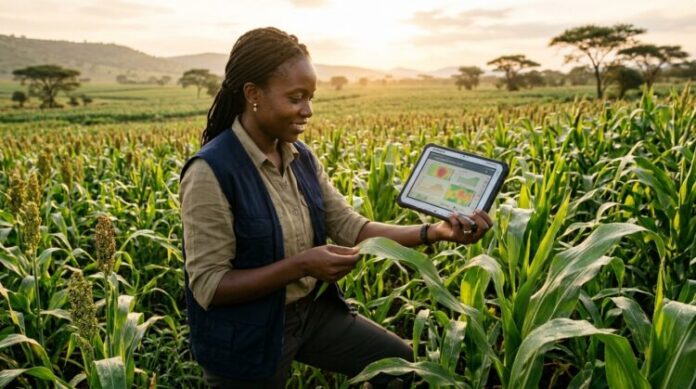
Artificial intelligence (AI) could play a significant role in strengthening food security and agricultural sustainability in Nigeria and South Africa, although the two countries require different approaches to technology adoption, according to a comparative study by researchers Lere Amusan and Adetayo Sowale.
The research finds that Nigeria could benefit primarily from AI-driven improvements in agricultural productivity, financial inclusion and access to farming knowledge. In South Africa, however, the technology’s greatest potential lies in improving resource efficiency, streamlining agricultural logistics and addressing severe water shortages.
The distinction reflects the countries’ contrasting agricultural structures. Nigeria’s agricultural sector is dominated by smallholder farmers and faces a yield gap exceeding 76 per cent between actual and potential harvests. South Africa, meanwhile, operates a more capital-intensive agricultural system characterised by commercial farming, advanced mechanisation and comparatively developed telecommunications infrastructure.
The researchers argue that technologies such as machine vision, automated sensors and predictive analytics could support progress towards the United Nations Sustainable Development Goals. However, their effectiveness depends heavily on socioeconomic conditions, infrastructure availability and the quality of institutional governance in each country.
The study emphasises that adopting similar technologies across African countries without considering their individual circumstances could undermine their intended benefits.
Theoretical foundations and research methodology
To examine the relationship between technological development, political economy and environmental sustainability, Amusan and Sowale based their investigation on two complementary theoretical frameworks: embedded liberalism and agroecological theory.
The embedded liberalism framework, originally developed by John Ruggie, highlights the importance of balancing market-driven economic activities with social protections and effective regulation.
Through this perspective, the researchers argue that artificial intelligence cannot operate independently of institutional safeguards. Without appropriate regulations, public support systems and equitable governance, commercial deployment of AI could deepen existing economic inequalities, displace vulnerable rural farmers and concentrate financial benefits among powerful agricultural businesses.
The second framework, agroecological theory, examines whether technological innovations contribute to environmental sustainability or encourage further dependence on industrial monoculture.
Based on biodiversity conservation, soil regeneration and farmer autonomy, agroecology requires agricultural technologies to reduce dependence on synthetic agrochemicals, incorporate local ecological knowledge and limit environmental damage.
Together, the frameworks establish that successful AI integration requires more than technical efficiency. It must also operate within effective governance systems and respect local ecological conditions.
For its methodology, the study adopted a qualitative desktop research design and a comparative case study approach. The researchers relied exclusively on secondary empirical information obtained from recognised international databases, institutional publications and peer-reviewed academic literature.
Their literature review covered publications from 2015 to 2025, using Scopus, Web of Science, Google Scholar and JSTOR. Additional information came from reports published by the Food and Agriculture Organization of the United Nations, World Bank, International Telecommunication Union, African Development Bank and Oxford Insights.
The selection process excluded non-English publications, unverified online commentaries, duplicate materials and non-empirical editorials. Following these criteria, approximately 15 primary institutional reports and academic studies were examined.
The researchers applied deductive qualitative content analysis to textual information and statistical indicators. Their assessment covered five areas: policy and governance environments, digital infrastructure, agricultural applications, socioeconomic outcomes and operational implementation constraints.
This framework allowed them to compare national indicators while accounting for the structural differences between the two agricultural systems.
Infrastructure gaps shape AI adoption
The study identifies considerable differences in electricity access, internet connectivity, digital skills and institutional preparedness between Nigeria and South Africa.
South Africa has an estimated electricity access rate of 87.7 per cent, compared with Nigeria’s 61.2 per cent. Internet penetration is also higher in South Africa, estimated at between 74 and 78 per cent, while Nigeria records between 41 and 53 per cent.
Institutional readiness for AI governance presents another significant difference. According to the Oxford Insights assessments cited in the research, South Africa records a readiness level of between 60 and 65 per cent, compared with Nigeria’s 35 to 40 per cent.
Digital skills capacity follows a similar pattern, with South Africa estimated at 70 per cent and Nigeria at 40 per cent.
The economic importance of agriculture also differs substantially. The sector contributes approximately 23 per cent of Nigeria’s gross domestic product (GDP) and employs about 36 per cent of its workforce. In South Africa, agriculture accounts for approximately 2.5 per cent of GDP and 6 per cent of total employment.
These differences influence the affordability, accessibility and practical application of advanced agricultural technologies in both countries.
South Africa leads in precision agriculture adoption
South Africa has recorded greater adoption of precision agriculture, supported by commercial investment, venture capital and a more mature agricultural technology ecosystem.
The country’s agritech innovation maturity score stands at 75 per cent, while precision agriculture adoption is estimated at between 30 and 40 per cent, particularly among commercial farming operations.
Farmers increasingly use drone-based computer vision, satellite tracking and automated irrigation systems to improve agricultural management.
One example highlighted in the study is Aerobotics, a company that uses artificial intelligence and aerial imaging to identify early signs of pest infestations, plant diseases and localised moisture stress before they cause significant crop damage.
Nigeria’s adoption rate, by comparison, remains below 10 per cent. Its agritech ecosystem maturity is estimated at 45 per cent, with most innovative applications concentrated in donor-supported projects and small-scale pilot programmes.
Despite this limited adoption, Nigeria has considerable room for improvement because of its substantial agricultural productivity gaps.
The researchers estimate the potential for AI-driven productivity enhancement at approximately 80 per cent in Nigeria, compared with 75 per cent in South Africa. This suggests that making agricultural technologies more accessible to Nigerian smallholders could generate substantial improvements across rural farming communities.
AI could improve market access and agricultural financing
Beyond agricultural production, artificial intelligence offers opportunities to address supply chain inefficiencies and financial exclusion.
In Nigeria, smallholder farmers frequently encounter fragmented distribution networks, unequal access to market pricing information and dependence on intermediary brokers who reduce their earnings.
The study identifies Fodlocker as an example of a digital platform that uses machine-learning demand forecasting to connect rural agricultural producers more directly with retail markets.
AI-powered credit assessment also presents opportunities for farmers who lack conventional collateral. By analysing satellite imagery and mobile phone transaction records, algorithmic systems can assess potential borrowers and expand access to agricultural financing.
The researchers estimate the opportunity for improved financial inclusion through these interventions at 70 per cent.
South Africa’s priorities are different because its financial institutions are comparatively established. Platforms such as Desert Green and Mezzanine already support agricultural distribution, creating opportunities for AI to improve logistics, strengthen cold-chain traceability and forecast wholesale demand.
However, the study warns that algorithmic lending systems can introduce additional inequalities if their assessment methods are not carefully designed.
Drawing on existing academic criticisms, the authors note that automated credit decisions may reproduce historical financial discrimination. Farmers without extensive digital transaction records, mobile phone histories or verifiable land ownership could be excluded from financing opportunities.
Climate change creates opportunities for AI-driven adaptation
Environmental sustainability represents another important area in which artificial intelligence could strengthen food security in both countries.
Nigeria and South Africa record identical macro climate vulnerability index scores of 75 per cent in the study. This highlights their exposure to extreme weather events, unpredictable rainfall and environmental degradation.
Nevertheless, their most pressing climate-related agricultural challenges differ.
South Africa faces severe and systemic water shortages, particularly across its semi-arid regions. Consequently, its smart irrigation demand intensity score stands at 80 per cent.
Machine-learning applications can support precision drip irrigation by regulating water distribution, improving efficiency and reducing pressure on limited water resources.
Nigeria, on the other hand, has underdeveloped irrigation infrastructure, with its capacity for intelligent water management estimated at 50 per cent.
The country’s immediate priorities therefore include AI-powered flood alerts, seasonal drought forecasting and localised soil health monitoring.
The researchers also highlight the environmental benefits of properly calibrated predictive technologies. By supporting more precise agricultural interventions, these systems could reduce indiscriminate applications of synthetic fertilisers and chemical pesticides.
Such improvements align with agroecological principles by helping preserve soil microbiomes and protect biodiversity.
High costs and infrastructure deficits remain major obstacles
Despite the potential benefits, the study identifies substantial barriers that could prevent artificial intelligence from delivering inclusive agricultural development.
In South Africa, the main challenge is structural inequality rather than an absence of technological capacity.
The country’s broader AI market is projected to grow from $3.18 billion in 2024 to $8.74 billion by 2030. However, the high cost of autonomous tractors, multispectral sensors and automated processing equipment makes these technologies difficult for smallholder farmers on communal lands to acquire.
This reinforces the existing divide between well-funded commercial agricultural enterprises and farmers with limited financial resources.
Nigeria faces more fundamental operational constraints.
Persistent electricity supply disruptions, unreliable rural internet connectivity, expensive imported hardware and fragmented agricultural data systems continue to restrict technology deployment.
The cost burden associated with hardware imports is estimated at 75 per cent, while the country’s agricultural data readiness score ranges between 35 and 40 per cent.
These limitations make it difficult for predictive models to operate consistently outside controlled experimental environments.
The researchers therefore emphasise that sophisticated algorithms cannot deliver reliable agricultural outcomes without dependable electricity, connectivity and accessible data infrastructure.
South Africa records stronger overall food security prospects
The comparative assessment produces different national outcomes in terms of food security resilience and the potential benefits of artificial intelligence.
South Africa records a Global Food Security Index positioning score of 65.5 and a composite AI food security prospect score of 70 per cent.
These figures reflect its stronger institutional coordination, established research infrastructure and more advanced commercial agricultural systems.
Nigeria records a Global Food Security Index rating of 57 and an AI food security prospect score of 57 per cent.
The researchers attribute the country’s comparatively lower performance to institutional weaknesses, persistent security challenges in rural areas and inadequate infrastructure, all of which restrict the practical application of technological innovations.
The study also considers academic perspectives that challenge the assumption that technology alone can eliminate rural poverty and unequal market access.
According to these arguments, successful AI adoption must be accompanied by public investment in rural road networks, secure land tenure, agricultural extension education and decentralised solar energy.
Without these supporting investments, advanced digital systems risk remaining accessible mainly to wealthy commercial farming operations or being limited to temporary pilot projects with little impact on household food accessibility.
Study identifies limitations and calls for targeted investment
The researchers acknowledge several limitations associated with their methodology and reliance on secondary information.
Because the investigation used published literature and institutional datasets, it did not include direct field research involving smallholder farmers, software developers or local policymakers. Consequently, the authors could not independently verify the operational performance of the technologies examined.
The study also recognises the possibility of publication bias, as successful agricultural technology projects and positive commercial experiences are more likely to receive attention than unsuccessful or discontinued initiatives.
Differences in national reporting standards and gaps in available data also make precise comparisons between certain indicators difficult.
Additionally, the rapid development of artificial intelligence means that some of the research’s empirical baselines will require regular reassessment.
Ultimately, Amusan and Sowale conclude that artificial intelligence should not be treated as an independent solution to food insecurity across Africa.
They argue that sustainable agricultural transformation requires targeted public investment in rural electrification, comprehensive data governance policies that safeguard national food sovereignty and inclusive technological systems designed around the realities of smallholder farmers.
Their findings reinforce the importance of adapting agricultural innovation to local economic, institutional and environmental conditions rather than pursuing a uniform technology-driven approach across African countries.
SOURCE: Bioengineer.
Do you want to share your impact stories or pitch the coverage of your CSR event to us? E-mail: editor@impactwatch.net or *Phone +234-806-795-0250 (Whatsapp &Text)


