

Africa’s move towards lower-carbon economies is increasingly being tested by a fundamental labour-market question: whether young people can gain meaningful access to the jobs, skills and businesses being created by the transition.
The Africa Policy Research Institute (APRI) convened a virtual discussion on October 1 to examine that challenge, bringing researchers and practitioners together to consider whether climate policies, investment programmes and green-economy initiatives are translating into employment and entrepreneurship opportunities for Africa’s growing youth population.
The discussion takes place as governments across the continent attempt to meet climate commitments while addressing the need for productive employment in economies where millions of young people enter the labour market every year.
The African Union and International Labour Organization’s Youth Employment Strategy for Africa estimates that 26% of young people across the continent are neither employed nor in education or training, underlining the scale of the employment challenge and the potential of structural economic transformation to address it.
For Africa’s green transition, the issue extends beyond counting jobs that can be classified as “green”. A central concern is whether investments in renewable energy, sustainable agriculture, waste management, construction, transport, manufacturing and environmental services are producing decent and accessible work, particularly for young people who have limited access to capital, technical training and formal labour markets.
APRI’s discussion places this gap at the centre of its policy concerns. Its programme considers what climate finance has delivered so far, the extent to which funding reaches youth-led green sectors, and whether national policy frameworks are sufficiently coordinated to help young people enter green technology and innovation.
It also considers urban construction and youth-oriented green jobs programmes as practical indicators of whether net-zero strategies are translating into employment outside government plans and policy documents.
The relationship between climate investment and employment is not automatic. Renewable-energy developments, for instance, may involve significant capital expenditure but generate comparatively few permanent jobs after construction ends. Their wider labour-market impact can depend on the development of domestic manufacturing, installation, maintenance, engineering, finance, logistics and other services around the infrastructure.
A similar dynamic applies to sustainable agriculture. Opportunities can arise through climate-smart farming, irrigation, agricultural processing, renewable-powered cold chains, waste-to-resource enterprises and digital services. However, young entrepreneurs still need access to land, finance, technology and markets to turn those opportunities into viable livelihoods.
The International Labour Organization and International Fund for Agricultural Development have identified skills development, finance, technology and market integration as important elements in building decent employment opportunities for rural youth within African agrifood systems.
Kenya illustrates efforts to bring climate policy and workforce planning closer together. The country has been developing a National Strategy on Green Skills and Green Jobs covering green governance, skills, research and technology, green enterprises, labour markets and financing.
The framework is designed to align workforce development with emerging opportunities in renewable energy, sustainable agriculture, ecotourism and the circular economy.
Its scale also reflects the size of the challenge facing policymakers. The Kenyan government and its partners have identified a youth population of about 18.4 million as a potential workforce for the emerging green economy.
The strategy’s approach of identifying jobs available now, those expected over the next two to four years, and opportunities emerging over longer periods addresses a key workforce-planning problem: training systems need to anticipate changes in labour demand rather than respond only after industries have already developed.
Across Africa, matching education and training with labour-market requirements is becoming increasingly important. ILO research on green employment indicates that green-oriented vacancies can demand combinations of technical, cognitive, socio-emotional and manual competencies rather than only specialised environmental qualifications.
In some countries and occupations, green vacancies have also been linked with better wages and employment characteristics, although the gains differ across labour markets.
As a result, the green transition could alter skills requirements across a much wider range of occupations than those traditionally associated with environmental work.
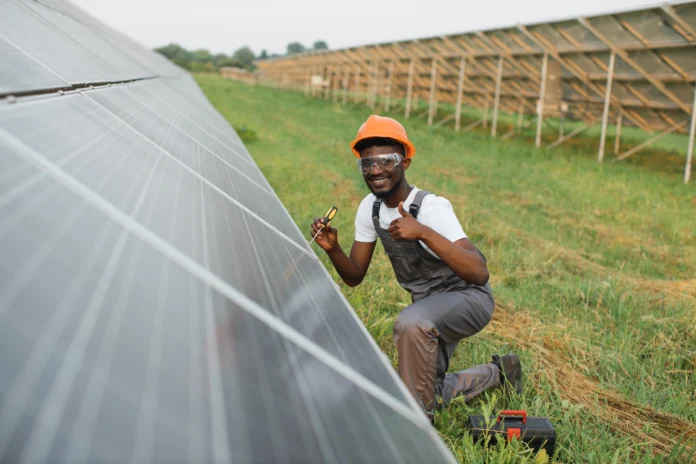
Electricians installing solar systems, engineers developing energy-efficient buildings, technicians maintaining electric transport systems, farmers using climate-smart technologies, waste workers running circular-economy enterprises and financial professionals evaluating climate risks can all become part of the wider green labour market.
Access to these opportunities, however, remains a major constraint. Many young Africans work within informal economies where finance, social protection, formal contracts and professional training can be difficult to obtain.
The movement from informal to formal employment is therefore also part of the sustainability challenge. The AU-ILO youth employment strategy cautions that the shift towards green and digital economies needs to be managed without disadvantaging informal businesses and workers, while also creating routes towards more productive and decent employment.
Climate change adds further pressure because sectors employing large numbers of Africans, including agriculture, construction and tourism, are exposed to heat, drought, floods and changing weather patterns.
A comprehensive green employment strategy must therefore consider not only new work created by climate investment but also the resilience of existing livelihoods.
The issue is particularly relevant to rural economies. The ILO has documented green-jobs initiatives in Kenya, Mali, Benin, Burkina Faso, Zimbabwe, South Africa, Tanzania, Uganda and Zambia. The initiatives cover areas including organic waste recycling, forest management and skills development for young people and rural communities.
Northern Côte d’Ivoire offers another example of the intersection between environmental pressures and employment needs. An ILO programme supported by Japan has been developing green jobs around biochar production using agricultural waste, with young people, women and refugees among its target groups in a region where climate pressures affecting agriculture and limited employment opportunities are already creating difficulties for vulnerable communities.
The potential economic impact extends beyond employment figures. Productive green enterprises can strengthen local value chains, raise household incomes and reduce reliance on imported technologies or services when domestic capabilities are developed.
For governments, successful green businesses could also expand the tax base over time and ease pressure on social-support systems. Those outcomes, however, depend on enterprises becoming sufficiently large and maintaining commercial viability.
This makes climate finance an important part of the employment debate. Africa continues to face a significant gap between the funding required to meet its climate commitments and the capital reaching projects on the ground.
Where financing is concentrated on large infrastructure projects without mechanisms that support local enterprise participation and skills development, the employment gains associated with the transition may remain constrained.
The challenge is not necessarily a lack of interest among young Africans in the green economy. Rather, the systems needed to turn that interest into sustainable livelihoods can remain fragmented.
Training institutions, employers, financial institutions, government agencies and investors may operate according to different timelines and use different measures of success. A solar technician, for example, may complete training without having the equipment or financing needed to work, while an energy company may find it difficult to recruit workers with the precise technical skills required for installation and maintenance.
Youth-led green enterprises face their own financing barriers. Early-stage businesses working in recycling, sustainable agriculture, clean cooking, renewable energy and climate services can struggle to satisfy conventional lending requirements.
Blended finance, guarantees, targeted credit facilities and business-development support could help address some of those barriers. Their effectiveness, however, depends on whether funding reaches commercially viable enterprises rather than remaining concentrated among larger and already established companies.
The implications also extend to industrial policy. To capture more value from the green transition, African countries would need to look beyond the deployment of imported solar panels, batteries, electric vehicles and other technologies.
Local assembly, maintenance, software development, engineering, recycling and component manufacturing could provide additional employment opportunities where markets, infrastructure and investment conditions are strong enough to support them.
The AU-ILO Youth Employment Strategy brings structural transformation, economic integration and the move towards inclusive green and digital economies into the same employment framework. It also identifies the African Continental Free Trade Area as an opportunity to link investment and trade policies more closely with employment creation.
That regional approach could become more significant as green industries emerge at different rates across Africa. Countries with stronger renewable-energy resources, mineral deposits, manufacturing capabilities or technology ecosystems could develop specialised industries, while regional trade could increase the markets available to businesses seeking customers beyond their domestic economies.
However, expansion of the green economy does not automatically guarantee broader inclusion. How jobs, wages, finance and ownership are distributed will depend on policy decisions, investment structures and labour-market institutions.
The ILO’s framework for green employment diagnostics therefore considers climate change and environmental transitions in relation to economies, labour markets, poverty and inequality at the same time.
For Africa, the challenge is particularly significant because the climate transition is occurring alongside rapid population growth, urbanisation and continued pressure to generate productive employment.
Net-zero strategies focused mainly on emissions targets and investment volumes could overlook the economic systems required to connect climate investments with households, workers and enterprises.
The emerging green economy will consequently be assessed not only through renewable-energy capacity installed, emissions reductions achieved or climate finance mobilised, but also through the ability of African economies to build the skills, enterprises and institutions needed to participate in the transition.
The issue highlighted by APRI is therefore one of implementation: translating climate commitments and investment frameworks into employment opportunities that young Africans can realistically access.
As governments continue refining climate and industrial policies, the relationship between green investment and employment is set to become an increasingly important measure of transition readiness. For Africa, where youth employment remains a structural economic priority, the outcome of the green transition will depend partly on whether young people can participate directly in the low-carbon industries emerging across the continent rather than simply benefit from policies developed elsewhere.
Source: Africa Sustainability Matters
Do you want to share your impact stories or pitch the coverage of your CSR event to us? E-mail: editor@impactwatch.net or *Phone +234-806-795-0250 (Whatsapp &Text)


