

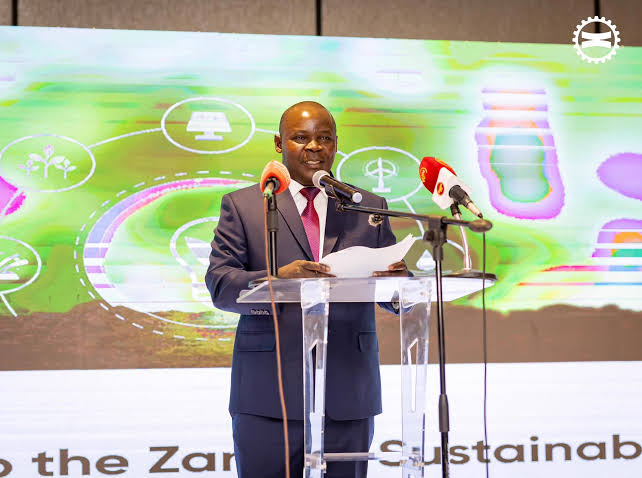
Zambia National Commercial Bank (Zanaco) has launched a US$100 million medium-term note programme designed to mobilise long-term capital for environmental and social projects across the country.
Announced in Lusaka on September 23, 2026, the programme will begin with a planned US$50 million sustainability-bond tranche aimed at institutional investors. British International Investment (BII), the UK’s development finance institution, has committed US$15 million to the initial issuance and will also provide technical support for Zanaco’s Sustainability Bond Framework.
The Lusaka Securities Exchange (LuSE) has described the transaction as the first sustainability bond issued by a Zambian bank. The development comes as Zambia seeks to strengthen its domestic capital markets and expand financing sources for climate and development priorities.
The programme is divided into two US$50 million tranches. While the first is structured as a sustainability bond, Zanaco said the use of proceeds for the second US$50 million tranche will be disclosed when that issuance takes place.
The current programme follows an announcement made in October 2025, when Zanaco and LuSE outlined plans for a US$100 million sustainability-bond programme. The proposed structure at the time comprised a US$50 million private placement followed by a US$50 million public offer. The latest development moves that earlier financing plan into an active capital-markets instrument.
Under the first tranche, proceeds are expected to finance projects and activities covered by Zanaco’s Sustainability Bond Framework. Eligible areas include renewable energy, energy efficiency, climate-resilient agriculture, small and medium-sized enterprises (SMEs), affordable housing, healthcare and education.
Zanaco said its framework aligns with the International Capital Market Association’s Sustainability Bond Guidelines, Green Bond Principles and Social Bond Principles, alongside Zambia’s regulatory framework for green finance.
The Bank of Zambia lists its Green Loans Guidelines among the regulatory guidelines applicable to the financial sector. Meanwhile, the Securities and Exchange Commission has established requirements for green bonds covering areas such as disclosure, project selection, management of proceeds and external review.
Sustainability bonds differ from conventional debt mainly through the way proceeds are designated and reported. Under ICMA’s framework, sustainability bonds are use-of-proceeds instruments through which funds are directed towards a combination of eligible green and social projects.
The framework places emphasis on transparency concerning the use of proceeds, project evaluation and selection, management of funds and reporting. For investors in emerging markets, these requirements can provide greater visibility over where capital is allocated and the environmental or social outcomes being measured.
BII’s US$15 million commitment will serve as an institutional anchor for the first tranche while extending an existing financing relationship with Zanaco. BII had previously provided the bank with a US$50 million financing facility, including an initial US$30 million tranche, to support lending to micro, small and medium-sized enterprises and climate-related projects.
The development finance institution’s participation in the new transaction also reflects a wider role for development capital in African sustainable finance, where such institutions can help financial institutions establish financing instruments capable of attracting additional private investment, alongside directly funding projects.
The mobilisation of capital is particularly significant for Zambia, which requires investment across energy, agriculture, infrastructure and social services while fiscal resources remain constrained and climate-related disruptions can affect economic output.
Zambia’s dependence on agriculture and hydropower creates a direct link between climate conditions and economic performance. Drought can reduce agricultural production and rural incomes while also affecting hydropower generation, electricity availability and the operating costs of businesses.
Financing for climate-resilient agriculture, renewable energy and energy efficiency can therefore affect both environmental outcomes and productive capacity.
In agriculture, climate-resilient financing can support areas such as irrigation, water management, climate-smart production systems, storage and technologies designed to reduce exposure to rainfall variability. Such financing is intended to strengthen the capacity of farmers and agricultural businesses to continue production and investment amid increasingly uncertain climatic conditions.
Agricultural performance has significant implications for food security, rural employment and household incomes in Zambia, making the availability and cost of resilience-focused capital relevant to the wider economy.
Energy presents another area where the financing could have an impact. Renewable-generation and energy-efficiency projects can help households and businesses reduce exposure to power shortages and high operating costs while supporting diversification of Zambia’s electricity system.
Zambia has already begun developing a domestic green-bond market through corporate issuance. In 2023, Copperbelt Energy Corporation registered a US$200 million green-bond programme intended to finance renewable-energy generation and potentially energy-storage investments.
According to the United Nations Development Programme, CEC Renewables subsequently issued about US$150 million through two green-bond tranches to support two solar plants with a combined capacity of 196 MW.
Zanaco’s programme therefore enters a market where green debt has already been used to connect Zambian capital-market instruments with physical energy assets.
However, Zanaco’s instrument combines environmental and social uses of proceeds and is being issued by a commercial bank rather than an energy company. This gives it a potentially wider connection with Zambia’s productive economy.
SME financing, for example, could reach businesses without direct access to international capital markets but which rely on banks for working capital and investment financing. Zambia’s Ministry of Small and Medium Enterprise Development has said MSMEs account for more than 90% of businesses in the country, highlighting the role of financial institutions in business formation, employment and expansion.
The transaction also comes as LuSE works to expand the pipeline of thematic debt instruments. Nicholas Kabaso, Chief Executive Officer of the Lusaka Securities Exchange, said the exchange intends to collaborate with market participants on additional thematic bond issuances while working to simplify issuance procedures and standardise reporting and verification requirements.
Such market infrastructure is relevant to the development of sustainable finance because repeatable processes can reduce the cost and complexity associated with issuing and monitoring labelled debt.
For institutional investors, the transaction provides another route into Zambia’s banking and sustainable finance markets. The longer-term credibility of such instruments, however, will depend on project selection, allocation of proceeds, reporting and verification.
ICMA’s principles emphasise transparency and disclosure because investors need to be able to establish where capital is directed and how issuers report environmental and social outcomes. Zambia’s regulatory framework similarly requires disclosure and oversight for green-bond issuance.
Zanaco’s programme brings together three developments in Zambia’s economy: the search for private capital to supplement constrained public resources, the growing need to finance climate resilience and the expansion of domestic capital markets.
For banks, sustainability bonds can provide an additional funding channel while supporting lending towards sectors facing climate and development pressures. For investors, they offer a structured instrument linked to defined expenditure categories. For policymakers, a credible thematic debt market can broaden the financial system’s contribution to infrastructure and productive investment without depending entirely on public expenditure or concessional development finance.
The development also has implications beyond Zambia. Across Africa, governments and financial institutions face financing gaps in areas including climate adaptation, renewable energy, resilient agriculture and essential social infrastructure. Public budgets and traditional development assistance cannot provide all the capital required.
Domestic financial institutions are consequently becoming increasingly important intermediaries between global pools of capital and African businesses and projects. The Zanaco transaction demonstrates how development-finance institutions can act as anchor investors and technical partners while local banks and capital markets provide the domestic platform for deploying funds.
The immediate focus for the programme will be its execution, including completion of the first tranche, allocation of proceeds to eligible projects and transparent reporting as the financed portfolio develops.
The second US$50 million tranche will provide another indication of how the market develops and which sectors attract capital under the programme.
LuSE’s plans for further thematic issuances, together with Zambia’s existing experience with green bonds, indicate that the country’s sustainable-finance market is moving beyond individual transactions towards a broader capital-market segment.
For businesses, investors and policymakers, the importance of that development lies in whether institutional capital is converted into productive investment, stronger infrastructure and greater economic resilience.
Zanaco’s US$100 million programme consequently represents more than a new debt issuance. It seeks to connect Zambia’s banking sector, institutional investors, development finance and domestic capital markets around projects where environmental resilience and economic performance increasingly intersect.
Its longer-term significance will depend on the amount of capital mobilised, the projects ultimately financed and the transparency available to investors in assessing what the funds achieve.
Source: africasustainabilitymatters
Do you want to share your impact stories or pitch the coverage of your CSR event to us? E-mail: editor@impactwatch.net or *Phone +234-806-795-0250 (Whatsapp &Text)


