

Stanbic IBTC Holdings is increasingly integrating sustainability into its banking strategy, directing lending and investment towards economic development, financial inclusion and infrastructure while also taking steps to reduce the environmental impact of its operations.
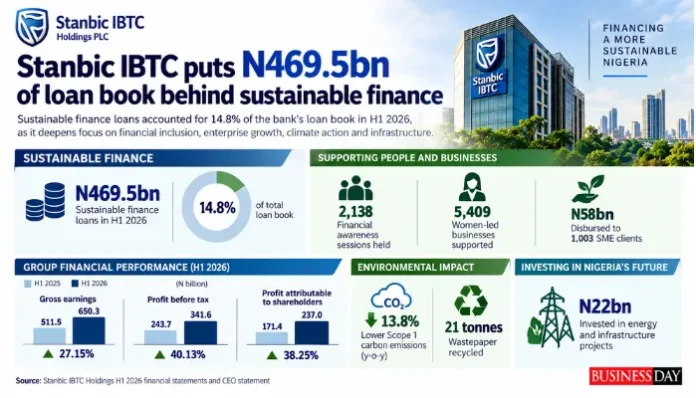
The group’s sustainable finance portfolio stood at N469.5 billion in the first half of 2026, representing 14.8 percent of its loan book. The portfolio covers financing connected to economic development, infrastructure and other sustainability objectives.
Chuma Nwokocha, chief executive of Stanbic IBTC Holdings, said sustainability remained a core part of the group’s strategy, with its approach covering financial inclusion, enterprise development, climate action and access to critical infrastructure.
“In H1 2026, we held 2,138 financial awareness sessions, reaching over 69,000 participants, and supported 5,409 women-led businesses with tailored financial services,” Nwokocha said.
During the period, the bank also disbursed N58 billion to 1,003 SME clients and invested N22 billion in energy and infrastructure projects, connecting its sustainability objectives with its lending and investment activities.
The group’s approach indicates that sustainability is being incorporated into the allocation of its balance sheet rather than being limited to corporate social responsibility programmes. A portion of its lending is being directed towards activities intended to deliver broader economic, social and environmental benefits.
Stanbic IBTC’s financial statements provide examples of this approach through its relationships with development finance institutions and its on-lending activities.
Among the disclosed facilities is a $25 million facility from DEG, a German development finance institution. Stanbic IBTC said the funds would be provided as sub-loans to eligible borrowers, with at least 50 percent allocated to Standard Bank Group sustainable finance projects. The remaining funds could be used to support eligible trade activities.
The bank also disclosed a long-term $40 million facility from FinDev Canada with a seven-year maturity, alongside other development-finance and on-lending facilities. Its financial statements also show funding arrangements supporting agricultural development, housing and other economic activities.
Through these arrangements, Stanbic IBTC is leveraging funding from development finance institutions in addition to deploying its own capital to channel resources towards eligible businesses and projects.
Agriculture forms another part of the group’s financing activities linked to sustainability. The bank disclosed an on-lending arrangement with the National Agricultural Development Fund, under which funds are provided for onward lending to farmers, cooperatives and corporate bodies across the agricultural value chain.
The stated objectives of the arrangement include supporting agricultural development, food production and food security.
Stanbic IBTC has also disclosed its involvement in the L-PRES project, which seeks to improve the management of Nigeria’s livestock sector and value chain, raise productivity and food and nutrition security, support income growth and strengthen the sustainability of the subsector.
The group’s sustainability strategy consequently covers several areas of the economy, including SMEs, women-led businesses, agriculture, infrastructure, energy and housing.
Its social-finance activities are complemented by wider financial inclusion efforts. In the first half of 2026, the bank conducted 2,138 financial awareness sessions involving more than 69,000 people and provided tailored financial services to 5,409 women-led businesses.
On the environmental side, Stanbic IBTC is addressing sustainability through both its financing activities and internal operations.
Nwokocha said the group recycled 21 tonnes of wastepaper during the period and achieved a 13.8 percent year-on-year reduction in Scope 1 carbon emissions.
The group’s corporate governance report also states that Stanbic IBTC is committed to sustainable development through ethical and responsible financing and business practices. This includes managing the environmental and social aspects associated with its activities, products and services.
Its sustainability policies incorporate the Nigerian Sustainable Banking Principles as well as relevant sustainability disclosure guidelines.
The sustainability strategy is being implemented alongside strong financial performance by the group.
Stanbic IBTC Holdings reported gross earnings of N650.31 billion for the six months ended June 2026, representing a 27.15 percent increase from N511.45 billion recorded in the corresponding period a year earlier.
Profit before tax rose by 40.13 percent to N341.57 billion, while profit attributable to shareholders increased by 38.25 percent to N236.98 billion.
Source: BusinessDay
Do you want to share your impact stories or pitch the coverage of your CSR event to us? E-mail: editor@impactwatch.net or *Phone +234-806-795-0250 (Whatsapp &Text)


