

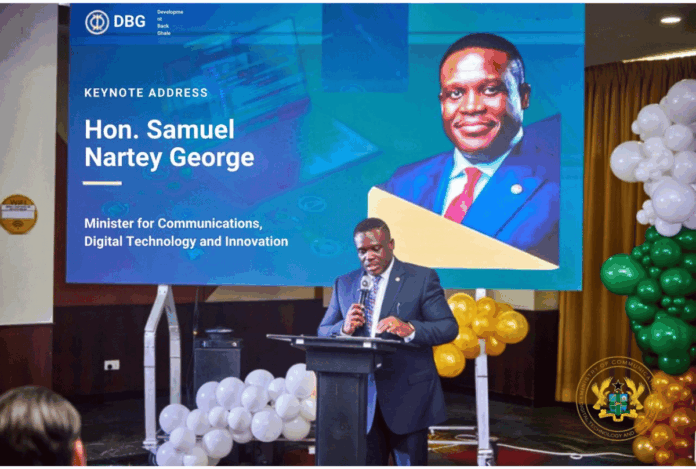
Ghana’s Minister for Communication, Digital Technology and Innovations, Samuel Nartey George, has urged stakeholders to develop financing models that address the specific needs of the country’s technology sector.
The Minister made the call at the Development Bank Ghana ICT Sector Financing Roundtable in Accra, held under the theme “From Connectivity to Capital: Unlocking Finance for Ghana’s ICT Sector.”
He said Ghana’s investments in fibre infrastructure, broadband, mobile connectivity and digital services have delivered significant progress, but the country’s next phase of digital development must focus increasingly on generating economic value.
According to George, this will require increased investment in areas such as data centres, cloud infrastructure, cybersecurity, software, fintech, business process outsourcing, artificial intelligence and other technology-enabled businesses.
He pointed to the limitations of conventional financing arrangements for technology companies, noting that such businesses may struggle to access funding because traditional financing often relies heavily on physical collateral.
Technology companies, he explained, can instead hold substantial value in intellectual property, proprietary technology, data, contracts, recurring revenues and human capital.
The Minister consequently advocated financing instruments that take into account the different risk profiles and stages of growth associated with technology businesses.
Among the financing options he identified were venture capital, private equity, patient capital, blended finance, guarantees and credit-enhancement mechanisms.
George also highlighted government efforts to expand Ghana’s digital skills base and strengthen its artificial intelligence capabilities.
He disclosed that the One Million Coders Programme had recorded 141,954 registered accounts as of August 2026. He also said the government is planning a $250 million Artificial Intelligence Computing Centre.
Beyond building digital infrastructure and increasing access to technology, the Minister said Ghana must now progress towards producing, scaling and exporting technology developed within the country.
He stressed that achieving this objective would depend on closer cooperation among government, financial institutions, development finance institutions, investors, technology entrepreneurs, regulators, development partners and academia.
The government’s stated objective is to mobilise capital for bankable technology projects, enable Ghanaian technology companies to expand, generate employment and retain a greater share of economic value within the country.
The Minister’s position places access to appropriate financing at the centre of Ghana’s efforts to transition from expanding digital connectivity to developing commercially viable technology companies and a stronger digital economy.
Source: TechAfricanews
Do you want to share your impact stories or pitch the coverage of your CSR event to us? E-mail: editor@impactwatch.net or *Phone +234-806-795-0250 (Whatsapp &Text)


