

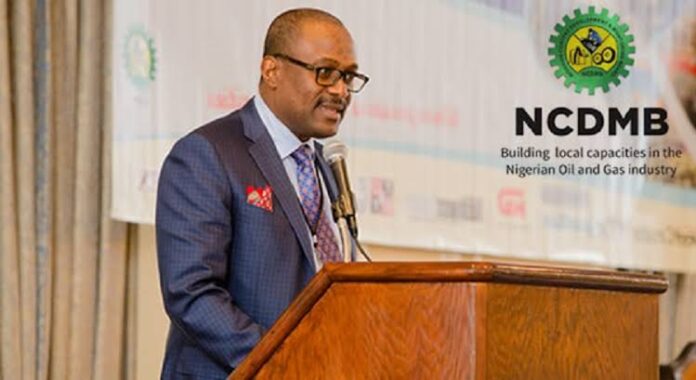
The Nigerian Content Development and Monitoring Board (NCDMB) has launched three digital platforms to improve ease of doing business, contract administration and access to financing across Nigeria’s oil and gas industry.
The newly introduced platforms are the online Compliance Certificate System, an upgraded Nigerian Content Development Fund (NCDF) Payment Portal and a revised Community Contractor Service.
The platforms were unveiled in Uyo, Akwa Ibom State, at an event themed, “Compliance Certificate System, Upgraded NCDF Payment Portal and Revised Community Contractor Service.”
Speaking at the launch, NCDMB Executive Secretary, Engr. Felix Ogbe, said the digital solutions were developed to support the Federal Government’s efforts to enhance efficiency, transparency and competitiveness within Nigeria’s business environment.
Ogbe was represented at the event by Emmanuel Yusuf, Manager of the NCDF Fund. He explained that the initiative was not limited to technological advancement but was also part of efforts to modernise processes and reinforce accountability in the oil and gas sector.
“This launch is not just about technology. It is about aligning with the national vision for ease of doing business, digital transformation, and accountability, as reinforced by recent Executive Orders of the Federal Government,” he said.
Ogbe identified the Nigerian Content Fund Compliance Certificate as a major element of the initiative and described it as an important requirement for companies operating in the industry.
Under the Nigerian Oil and Gas Industry Content Development Act, one per cent of every contract awarded to an operator is deducted at source and remitted to the Nigerian Content Development Fund.
The compliance certificate provides evidence that companies have fulfilled their obligations and also enables them to access financing from the fund.
According to Ogbe, the fund has made significant contributions to supporting indigenous businesses, with more than $400 million deployed to assist over 130 indigenous companies experiencing financing challenges within the oil and gas industry.
He further noted that initiatives including Project 100 and innovative financing programmes, such as a $100 million equity investment scheme, have contributed to strengthening local capacity and expanding access to capital.
The NCDMB boss said the new platforms were introduced in response to challenges experienced under the previous manual compliance system.
Previously, companies were required to submit physical documents and wait for verification, with processing sometimes taking weeks. Ogbe said the delays affected project approvals and made it more difficult for contractors and investors to plan effectively.
With the new digital systems, certificate processing time is expected to fall from weeks to days. Companies will also be able to submit applications online without physical visits or extensive paperwork.
Applicants will have access to real-time updates on their application status, helping to reduce uncertainty for vendors and contractors.
The digital system is also expected to provide regulators with improved real-time compliance verification, data collection and oversight. A centralised record system will further support confidence among lenders and investors.
Ogbe said faster processing would enable companies that meet their obligations to obtain financing more quickly and deploy funds into projects that create jobs, strengthen local capacity and support Nigeria’s oil and gas value chain.
“For operators and contractors, it means faster access to funding. For regulators, stronger oversight and improved data collation,” he said.
The initiative also received support from financial institutions, with the Bank of Industry (BOI) and Nigeria Export-Import Bank (NEXIM) pledging to support vendors and NCDMB operations.
Representing the Bank of Industry, Olamide Oladele highlighted the various financing opportunities available to indigenous businesses operating in the oil and gas sector.
“With the launch of the new portal, the bank is ready to provide finances to support businesses in the oil and gas industry,” she said.
The digital transformation is expected to make compliance procedures more efficient while improving access to finance for indigenous oil and gas businesses.
The initiative is also expected to help contractors execute projects faster and contribute more effectively to the development of Nigeria’s local oil and gas value chain.
Source: MSME Africa Online
Do you want to share your impact stories or pitch the coverage of your CSR event to us? E-mail: editor@impactwatch.net or *Phone +234-806-795-0250 (Whatsapp &Text)


