

The Federal Government of Nigeria has inaugurated a 17-member technical committee tasked with addressing Nigeria’s fish production deficit, reducing dependence on imports and strengthening the fisheries and aquaculture value chain.
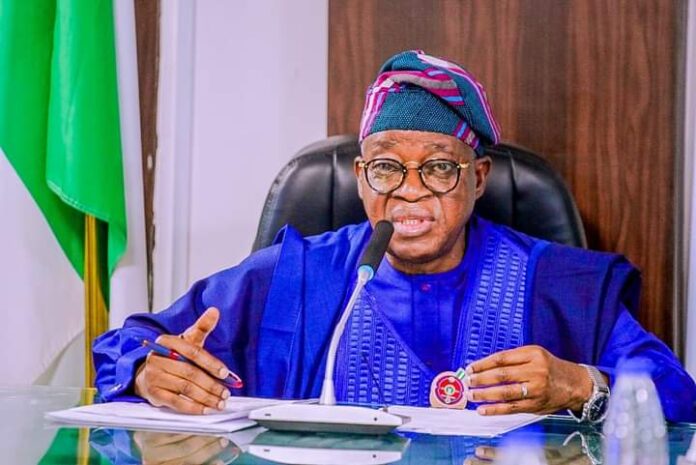
Minister of Marine and Blue Economy, Adegboyega Oyetola, inaugurated the Technical Committee on Accelerating Fish Production in Nigeria on Thursday in Abuja, directing members to translate recommendations from an earlier strategic roundtable into concrete and measurable actions.
Oyetola said the committee’s responsibility was to develop a coordinated implementation roadmap that would address the barriers limiting domestic fish production, rather than generate another set of policy recommendations.
He described fish as an important source of animal protein for millions of Nigerians, while noting that the fisheries and aquaculture industry provides livelihoods through production, processing, marketing, transportation and other related services.
Despite the sector’s importance, domestic fish production remains considerably below national demand. According to the minister, the shortfall is putting pressure on food security, household incomes and foreign-exchange resources.
Among the major challenges identified by Oyetola are high production costs, particularly fish feed expenses, limited access to quality fish seed and broodstock, weak fish-health and biosecurity systems, post-harvest losses, and inadequate cold-chain and storage infrastructure.
The sector also faces limited access to affordable financing, shortcomings in research and innovation, weak data systems, inadequate standards and traceability mechanisms, as well as underdeveloped markets.
Oyetola said the transfer of fisheries and aquaculture responsibilities to the Federal Ministry of Marine and Blue Economy had provided a stronger institutional platform for addressing these issues within Nigeria’s wider blue-economy development agenda.
He reaffirmed the ministry’s commitment to expanding sustainable domestic fish production, strengthening the fisheries value chain and progressively reducing Nigeria’s reliance on imported fish.
The minister recalled that the ministry, working with the National Institute for Policy and Strategic Studies, convened a strategic roundtable on October 29, 2025, to explore ways of accelerating fish production in Nigeria.
The roundtable generated recommendations aimed at resolving challenges affecting production and the wider value chain. The new committee will review those proposals and convert viable recommendations into a prioritised implementation roadmap.
“Your assignment is not to develop another policy or establish a parallel programme,” Oyetola told the committee.
He instructed members to evaluate the roundtable recommendations against the National Policy on Marine and Blue Economy, the National Fisheries and Aquaculture Policy, relevant legislation, existing government programmes and the mandates of appropriate institutions.
The committee is expected to determine which recommendations should be adopted, refined, incorporated into existing frameworks, subjected to additional research or rejected as unviable.
It will also identify and map existing initiatives involving government, private-sector players and development partners. The exercise is intended to strengthen interventions that are already working and avoid duplication of scarce resources.
Oyetola said the committee’s final report must provide a clear implementation roadmap and matrix covering priority interventions, responsible institutions, timelines, indicative costs, funding options, performance indicators and required approvals.
The report is also expected to highlight opportunities for private-sector investment, public-private partnerships, development finance and other sustainable funding arrangements.
The minister urged the committee members, drawn from government, academia, professional bodies, research institutions and industry, to treat the assignment with urgency and concentrate on measurable outcomes.
He said the recommendations must be realistic, evidence-based and financially responsible, while producing tangible improvements in fish production, job creation and food security.
Earlier, the Permanent Secretary of the ministry and chairman of the committee, Fatima Mahmood, said members would examine the roundtable recommendations and turn them into practical interventions.
She said the committee would collaborate with government institutions, researchers, industry stakeholders and development partners to determine priority actions, address existing gaps and formulate a realistic implementation roadmap.
Akintola Latunji, a committee member and Professor of Fisheries at Lagos State University, said the committee would work with relevant stakeholders to fulfil its mandate and accelerate fish production across Nigeria.
Membership of the committee includes representatives of government, academia, industry and development organisations. They include officials from the Federal Department of Fisheries and Aquaculture, the National Institute for Policy and Strategic Studies, the Nigerian Institute for Oceanography and Marine Research, fisheries associations and WorldFish Nigeria.
The committee has been given eight weeks to submit its report.
The government had identified a deficit of more than 2.2 million metric tonnes between Nigeria’s annual fish production and its estimated requirement of 3.6 million metric tonnes in October 2025.
Following the identification of the gap, the Federal Ministry of Marine and Blue Economy and the National Institute for Policy and Strategic Studies agreed to develop a National Fish Production Acceleration Roadmap to guide investment and reforms in the fisheries and aquaculture sector.
Oyetola had also disclosed that domestic fish production accounted for only about 38.9 per cent of Nigeria’s annual requirement, leaving the country heavily dependent on imports.
Since then, the government has highlighted measures such as the development of a Fisheries Bill and National Fisheries and Aquaculture Policy, automation of fisheries operations and the creation of a Blue Data Bank.
It has also outlined initiatives focused on supporting young people and women in aquaculture.
Source: msme Africa online
Do you want to share your impact stories or pitch the coverage of your CSR event to us? E-mail: editor@impactwatch.net or *Phone +234-806-795-0250 (Whatsapp &Text)


