

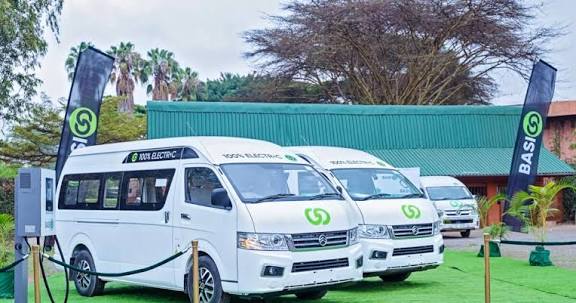
Co-operative Bank of Kenya has set aside KSh1.5 billion over 12 months to support the purchase and operation of electric public service vehicles, strengthening the banking sector’s role in the country’s shift towards cleaner public transport.
Announced on 13 November 2026, the financing programme will serve matatu Savings and Credit Co-operative Organisations (Saccos), covering electric vehicle purchases, charging infrastructure and digital fare collection.
Under the arrangement, the bank will provide up to 90 per cent of the cost of acquiring vehicles, while operators will contribute the remaining 10 per cent. The facility adopts a Sacco-based fleet financing model, enabling transport organisations to secure funding for several electric vehicles instead of depending solely on individual purchases.
The programme adds Co-operative Bank to a growing group of financial institutions developing products for Kenya’s electric mobility sector. NCBA, KCB and SBM Bank have also introduced financing facilities and partnerships aimed at different parts of the market.
Co-operative Bank is building on its existing relationships with transport Saccos, which coordinate vehicle ownership and operations across public transport routes. Vincent Marangu, the bank’s Director of Co-operatives Banking, said the fleet financing structure was designed to reflect how these organisations manage their vehicles and transport operations.
The programme has already supported the delivery of two 16-seater electric vans supplied by BasiGo to Enabled Mashariki Sacco. Other participating vehicle suppliers are QuantumDrive, MojaEV Africa and Rideence Africa. Their involvement could give operators access to a wider selection of vehicles, although the programme’s expansion will depend on supply, financing conditions and the commercial performance of electric fleets.
Co-operative Bank’s commitment comes amid increased activity by lenders seeking to finance electric mobility. NCBA, for instance, operates a KSh2 billion e-mobility financing facility and entered a partnership with BasiGo in August 2026 to support the deployment of 1,000 electric vehicles. More than KSh800 million had already been disbursed through the facility, according to the earlier announcement.
Through the NCBA arrangement, established Saccos and companies can obtain financing covering up to 90 per cent of vehicle costs over five years. Individual Sacco members are eligible for up to 80 per cent financing over four years.
The partnership also incorporates BasiGo’s Pay-As-You-Drive model, which enables operators to access electric vehicles through payments based on usage rather than relying entirely on conventional asset financing.
SBM Bank has separately allocated KSh1 billion to green financing for electric and hybrid vehicles over a 12-month period. Announced in July, the facility serves individual consumers and businesses and includes a partnership with CFAO Mobility Kenya.
KCB has also developed financing arrangements for public transport operators through partnerships with the Matatu Owners Association and ePureMotion.
The various facilities have different scopes. SBM’s offering covers hybrid vehicles and private customers, while NCBA’s agreement with BasiGo targets commercial electric vehicle deployment. Co-operative Bank, on the other hand, is placing Saccos, fleet acquisition and supporting infrastructure at the centre of its financing strategy. Collectively, these initiatives show the growing involvement of Kenya’s banking industry in electric mobility.
For public transport operators, securing affordable financing is a major consideration when replacing conventional vehicles with electric alternatives. Electric matatus require significant initial investment, while their profitability depends on passenger demand, route distances, daily vehicle utilisation, charging availability and maintenance expenses.
The structure of financing therefore affects both access to vehicles and how acquisition costs are spread across a fleet’s operating life.
Sacco-based lending provides an established framework for managing these requirements. Transport Saccos already coordinate vehicle ownership, route activities and member operations, giving banks an organisational structure through which they can assess and finance fleet purchases.
However, Co-operative Bank has not announced the repayment periods or detailed lending conditions for its new programme. The borrowing costs and allocation of financial risks therefore remain unspecified.
A notable feature of the facility is its inclusion of charging infrastructure. Purchasing electric vehicles without providing suitable charging facilities would make it difficult to maintain reliable public transport operations. Charging networks must accommodate route schedules, vehicle capacity and daily operating needs, particularly for commercial fleets where prolonged downtime can disrupt services and reduce operators’ income.
Charging infrastructure is also expanding beyond Nairobi. In July 2026, BasiGo and Rubis Energy Kenya commissioned a 100-kilowatt direct-current fast-charging station at Sabaki, Athi River.
The facility supports CCS2 and GB/T charging standards and is equipped to serve electric buses, vans, trucks and compatible passenger vehicles. BasiGo indicated a charging price of KSh48 per kilowatt-hour.
Additional charging stations have been planned for Meru, Nanyuki and Nyeri. BasiGo has also reported infrastructure development around terminals and depots in Nakuru, Nyeri, Meru and Nanyuki. Establishing these facilities requires investment in electricity connections, transformers and distribution equipment capable of meeting the demands of commercial vehicle charging.
Kenya Power’s reported e-mobility earnings also point to the growth of the sector’s electricity market. The utility generated cumulative revenue of KSh382 million from electric vehicle charging during the 34 months to April 2026. Monthly charging revenue reached KSh35 million in February.
Its figures further showed that monthly electricity sales to the e-mobility sector increased more than 113-fold between July 2023 and April 2026.
Electricity tariffs remain an important factor in determining operating costs for transport businesses and charging station providers. In September 2026, the Energy and Petroleum Regulatory Authority revised the e-mobility electricity tariff framework, replacing the former fixed monthly consumption ceiling with an Energy Consumption Threshold mechanism.
Under the revised arrangement, the energy charge is KSh16 per kilowatt-hour for customers supplied at 240 or 415 volts, while applicable off-peak electricity costs KSh8 per kilowatt-hour.
For electric public transport operators, the relationship between power costs, vehicle usage and fare income will be central to fleet profitability. Charging facilities must also be strategically located and adequately scaled to serve the routes on which the vehicles operate. Co-operative Bank’s decision to finance charging infrastructure alongside vehicle purchases addresses these connected requirements.
The expansion of local vehicle supply is another development shaping the market. In February 2026, Rideence Africa and Associated Vehicle Assemblers announced a KSh320 million agreement to begin assembling electric vehicles in Mombasa.
The partnership included plans to produce 20 Joylong electric high-roof matatus and 132 electric taxis, alongside efforts to increase charging infrastructure.
Local assembly could broaden vehicle availability and create opportunities to develop maintenance and servicing capabilities. Nevertheless, vehicle prices, production capacity, component sourcing and spare-parts availability will remain important factors influencing acquisition and operating costs.
Co-operative Bank’s KSh1.5 billion facility provides another funding source for Kenya’s expanding electric mobility ecosystem. Its combination of Sacco-based vehicle financing, charging infrastructure support and digital fare collection extends the programme beyond vehicle acquisition to the systems needed for commercial fleet operations.
The programme’s eventual impact will depend on the speed of fund deployment, the number of vehicles purchased and operators’ ability to maintain financially viable fleets. With banks, vehicle manufacturers and energy providers increasing their participation, the growth of electric public transport in Kenya is becoming increasingly linked to access to finance and the infrastructure required to sustain operations at scale.
Source: Africa Sustainability Matters
Do you want to share your impact stories or pitch the coverage of your CSR event to us? E-mail: editor@impactwatch.net or *Phone +234-806-795-0250 (Whatsapp &Text)


