

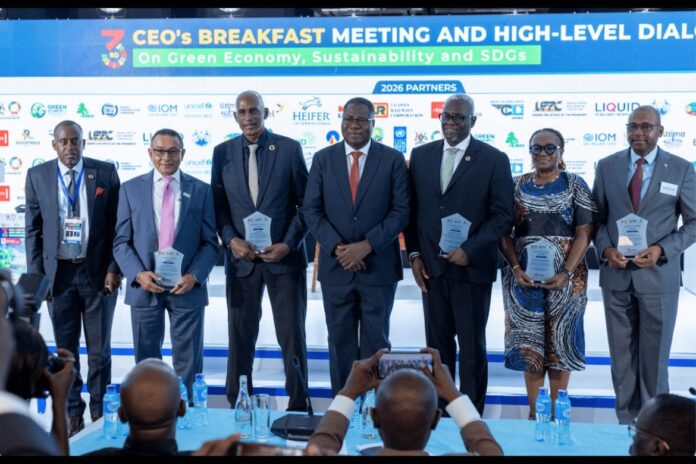
Managing Director Gift Shoko disclosed the bank’s sustainability activities at the third CEOs’ Breakfast Meeting and High-Level Dialogue on Green Economy, Sustainable Development Goals (SDGs) and Sustainability, held on 14 October 2026 at the UNICEF Conference Centre in Mbuya, Kampala.
Themed “Accelerating Uganda’s Green Economy Transition Through Digital Transformation”, the meeting brought together government officials, financial institutions, development partners and private-sector representatives to discuss how investment and technology could support greener economic growth.
“The question is no longer whether Uganda can afford to invest in sustainability. The question is whether we can afford not to,” Shoko said.
Over the past three years, Equity Bank Uganda has supported the sale of 157,035 clean-energy products, partnered with 18 clean-energy implementing organisations and contributed to planting 96,638 trees.
The bank’s regional climate finance efforts include the US$200 million Africa Rural Climate Adaptation Finance Mechanism, launched by Equity Group and the International Fund for Agricultural Development (IFAD) in September 2026.
The 12-year programme aims to expand climate-adaptation financing for smallholder farmers and rural enterprises across East Africa while strengthening agricultural value chains. Uganda is expected to receive approximately 25% of the funding, equivalent to about US$50 million, according to the figures supplied for the initiative.
The mechanism targets smallholder producers and micro, small and medium-sized enterprises in Uganda, Kenya, Tanzania and Rwanda. It combines lending capital with technical assistance to help farmers and rural businesses invest in climate adaptation.
Tree-planting initiatives
Equity Bank Uganda has contributed to planting 96,638 trees over the past three years. Its Green Schools Programme is targeting 50,000 trees across 25 schools in 10 districts by the end of 2026, with a longer-term goal of planting 200,000 trees by 2027.
Reported activities include approximately 3,500 trees at Nakanyonyi Secondary School in Mukono, 1,500 at Kyasanku Hill College in Mpigi and 1,000 at St. Julian Secondary School in Wakiso.
At Busoga College Mwiri, more than 43,000 indigenous trees have been planted across the school’s hill slopes, according to the supplied information.
Youth development and digital transformation
Under the Young Africa Works framework, more than 100,000 young people have received training through initiatives associated with Equity Bank Uganda. The bank also runs financial literacy and capacity-building programmes targeting women and young people.
Participants at the October meeting discussed strengthening public-private partnerships and using digital technology to improve energy management, expand clean-energy access and scale climate-smart agriculture.
Speaker of Parliament Jacob Markson Oboth attended as keynote speaker and guest of honour, joining participants in calling for sustainability commitments to be translated into practical regulations, investment and implementation.
Equity Bank Uganda’s green lending, clean-energy distribution, tree planting and youth development programmes form part of its reported efforts to support the country’s green economy transition.
Source: Africa Sustainability Matters
Do you want to share your impact stories or pitch the coverage of your CSR event to us? E-mail: editor@impactwatch.net or *Phone +234-806-795-0250 (Whatsapp &Text)


