

The World Bank Group has committed $200 million to support Nigeria’s efforts to expand fisheries and aquaculture production, strengthen domestic fish supply and reduce reliance on imported fish.
The funding will be provided to state governments as concessional loans to improve their capacity to develop fisheries and aquaculture activities, attract investment and increase local production.
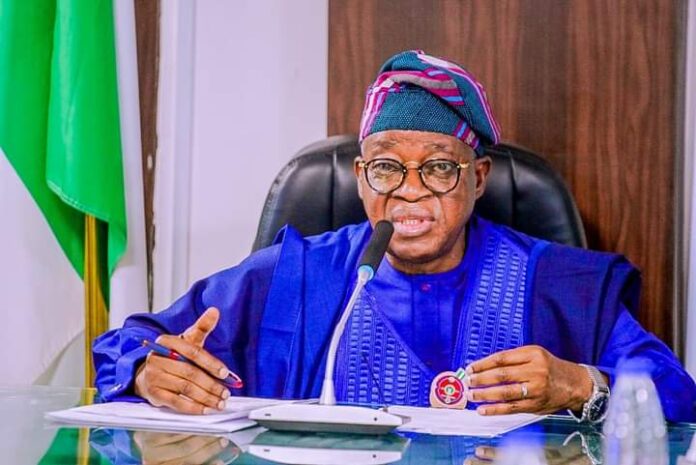
The Minister of Marine and Blue Economy, Adegboyega Oyetola, announced the commitment as the Federal Government intensifies efforts to position Nigeria as a fish-sufficient nation through partnerships involving state governments, investors and development partners.
Oyetola’s position was communicated by the Senior Special Assistant to the President on Marine and Blue Economy, Professor Busayo Fakinlede, who represented the minister at a high-level Executive Training on Aquaculture Investment Guide.
The training was organised in Abuja by the Federal Ministry of Marine and Blue Economy in partnership with the World Bank Group.
Speaking through his representative, Oyetola said, “We have secured a $200m commitment from the World Bank Group to support a renewed national drive to expand fisheries and aquaculture production across the country,” he said.
The programme attracted policymakers and technical officials, including commissioners from Rivers, Bayelsa, Delta and Cross River States. Permanent secretaries and directors responsible for fisheries and aquaculture from across the federation also participated.
According to the minister, the training was designed to strengthen the ability of state-level decision-makers to convert investment opportunities into bankable aquaculture projects.
Key areas covered include commercially viable business models, risk management, environmental and social safeguards, and public-private partnerships.
Oyetola stressed that achieving national fish sufficiency would require stronger involvement from state governments, noting that individual states must take greater responsibility for increasing domestic production.
“Fish is a pillar of food security, household nutrition and rural livelihoods. No nation can call itself food secure while it imports most of the fish it eats. Our ambition is to produce more, import less and, in time, become a net exporter. That ambition can be achieved only when every state plays its part,” he said.
Nigeria currently produces approximately 1.4 million tonnes of fish annually against an estimated national demand of 3.6 million tonnes. This leaves a supply gap exceeding 2.2 million tonnes, which is largely covered through imports.
The country’s fish imports cost close to $1 billion in foreign exchange every year, highlighting the financial implications of the domestic production shortfall.
To address the challenge, the Ministry of Marine and Blue Economy is developing a state-driven aquaculture framework. Under the initiative, each state will be expected to identify priority value chains, evaluate its investment readiness, establish a pipeline of bankable projects and make measurable commitments towards national fish production.
Oyetola explained that the World Bank’s $200 million commitment would help state governments finance these priorities, increase production capacity and accelerate the country’s transition towards fish sufficiency.
He further noted that cooperation between federal and state authorities would establish a coordinated approach to national fish security, translating the Federal Government’s objectives into measurable production targets and investment outcomes across states.
The minister also praised the World Bank Group for its continued partnership and support for Nigeria’s marine and blue economy development, particularly in analytical studies, cluster-based development and capacity building.
SOURCE: MSME Africa Online
Do you want to share your impact stories or pitch the coverage of your CSR event to us? E-mail: editor@impactwatch.net or *Phone +234-806-795-0250 (Whatsapp &Text)


