

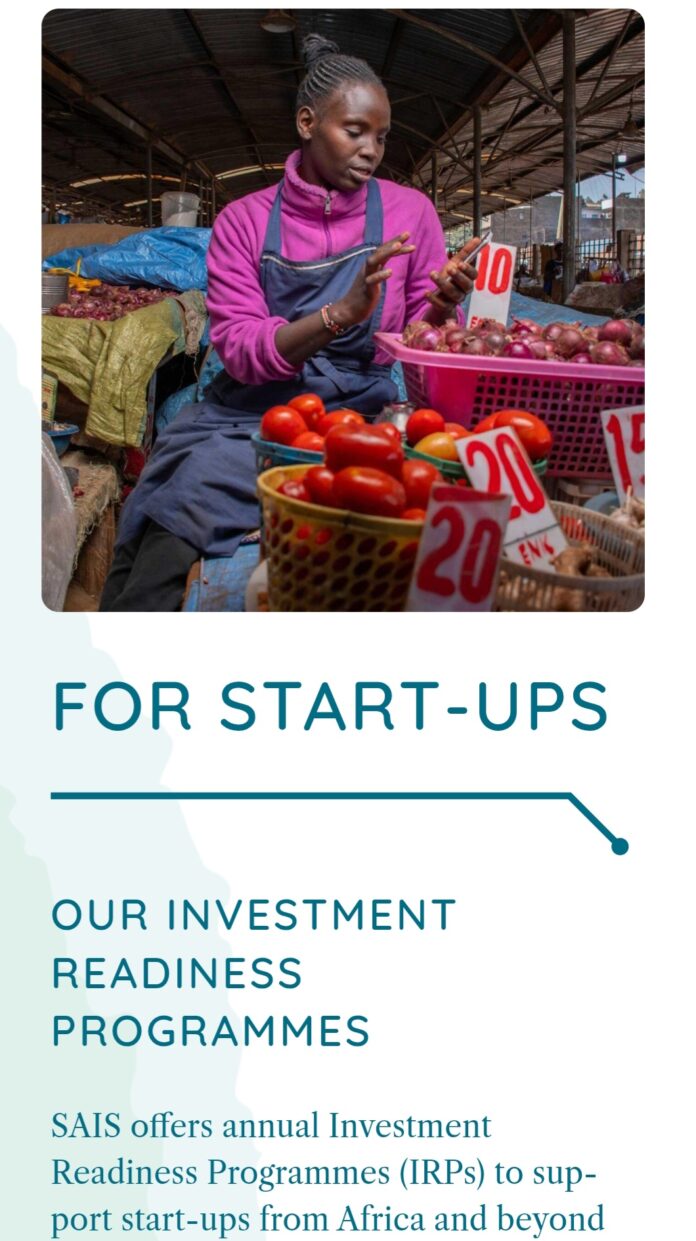
The Scaling Digital Agriculture Innovations through Start-ups (SAIS) programme has opened applications for its 2027 Livestock Investment Readiness Programme, offering African startups developing technology-driven solutions for livestock and aquaculture businesses an opportunity to strengthen their operations and prepare for investment.
The initiative targets businesses working across animal health, feed and nutrition, genetics, dairy production and aquaculture. It has a particular interest in dairy innovations serving East Africa and aquaculture solutions relevant to West Africa, including Nigeria and Senegal.
Selected startups will receive 12 months of tailored business development and investment-readiness support, including technical assistance worth up to €15,000. The programme does not take equity in participating businesses.
Applications close on November 15, 2026.
Under the programme, participating businesses will receive support to address operational challenges, improve their commercial readiness and establish connections with investors and potential business partners.
Each selected startup will have access to a dedicated SAIS adviser, known as a Navigator, who will help identify its most pressing growth challenges and develop appropriate solutions.
The support package also includes assistance with fundraising strategies, financial planning, due diligence and preparation for investor engagements.
The technical assistance, valued at up to €15,000, will cover agreed business needs such as expert consultancy, legal services, product optimisation, licensing, certification, marketing, customer acquisition, sales campaigns and employee training. The funding is provided in kind rather than as unrestricted cash.
Other programme benefits include access to curated investor pitch sessions, introductions to relevant investment funds and potential business partners, and networking opportunities.
Selected ventures will also receive sponsored participation in two in-person community events organised alongside the Sankalp Africa Summit in Nairobi, Kenya, as well as one additional sector conference. They will also gain access to the wider SAIS portfolio, which includes more than 100 startups.
Beyond the core programme, eligible businesses may be considered for additional financing opportunities. These include the SAIS Scale-up Grant, which provides up to €40,000 for qualifying ventures seeking to expand their market reach and deepen their impact.
Another option is access to revolving working capital loans of up to €50,000, carrying a nine-month maturity period and an interest rate of 1.5%.
However, these financing opportunities are separate from the main programme and are not guaranteed benefits for every participating startup.
Eligibility Requirements for Applicants
The programme is open to African startups that meet specific business, operational and development requirements.
Applicants must operate as registered, for-profit companies in an African country and have a technology-driven solution designed to improve livestock, dairy or aquaculture value chains.
Businesses must also have a functioning minimum viable product (MVP). Startups with paying customers, recurring revenue or established business partnerships are particularly well positioned.
In addition, applicants must have at least two people on their management team and operate at the pre-seed, seed or Series A fundraising stage.
Participating businesses must appoint a management team member as their primary contact and ensure that the individual can commit an average of two hours weekly to programme activities throughout the year.
Startups located outside the programme’s priority regions are also eligible to apply. However, they must demonstrate how their solutions, business models or experience could contribute to strengthening the targeted dairy or aquaculture value chains.
Priority Areas for Eligible Innovations
SAIS is seeking technology-driven solutions that address practical challenges affecting livestock farmers, dairy producers and aquaculture businesses.
The programme identifies several areas of interest, including:
– Animal feed and nutrition: Technologies that lower feed costs, improve feed quality or help farmers manage feed production and supply.
– Animal health: Digital solutions supporting disease prevention, diagnosis, treatment and livestock health monitoring.
– Genetics and breeding: Innovations that improve breeding outcomes, animal productivity and the quality of livestock and aquaculture stocks.
– Dairy production: Technologies that enhance milk production, farm management, productivity and the efficiency of dairy value chains.
– Aquaculture: Solutions that improve fish farming, feed efficiency, genetics, production systems and farm management.
For Nigerian startups, aquaculture represents a particularly relevant opportunity because of the programme’s interest in solutions applicable to West African markets, including Nigeria and Senegal.
For instance, a technology-enabled fish-feed business could qualify if it has a functioning product and satisfies the programme’s registration, management team and commercial traction requirements.
However, the initiative is not designed for every agricultural enterprise. Applicants must demonstrate how their technology can contribute to improving the specific livestock or aquaculture value chains targeted by SAIS.
Participation Commitments for Selected Startups
Businesses admitted into the programme will be expected to participate actively throughout the support period and meet specific reporting and engagement requirements.
Each selected startup must appoint a management team member to serve as its main contact with SAIS and commit an average of two hours per week to programme activities.
At least one team member must also attend the two designated in-person SAIS community events.
Participating businesses will be required to provide regular updates on key performance indicators, including revenue, customers, users, funding raised and employee numbers. These reporting obligations will continue during the programme and for at least one year after its completion.
Other responsibilities include cooperating with impact assessments, assisting programme partners in reaching customers for surveys, and working with assigned experts and service providers to implement agreed support activities.
Founders are therefore expected to consider these commitments before submitting their applications. Although much of the programme will be delivered virtually, attendance at the designated physical events remains a requirement.
SAIS 2027 Programme Timeline
The published schedule for the 2027 cohort outlines the following key dates:
-
November 15, 2026: Application deadline.
-
November 16–30, 2026: Screening of applications and applicant interviews.
-
December 2026: Communication of selection decisions.
-
January 2027: Virtual programme kickoff and onboarding.
-
February 22, 2027: SAIStival community event in Nairobi, Kenya.
-
February 24–25, 2027: Sankalp Africa Summit in Nairobi, Kenya.
-
March 2027–February 2028: Delivery of investment-readiness services, technical assistance and virtual check-ins.
-
February 2028: Expected graduation of participating startups at SAIStival 2028.
How to Apply for the SAIS 2027 Programme
Interested founders can submit applications through the programme’s official website by following these steps:
-
Visit the official SAIS Livestock Investment Readiness Programme 2027 application page.
-
Review the eligibility requirements and establish whether the startup’s product addresses a relevant livestock or aquaculture challenge.
-
Prepare the necessary company information, including details of the management team, product, commercial traction and business growth plans.
-
Complete the online application form and submit it before the closing date.
-
Monitor the registered email address for updates regarding application screening and possible interviews.
Application deadline: November 15, 2026.
Programme duration: One year, with the main support period running from March 2027 to February 2028.
Interested startups can access the application through the official SAIS Livestock Investment Readiness Programme 2027 page.
The programme is implemented by the Deutsche Gesellschaft für Internationale Zusammenarbeit (GIZ) on behalf of Germany’s Federal Ministry for Economic Cooperation and Development (BMZ), with co-funding from the Gates Foundation.
Do you want to share your impact stories or pitch the coverage of your CSR event to us? E-mail: editor@impactwatch.net or *Phone +234-806-795-0250 (Whatsapp &Text)


