

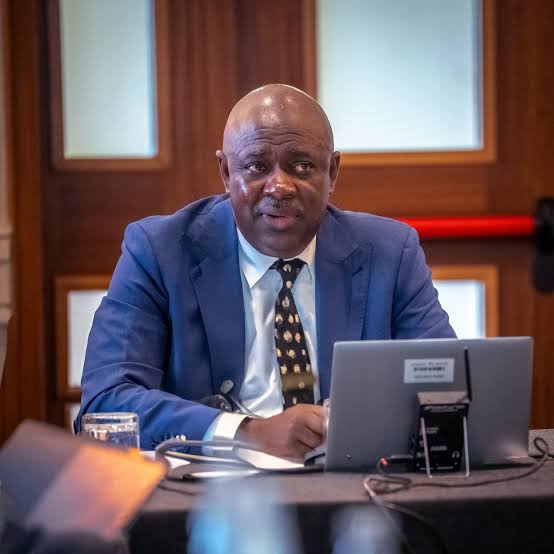
Nigeria is positioning itself to develop a world-class oil and gas workforce as investor confidence rises and an unprecedented pipeline of major projects advances toward Final Investment Decisions (FIDs).
The Minister of State for Petroleum Resources (Oil), Senator Heineken Lokpobiri, said the government is committed to deepening its support for the Oil and Gas Trainers Association of Nigeria (OGTAN) to help build the human capital required to meet the sector’s growing demands.
Lokpobiri made the pledge during his keynote address on Day Two, themed “Setting the Agenda”, at the ongoing OGTAN Human Capital Development (HCD) Conference and Expo in Warri, Delta State.
The minister described Nigeria as an emerging global investment hub, attributing the development to the incentive-driven reforms of President Bola Tinubu, which he said have strengthened the country’s competitiveness in attracting international capital.
His call for stronger human capital development also reflects concerns raised by the African Energy Chamber (AEC), which is advocating concerted action by African countries to develop broader local-content skills as the continent expands its hydrocarbon resources.
The Chamber noted that Africa is seeking to develop its estimated 125.3 billion barrels of crude oil and 620 trillion cubic feet of natural gas to improve energy security and expand local economies. It said local-content frameworks are consequently entering a new phase.
“Africa’s local content agenda is no longer just about listing companies on a page; it is about equipping domestic businesses with real skills, putting them to work on the ground, and holding them accountable to local laws all while maintaining an attractive environment for global investors. Local content must drive tangible industry growth, not act as a bureaucratic barrier,” stated NJ Ayuk, Executive Chairman of the Chamber.
According to the Chamber, governments are increasingly moving beyond basic local employment and procurement requirements by focusing on domestic industrial capacity, stronger digital compliance and an investment environment that can continue to provide competitive returns for international partners.
Lokpobiri said Nigeria also benefits from relative regional stability, its strategic geographical position and proximity to major markets, including Europe. These factors, he added, offer additional advantages for oil and gas investment and the distribution of petroleum products.
He said the large number of projects progressing toward FID would create significant demand for professionals trained to globally competitive standards. Much of the required training, he noted, would be provided through OGTAN’s more than 400 members.
“Those human beings are members of the public who must have been trained by OGTAN… who are expected to have the competence to deliver those projects, not just for Nigeria, but for the entire world,” he said.
The minister also raised concerns about the preparedness of trainers within Nigeria’s education system. He noted that many lecturers and resource persons in universities and other tertiary institutions continue to rely on training materials that have not kept pace with the requirements of a modern, AI-driven industry.
He stressed that trainers must themselves undergo retraining so they can effectively prepare the next generation of engineers, technicians and other professionals for the skills now required across the oil and gas industry.
“If the training system underpinning that capital is still operating on a fifty-year-old blueprint, the risk is that Nigeria’s newly de-risked capital arrives faster than its newly-promised workforce can be built,” he said.
Lokpobiri disclosed that the Federal Government is addressing the human capital gap through the Nigerian Content Development and Monitoring Board (NCDMB) and the Nigerian Oil and Gas Industry Content Development (NOGICD) Act, working directly with OGTAN to strengthen training capacity across the country.
“As government, what we do is see how we can support OGTAN members.
The government is committed to this, and we are doing it through NCDMB and the NOGICD Act,” he said.
The minister also urged OGTAN to broaden its activities beyond Nigeria and take a more continental approach to training oil and gas professionals.
He pointed out that countries including Angola, Congo and Gabon already rely on oil and gas professionals trained in Nigeria.
“The rest of Africa is depending on human resources from Nigeria, and someone must be responsible for training that human capital — not just for Nigeria,” he said.
Lokpobiri said the government’s broader objective is to produce Nigerian professionals who can compete for oil and gas employment opportunities around the world. He linked the human capital development drive to Nigeria’s wider ambition of building a $1 trillion economy.
“We will provide the enabling environment to raise human capital, not just for Nigeria, but to take over oil and gas jobs globally.”
The minister reaffirmed that NCDMB, operating under the NOGICD Act, has a clear mandate to support capacity development. However, he acknowledged that government support for OGTAN would have to be strengthened further to meet the scale of human capital requirements expected as investment activity in the sector enters a new cycle.
Source: leadership.ng
Do you want to share your impact stories or pitch the coverage of your CSR event to us? E-mail: editor@impactwatch.net or *Phone +234-806-795-0250 (Whatsapp &Text)


