

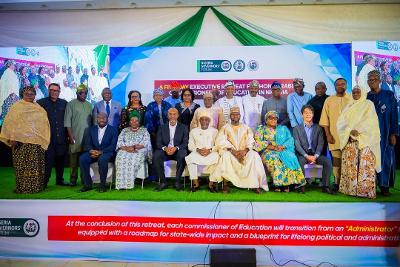
The Minister of Education, Dr Maruf Olatunji Alausa, has said meaningful transformation of Nigeria’s education sector depends on closer collaboration between the Federal Government and state governments, backed by evidence-based decision-making.
Addressing participants at the opening of the five-day Executive Retreat for Honourable Commissioners of Education in Abuja, the minister described education as Nigeria’s most effective instrument for driving economic growth, strengthening national security and advancing sustainable development.
The retreat was organised by the Committee of States’ Commissioners of Education (COSCEN).
Dr Alausa stated that President Bola Ahmed Tinubu has positioned education as a central pillar of the Renewed Hope Agenda by providing the political support and leadership needed to implement far-reaching reforms capable of transforming the sector.
He explained that while the Federal Government is responsible for policy direction and strategic interventions, state governments remain primarily responsible for delivering quality education, making stronger intergovernmental cooperation essential to achieving sustainable reforms.
The minister also commended COSCEN, led by its Chairman, Dr Lawal Olohungbebe, for organising the retreat, describing it as a timely forum for enhancing strategic leadership, encouraging peer learning and strengthening collaboration among education stakeholders nationwide.
“The transition from assumption-based planning to evidence-based governance as one of the most significant reforms being implemented in Nigeria’s education sector,” he said.
Dr Alausa announced the rollout of the National Education Data Infrastructure (NEDI) and the Digitalised Nigeria Education Management Information System (DNEMIS), noting that the integrated digital platforms will provide real-time information on learner enrolment, teacher deployment, school infrastructure, learning outcomes and other critical indicators needed for planning, budgeting, monitoring and effective allocation of resources.
“The new digital ecosystem would integrate education data from schools, local governments, states and federal institutions into a single interoperable platform, providing reliable information to guide policy decisions while improving accountability, transparency and service delivery across the sector,” he said.
He urged every state government to complete its Annual School Census through the digitised platform, praising Kaduna and Borno states for their progress while encouraging other states to speed up implementation.
According to the minister, the Federal Ministry of Education has already introduced digital dashboards and smart boards to strengthen evidence-based planning, with additional analytical support being provided by the National Bureau of Statistics to improve education planning across the country.
Dr Alausa further encouraged commissioners to maximise opportunities under the World Bank-supported HOPE Education Programme, which offers US$552 million in performance-based financing to states that meet agreed implementation milestones.
He noted that although all 36 states qualify for the programme, several have yet to complete key requirements, including signing Subsidiary Loan Agreements (SLAs), opening designated programme accounts and meeting mandatory data reporting obligations.
The minister called on commissioners to work closely with the Federal Ministry of Education and the World Bank to fulfil the Programme-for-Results requirements and unlock additional funding aimed at improving access to education, learning outcomes and governance across the sector.
To maintain the pace of reforms, Dr Alausa proposed that the Council of State Commissioners of Education institutionalise quarterly review meetings to encourage peer learning, assess progress, exchange best practices and reinforce collective accountability among states.
Speaking on additional priorities under the Nigeria Education Sector Renewal Initiative (NESRI), the minister said the Federal Government is expanding access to affordable digital learning technologies, including offline learning platforms, digital educational resources and teacher support tools designed to improve classroom instruction.
Source: Voice of Nigeria
Do you want to share your impact stories or pitch the coverage of your CSR event to us? E-mail: editor@impactwatch.net or *Phone +234-806-795-0250 (Whatsapp &Text)


