

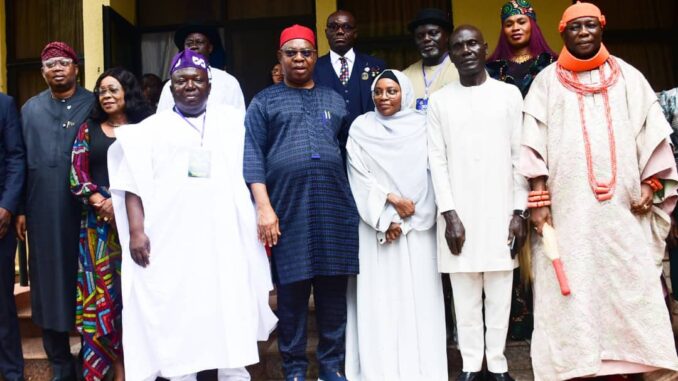
The Universal Basic Education Commission (UBEC) has called on state governments to urgently access more than ₦65 billion in counterpart funds and utilise approximately ₦267 billion in intervention funds already released to them.
UBEC Executive Secretary, Aisha Garba, made the call in Asaba, Delta State, during the opening of the commission’s 30th quarterly meeting with executive chairmen of State Universal Basic Education Boards (SUBEBs).
The meeting, themed “Repositioning Basic Education in Nigeria to Optimise Investment and Impact,” focused on improving the use of education funding and ensuring that investments produce measurable benefits for Nigerian children.
Garba disclosed that states had so far accessed more than ₦177 billion in UBE matching grants. However, over ₦65 billion in counterpart funding remained unaccessed, while approximately ₦267 billion in intervention funds previously released to the states had not been utilised.
She said the figures showed that states needed to move beyond simply accessing available resources and focus on proper planning, implementation and monitoring to ensure that funding translates into measurable improvements.
The UBEC executive secretary also encouraged states to expand collaboration with the private sector, development partners and civil society organisations. She said the scale and complexity of the challenges facing basic education made broader and more sustainable financing partnerships necessary.
Garba further announced the commencement of a review of UBEC’s Ten-Year Strategic Roadmap, which is being extended to cover the 2026–2035 period. According to her, the revised roadmap will help align investments, strengthen implementation and respond to changing needs within the basic education sector.
She identified the HOPE-EDU Operation as an opportunity to strengthen the systems, institutions and capacity needed to achieve sustainable improvements in basic education. Garba urged states to prepare fully for participation and make the most of the opportunities available through the initiative.
The UBEC chief also disclosed that the commission had developed the Basic Education Action Plan Management System (BEAP-MS), a digital platform designed to replace the largely manual preparation and submission of state action plans.
According to Garba, the platform will improve coordination between UBEC and state governments, increase efficiency and reduce repeated physical engagements at the commission’s headquarters.
Another initiative highlighted was the Whole School Approach, which seeks to move UBEC interventions away from isolated projects towards comprehensive improvements within selected schools.
Under the approach, facilities and infrastructure such as classrooms, water, sanitation and hygiene facilities, perimeter fencing, furniture and other essential components are integrated within selected schools to create more complete and functional learning environments.
Garba also said the successful completion of the National Learning Assessment, carried out in collaboration with the Federal Ministry of Education, would provide credible evidence for targeted interventions, better planning and improved learning outcomes.
Speaking through Delta State Deputy Governor, Sir Monday Onyeme, Governor Sheriff Oborevwori described education as the most strategic investment any country can make.
The governor said the value of education ultimately depends on the quality of learning provided, the opportunities created and the future secured for children.
He said the Delta State Government had made education a priority under its MORE Agenda, consistently supported the Universal Basic Education programme and met its counterpart funding obligations.
Oborevwori also expressed appreciation to UBEC for approving two additional model SMART Schools for Delta State, noting that the state had already provided the land required for the projects.
He highlighted investments in classrooms, perimeter fencing, gatehouses, toilets, solar power facilities, furniture and staff quarters, alongside SMART Schools and technical and vocational education.
According to the governor, the interventions are aimed at creating safer learning environments while equipping young people with skills suited to a technology-driven future.
The Asagba of Asaba, Prof. Epiphany Azinge, described investment in education as the highest form of national capital formation, arguing that Nigeria’s real wealth lies in the minds of its children.
Azinge said the construction of every classroom, education of every child and support provided to competent teachers contributes to national productivity. He added that basic education establishes the foundation for literacy, numeracy, character, citizenship and innovation.
He urged UBEC and SUBEBs to give greater priority to learning outcomes instead of expenditure alone. According to him, the success of education investments should be judged by the competencies children develop and the futures transformed, rather than only by approved budgets or completed classrooms.
Azinge also called for increased attention to inclusive education for girls, children with disabilities, rural and nomadic populations, conflict-affected children and children from economically disadvantaged households.
In his welcome address, the Executive Chairman of the Delta State Universal Basic Education Board (D-SUBEB) said hosting the quarterly meeting in Delta State reflected the national importance of basic education and the shared responsibility of stakeholders to strengthen the foundation of Nigeria’s future.
He praised UBEC for its continued partnership with Delta State, saying the meeting gave SUBEB chairpersons an opportunity to exchange experiences, identify common challenges and develop practical approaches to improving basic education delivery across the country.
The D-SUBEB chairman also commended the Delta State Government for its efforts to digitalise education and develop SMART Schools, as well as its use of technology for school administration and monitoring.
He said SMART Board technology and digital monitoring systems were strengthening oversight of schools and helping to address issues including teacher absenteeism. He also acknowledged the contribution of the First Lady of Delta State to the welfare and educational development of vulnerable children.
The 30th quarterly meeting brought together UBEC management, executive chairpersons and chairpersons of SUBEBs, education officials, development partners and other stakeholders to assess progress, address common challenges and agree on practical steps for strengthening basic education nationwide.
The meeting is expected to strengthen cooperation between UBEC and state governments, speed up the utilisation of available resources and improve planning, implementation and accountability across the education sector.
Under the leadership of Executive Secretary Aisha Garba, UBEC reaffirmed its commitment to working with states to strengthen accountability, improve the utilisation of resources, expand strategic partnerships and maximise the impact of investments in basic education.
The commission also assured stakeholders that it would continue providing the coordination, technical assistance and reform leadership required to help states optimise available resources, improve learning outcomes and ensure that every Nigerian child, regardless of location or circumstance, has the opportunity to learn, develop and succeed.
Source: Blueprint
Do you want to share your impact stories or pitch the coverage of your CSR event to us? E-mail: editor@impactwatch.net or *Phone +234-806-795-0250 (Whatsapp &Text)


