

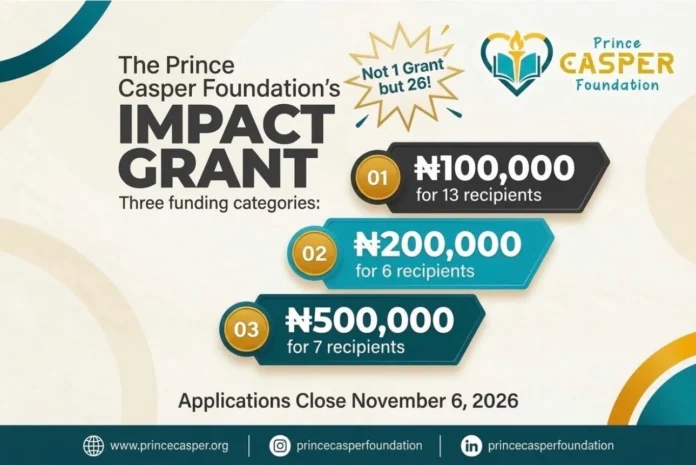
The programme provides three funding categories for initiatives at different stages, from early-stage ideas to established projects seeking to expand their impact.
The Trailblazer Grant offers ₦500,000 for transformational projects promoting sustainable change, while the Catalyst Grant provides ₦200,000 to help promising initiatives develop into scalable, long-term solutions. The Launchpad Grant awards ₦100,000 to help early-stage ideas move from planning to implementation.
The Foundation will award seven Trailblazer grants, six Catalyst grants and 13 Launchpad grants. Applicants cannot select their preferred funding category, as the selection committee will determine awards based on each project’s scope, cost, need and relevance.
The grants target educators and education-sector professionals working in Nigeria’s primary and secondary education systems, particularly those serving rural, underserved and educationally disadvantaged communities.
Eligible applicants include classroom teachers, school heads, school administrators, education programme staff, NGO workers and education volunteers. Applicants must contribute directly to children’s learning, development or educational outcomes and demonstrate genuine financial need affecting their ability to improve teaching or learning.
Projects must address at least one of the Foundation’s four priority areas, with applicants required to select two focus areas in their applications.
These areas are Learning Access, covering classroom resources, school infrastructure, sanitation, water, textbooks, stationery and literacy materials; Digital Innovation, which includes computers, internet access, digital learning resources and technology literacy; Educator Excellence, focused on teacher training, teaching methods, digital skills and school leadership; and Inclusive Empowerment, covering special-needs support, psychosocial care, community welfare and vocational skills.
Proposals should explain how the planned activities will improve educational outcomes for children and young people.
Applicants must submit a 500–750-word Letter of Intent outlining the educational challenge, proposed solution and expected impact. They must also provide a CV in PDF format detailing their education, experience, initiatives and achievements, alongside a recent photograph.
Other requirements include an itemised project budget and a referee who can speak to the applicant’s work. Supporting photographs, quotations, certificates and evidence of previous projects may also be included.
Applications opened on September 21, 2026, and will close on November 6, 2026, at 11:59 p.m. West Africa Time (WAT). Projects must not begin before January 2027.
Interested applicants can review the guidelines on the official Prince Casper Foundation Impact Grants page and submit their applications through the online application portal.
Enquiries can be sent to grants@princecasper.org.
Source: Prince Casper Foundation
Do you want to share your impact stories or pitch the coverage of your CSR event to us? E-mail: editor@impactwatch.net or *Phone +234-806-795-0250 (Whatsapp &Text)


