

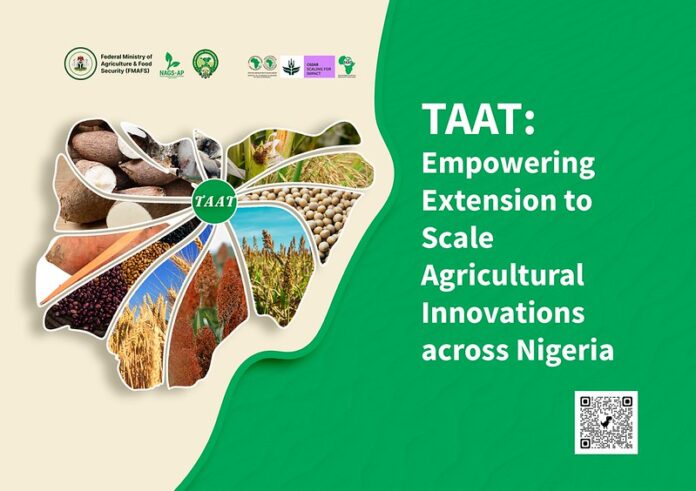
The Technologies for African Agricultural Transformation (TAAT) and its partners have launched a five-day capacity-building workshop for 100 agricultural extension workers, with the aim of improving farmers’ access to and adoption of modern agricultural technologies.
The training is taking place in Dutse, Jigawa State, and features extension master trainers and subject-matter specialists drawn from Jigawa, Kaduna, Kano, Katsina, Kebbi, Sokoto and Zamfara States. Participants represent agricultural organisations from both the public and private sectors.
The programme is being implemented in collaboration with the Federal Ministry of Agriculture and Food Security, the CGIAR Scaling for Impact Programme, the Jigawa Agricultural Transformation Agency (JATA), the National Agricultural Growth Scheme-Agro-Pocket (NAGS-AP) Secretariat and research institutions.
The workshop is taking place as Nigeria implements the NAGS-AP programme, against the backdrop of the African Development Bank’s $1.5 billion African Emergency Food Production Facility.
TAAT said the initiative is intended to improve farmers’ access to agricultural technologies, inputs and quality extension services, with the broader objectives of increasing productivity and farm incomes while strengthening food security and resilience.
The organisation said the training also addresses persistent weaknesses in Nigeria’s agricultural extension system. These include the low ratio of extension agents to farmers, estimated at between one agent for every 5,000 and 10,000 farmers, alongside inadequate funding, limited technical capacity and logistical challenges.
Head of the TAAT Clearinghouse, Dr Solomon Gizaw, said the programme is leveraging scientific and technological resources from CGIAR centres and other partners across a range of agricultural commodities.
These commodities include wheat, rice, maize, soybeans, cassava, vegetables, livestock and aquaculture.
According to Gizaw, participants will receive practical training covering climate-smart agriculture, soil health and integrated nutrient management, pest and disease management, improved seed systems, digital agriculture, market linkages and farmer-centred extension methods.
The extension professionals will also be trained to use mobile-based advisory platforms, geographic information systems (GIS), remote sensing, data collection tools and decision-support systems. These technologies are expected to support the delivery of timely agricultural and climate information to farmers.
Gizaw said the programme would operate through a cascade training model, with the 100 master trainers expected to subsequently train frontline extension personnel and farmer organisations.
Through the subsequent training and extension activities, the initiative is targeting at least 500,000 farmers, thereby extending its reach well beyond the initial group participating in the workshop.
“The central message is clear: Nigeria cannot scale agricultural innovation without scaling the people and systems that deliver it,” Gizaw said, adding that strengthening extension professionals would help bridge the gap between agricultural research, technology and farming communities.
At the opening of the workshop, the Director-General of JATA, Dr Saffulai Umar, said the programme’s theme, “Empowering Extension to Scale Agricultural Innovations,” speaks to a major challenge confronting Nigeria’s efforts to increase food production.
Umar noted that Nigeria already has access to several agricultural technologies and practices, including improved maize hybrids, high-yielding and stress-tolerant rice and wheat varieties, improved soil-health practices, climate information, mechanisation options, integrated pest management and water-efficient irrigation.
However, he identified the effective transfer of relevant knowledge to farmers as a major challenge, particularly ensuring that information reaches them in a usable form and at the appropriate time while supporting profitable adoption of available technologies.
He further said shortcomings within the extension system could contribute to late planting, improper use of inputs, avoidable crop losses, reduced yields, weak participation in markets and lower farmer incomes.
The training is consequently expected to improve extension workers’ ability to provide practical guidance to farmers while linking them with appropriate technologies, agricultural inputs and market opportunities capable of improving the productivity and profitability of their enterprises.
Source: msmeafricaonline
Do you want to share your impact stories or pitch the coverage of your CSR event to us? E-mail: editor@impactwatch.net or *Phone +234-806-795-0250 (Whatsapp &Text)


