

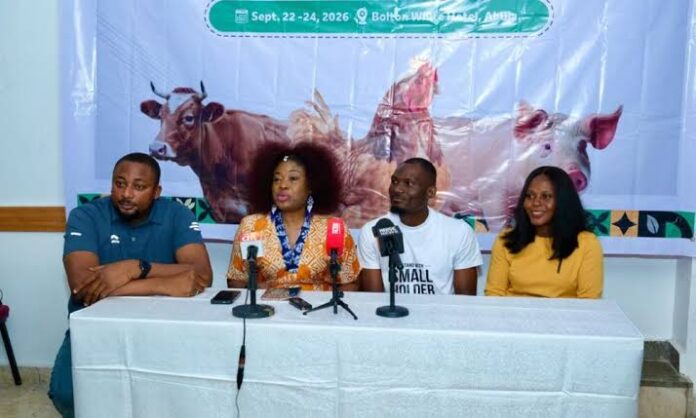
A coalition of Nigerian civil society organisations, farmers’ and pastoralist groups, alongside youth, women, environmental and animal-welfare organisations, has called for full disclosure of the Federal Government’s proposed $2.5 billion investment agreement with global meat company JBS.
The groups raised concerns that decisions regarding the proposed investment were being made without sufficient public disclosure and could have implications for Nigeria’s land, water, and food systems.
The demand followed a three-day strategy workshop on JBS engagement and industrial livestock expansion held in Abuja from September 22 to 24, 2026.
The proposed investment would establish six industrial meat-processing facilities across Nigeria and is linked to the Federal Government’s National Livestock Transformation Plan and the Nigeria Livestock Master Plan 2026–2040.
According to the coalition, almost two years after the Federal Government signed a Memorandum of Understanding with JBS, the agreement had not been made public. It also said no Environmental and Social Impact Assessment relating to the project had been published.
The groups stressed that they were not opposed to agricultural investment but maintained that an initiative capable of significantly altering Nigeria’s livestock and food systems should be transparent, accountable and subject to meaningful participation by affected communities.
They identified several areas where they said information remained inaccessible, including the project’s financing arrangements, environmental and social assessments, land allocation agreements, incentive packages and records of consultations with communities.
While the $2.5 billion headline investment figure is publicly known, the coalition said the terms attached to lenders, the allocation of the funds and the beneficial ownership of private investment vehicles involved in the project had not been disclosed.
The groups also said Freedom of Information requests submitted to the Federal Ministry of Livestock Development, the Ogun State Ministry of Agriculture and Food Security and the Niger State Ministry of Livestock and Fisheries had not been honoured.
The requests sought access to the JBS MoU, related agreements, environmental and social impact assessments and records documenting engagement with the company.
The coalition warned that the absence of such information made it difficult for Nigerians to establish whether public land and resources were being committed in ways that primarily served private interests.
It said it would use lawful avenues under the Freedom of Information Act 2011 to pursue the release of the requested documents.
Communities in Niger State were identified as a particular concern, with the coalition describing them as being at the frontline of the proposed livestock expansion. It said residents had raised grievances over land acquisition, including resettlement concerns, unfulfilled promises and access to water.
The groups also expressed solidarity with communities in Niger and Ogun states, stressing that their rights should be protected as industrial livestock expansion progresses.
They called for comprehensive and independent environmental and social impact assessments to examine the cumulative effects of the proposed development on land, water and ecosystems before further land allocation, approvals or construction take place.
The coalition also demanded meaningful consultation with farmers, pastoralists, women, youth and civil society organisations, including what it described as the free, prior and informed consent of communities affected by the project.
It urged the Federal Government to publish all agreements and contracts associated with the JBS investment, along with land allocation arrangements, incentives, financing terms and the beneficial ownership of private investment vehicles involved in the initiative.
The groups further sought enforceable safeguards to protect smallholder farmers and pastoralists’ access to land and markets, waterways and groundwater. They also called for attention to animal welfare and public health concerns.
According to the coalition, livestock reforms should be implemented consistently with Nigeria’s commitments on climate change, biodiversity and open government. It specifically called for transparent budgets, grievance mechanisms and independent monitoring involving civil society.
The groups argued that Nigeria already has functioning food systems supported by pastoralists, smallholder farmers and traditional producers, and said these systems should be strengthened rather than displaced by industrial expansion.
They also advocated increased investment in agroecology, indigenous seeds and resilient local food systems as ways of strengthening the livelihoods of farmers and pastoralists.
The coalition raised concerns about JBS’s international record, citing what it described as links between the company’s supply chain and deforestation in Brazil, alongside allegations involving labour and land rights.
It also referred to what it said was JBS’s recent removal of explicit protections for Indigenous peoples and land rights from its human rights policy, as well as the company’s abandonment of its Net Zero 2040 climate and zero-deforestation pledges.
Australia was also cited by the groups as a country from which Nigeria could draw lessons. JBS entered Australia’s meat-processing sector in 2007, and the coalition said the experience should be considered as the Nigerian government weighs the proposed investment.
The groups cautioned against treating increased production alone as equivalent to food security. They said the distribution of benefits, control over resources and protection of farmers, communities, animals and ecosystems were also important considerations.
They therefore maintained that the proposed investment should be assessed beyond its promised capital injection and industrial processing capacity, with attention also given to its potential implications for the people and natural resources supporting Nigeria’s food system.
“Transparency is not optional. It is the foundation of food security,” the coalition said, insisting that Nigeria’s food future must be built on public accountability, food sovereignty, environmental integrity and the voices of the people who produce the nation’s food.
The coalition said Nigeria could draw on lessons from other countries and urged the Federal Government to ensure that agreements capable of transforming the country’s food system were not concluded behind closed doors.
It maintained that communities affected by decisions concerning their land, water and livelihoods should have an opportunity to be heard before such decisions are taken, rather than afterwards.
Source: ThisDay
Do you want to share your impact stories or pitch the coverage of your CSR event to us? E-mail: editor@impactwatch.net or *Phone +234-806-795-0250 (Whatsapp &Text)


