

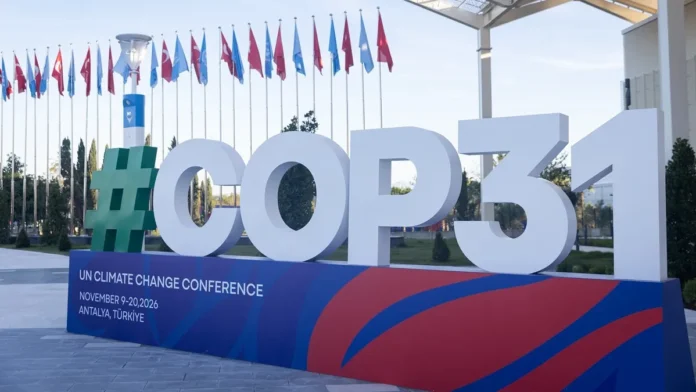
African civil society organisations have called on developed countries to translate their climate commitments into concrete funding and measurable action, warning that the ongoing COP31 negotiations could end without meaningful benefits for vulnerable communities.
The organisations, operating under the Pan African Climate Justice Alliance (PACJA), made the appeal on Wednesday in Antalya, Turkey, where they expressed concern over the growing disconnect between climate commitments and their implementation.
“The climate crisis is no longer a crisis of ambition. It is a crisis of delivery,” they said in a statement titled “From Promises to Proof: Our Call in Antalya”.
Augustine Njamnshi, Chair of the Political and Technical Affairs Committee of the PACJA Board, presented the statement during a press conference assessing the negotiations, two days before the scheduled conclusion of the conference.
The intervention came amid unresolved disagreements at COP31 over climate financing, fossil fuel commitments and the just transition. The conference presidency disclosed that 21 issues remained unsettled, with revised negotiating texts expected early Thursday ahead of the scheduled Friday conclusion.
A draft agreement released on Monday proposed stronger measures to transition away from fossil fuels and increase adaptation financing threefold to at least $120 billion annually by 2035, according to PREMIUM TIMES.
However, neither proposal had secured agreement, as participating countries remained divided over financing commitments, which nations should contribute and whether funding should be provided through grants rather than loans.
PACJA said African communities were already experiencing the consequences of climate change through droughts, flooding, food insecurity and displacement, despite the continent’s limited contribution to the causes of the crisis.
“The credibility of this COP will, therefore, not be measured by speeches, declarations or catchy headlines. It will be measured by whether those most responsible for the climate crisis deliver action, finance and accountability at the scale required,” they said.
The organisations urged developed countries and major greenhouse gas emitters to provide clear commitments on reducing dependence on fossil fuels. They called for specific targets, timelines and mechanisms for measuring progress.
They also cautioned against exploiting flexibility provisions in previous climate agreements and voluntary initiatives to postpone meaningful action.
According to the groups, continued public funding for fossil fuels, expansion of new oil and gas projects and related subsidies contradicted the climate leadership expected from countries with the greatest responsibility for emissions.
They maintained that nations with the highest historical responsibility for emissions and the financial capacity to address climate change should face the greatest accountability.
Climate finance was identified as the central measure of trust in the negotiations, with PACJA rejecting the characterisation of financial support as charitable assistance.
“Climate finance is an obligation grounded in responsibility, equity and commitments already made under the Convention and Paris Agreement,” the statement read.
The organisations also criticised developed countries for favouring a climate finance work programme that operates primarily as a platform for discussions, producing non-binding outcomes without establishing additional financial obligations.
They argued that the persistent funding deficit was not simply a consequence of insufficient resources but also reflected political decisions.
The groups further warned that African countries were facing increased financial pressure because they had to borrow money to respond to the effects of climate change.
Beyond financing, they called for policies that would improve electricity access, encourage the development of green industries, generate employment and strengthen community resilience.
“Africa does not seek permission to develop. We seek a fair opportunity to develop differently,” the statement said.
With COP31 scheduled to conclude on Friday, 20 November, PACJA urged participating governments to prioritise decisions that directly improve the lives of communities affected by climate change.
The alliance stressed that the conference’s success should ultimately be judged by the delivery of policies that put people at the centre of climate action rather than another round of commitments without implementation.
SOURCE: Premium Times
Do you want to share your impact stories or pitch the coverage of your CSR event to us? E-mail: editor@impactwatch.net or *Phone +234-806-795-0250 (Whatsapp &Text)


