

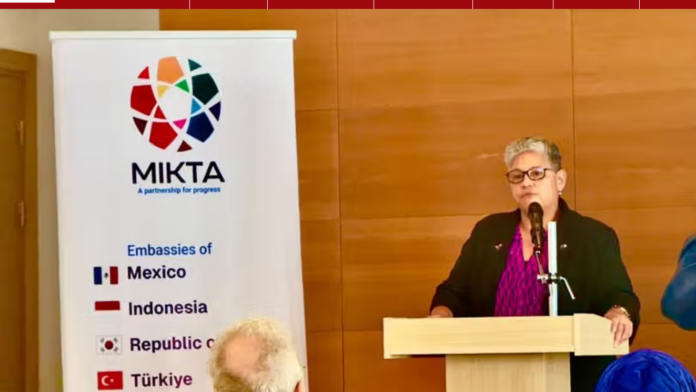
Nigeria will collaborate with Mexico, Indonesia, South Korea, Turkey and Australia under the MIKTA grouping to push for improved climate finance at the 31st United Nations Climate Change Conference (COP31).
Omotenioye Majekodunmi, director-general of the National Council on Climate Change (NCCC), announced Nigeria’s commitment at a COP31 side event hosted by MIKTA countries at the Turkish embassy in Abuja on Tuesday.
The meeting brought together diplomats to discuss climate financing, including the challenges and opportunities involved in implementing climate commitments.
Leilani Bin-Juda, Australian high commissioner to Nigeria, said Australia would prioritise implementing the Paris Agreement and achieving tangible outcomes at COP31.
“I can assure you that climate change is not an abstract or distant challenge. Its effects are very real, and they are here now,” Bin-Juda said.
“That is why Australia places such importance on working alongside our Pacific partners, and on improving access to climate finance for developing countries, particularly the most vulnerable.”
She also called on Nigeria to support a MIKTA initiative aimed at improving access to climate finance for small island developing states and least developed countries.
“Nigeria’s voice would carry particular weight. Its support would demonstrate solidarity with African least developed countries, while strengthening the broader case for a climate-finance system that is simpler, more responsive and more accessible,” the high commissioner said.
Bambang Suharto, Indonesian ambassador to Nigeria, expressed hope that COP31 would narrow the gap between climate ambitions and actual implementation.
“Dialogue, consensus, and action provide a constructive basis for cooperation that recognizes countries’ different circumstances and capacities,” Suharto said.
He said Indonesia would welcome progress on existing climate finance commitments, assistance to prepare projects that translate national priorities into investment-ready proposals, and blue finance commitments to strengthen aquatic ecosystems.
Suharto also proposed consultations involving Nigeria, interested MIKTA partners and relevant institutions on a possible Indonesia–Nigeria climate finance and resilience partnership. The proposed collaboration would explore grants, concessional loans, guarantees and blended finance based on individual project requirements.
“Indonesia would be pleased to share experience in sustainable finance, thematic bonds, energy-transition financing, and ocean-related projects, supporting South-South and triangular cooperation,” he said.
Mehmet Poroy, Turkish ambassador to Nigeria, stressed that African countries must remain central to efforts to expand access to climate finance.
“Our consultations in preparation for COP31 have made clear that African partners consistently identify adaptation, loss and damage, sustainable development and access to climate finance among their key priorities. Nigeria is an important partner in this regard,” Poroy said.
He added that climate finance should be connected to development priorities and urged MIKTA members to maintain momentum from COP31 through COP32, scheduled to take place in Ethiopia.
Legesse Haile, Ethiopian ambassador to Nigeria, said his country was preparing to host COP32 in 2027.
According to Haile, the conference would offer Ethiopia a pivotal opportunity to place developing countries at the centre of the global climate agenda, with attention to Africa’s development realities, just energy transitions, and the delivery of loss-and-damage commitments.
Jeong Yo-an, North Korea’s ambassador to Nigeria, also spoke at the event, saying his country would address plastic pollution. José Manuel Briseño Flores, Mexico’s chargé d’affaires in Nigeria, called for climate resources to be directed towards renewable energy projects.
Majekodunmi, represented at the meeting by Jummai Vandu of the NCCC’s department of energy, said Nigeria shared COP31’s focus on closing the gap between climate commitments and implementation.
She said the country’s efforts to turn climate frameworks into practical outcomes would centre on adaptation finance, climate action, and an inclusive and just transition.
“Nigeria knows precisely where it is going. We are leveraging strategic international cooperation to transform our climate vulnerabilities into green economic opportunities. We do not just want to participate in the global climate architecture; we want to help build its enduring pillars,” Majekodunmi said.
“Nigeria stands ready to walk this path hand-in-hand with MIKTA, with the UNFCCC, and with every nation represented here today.”
The NCCC director-general urged partner countries to establish a foundation for implementing climate commitments at COP31.
Source: The Cable
Do you want to share your impact stories or pitch the coverage of your CSR event to us? E-mail: editor@impactwatch.net or *Phone +234-806-795-0250 (Whatsapp &Text)


