

By Akinlabi Hassan
For decades, the debate over Nigeria’s governance model has centered on a crucial question: how do we effectively bring development to our people?
In theory, the third tier of government, the local government area (LGA), is designed, by default, to be the engine room for grassroots transformation. In practice, however, Nigeria’s 774 LGAs had largely been reduced to administrative ghosts, financially paralyzed and politically controlled by the state governors.
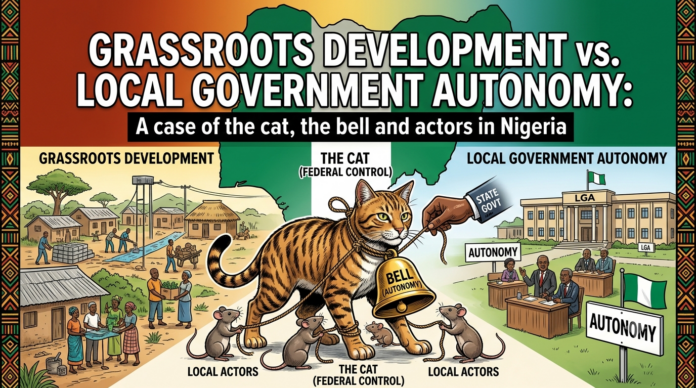
As the struggle between grassroots development and local government autonomy intensified, the Tinubu administration had embarked on the road that can eventually lead to unlocking grassroots development amidst struggle for Nigeria’s Local Government Autonomy.
It is making significant efforts to “bell the cat” and the ringing is quite inaudible yet. Everyone agrees that the overbearing influence of state governments needs to be curbed, and the current presidency has shown the political will, the structural muscle, and the moral authority to actually enforce that freedom through two key actions: official enforcement of direct allocation from the national pool and the constitutional uphold of the local government autonomy through the Supreme Court judgement.
The Promise of the Third Tier vs. The Reality of Capture
The foundational logic of creating local governments is simple: proximity. Decisions regarding rural roads, primary healthcare centers, community markets, streets organization and maintenance, basic sanitation and even policing are best made by those who live closest to the problems. When local governments function independently, development is direct, responsive, and accountability is assured.
However, the 1999 Constitution of the Federal Republic of Nigeria inadvertently created a structural loophole that crippled this potential over the years. Through the establishment of the State Joint Local Government Account (SJLGA), state governments were given administrative oversight over local allocations flowing from the federation account. This is despite LGAs having their residual obligation on certain local controls.
Instead of acting as a transparent clearing-house, the SJLGA became a tool for systemic starvation. State governors routinely divert, delay, or arbitrarily deduct funds meant for local councils for political gains. Deprived of their statutory allocations and stripped of their ability to generate independent revenue, local governments were left incapable of executing even the most basic capital projects but resort to intentionally misappropriating the limited revenue generated from tolls, fines and “small small” taxes. This showed that without active civic tracking, shifting money from the state capital to the local secretariat might simply decentralize corruption rather than accelerate development.
Communities must organize to demand transparency in budget implementation at the local level. Grassroots development will continue to stall if the local administrators are entirely dependent on the financial crumbs dropped from the state capital.
The Supreme Court Intervenes: Belling the Cat?
The narrative took a dramatic turn in July 2024 when the Supreme Court of Nigeria delivered a landmark judgment. In a suit filed by the Federal Government, the apex court ruled that it is unconstitutional for state governors to hold or alter funds meant for local government councils. The court ordered that allocations from the Federation Account be paid directly to democratically elected local government councils. Furthermore, it declared the widespread practice of governors dissolving elected councils and replacing them with handpicked “caretaker committees” illegal.
On paper, this judgment was hailed as the definitive “belling of the cat.” The judiciary had seemingly broken the financial chains binding the LGAs to the governors’ leash. Yet, a closer look at the aftermath reveals that while the legal cage was opened, the bird remains hesitant to fly. Laws do not execute themselves; they rely on political systems to breathe life into them. While direct funding is now a legal mandate, state governments still hold immense structural leverage. Many states have quickly adjusted by passing local laws or putting pressure on council chairmen who are often political loyalists of the governor to return funds to state-controlled pools under the guise of “joint regional projects.”
The Political Bottleneck: State Electoral Commissions
Truly the bottleneck to genuine local government autonomy lies in the electoral process. Local government elections are conducted by State Independent Electoral Commissions (SIECs), which are funded and controlled by state governors. Obviously, almost every local government election in Nigeria results in a clean sweep for the ruling party in that state. A governor cannot be realistically expected to midwife a truly independent third tier of government when they hold absolute power over who gets elected. The Council Chairmen know that their political survival depends entirely on the governor’s goodwill, not the voters’ satisfaction. Consequently, even with financial autonomy secured by law, political autonomy remains a mirage. The cat is still very much in charge of the mouse hole.
Moving Forward: Who will enforce the balance?
To transition from mere legal pronouncements to actual grassroots development, Nigeria needs a multi-pronged approach that moves beyond relying solely on the courts but exploring the efficacy of institutional restructuring.
- Scrapping or Reforming SIECs: True autonomy is impossible if governors control the ballot boxes at the local level. There must be a constitutional amendment transferring the responsibility of conducting local government elections to the Independent National Electoral Commission (INEC) or an entirely independent federal body to ensure competitive and credible local government elections.
- Civic Vigilance and Local Accountability: Financial autonomy means local leaders will now handle billions of Nairas directly. Hence, the masses must be ready to hold local leaders accountable for their actions and decisions.
- Strengthening Institution Over Individuals: The Federal Government must strictly enforce the non-remittance of funds to any LGA operating under an unelected caretaker committee, forcing states to maintain democratic structures.
This silent battle between grassroots development and local government autonomy in Nigeria is not just a legal dispute; it is a battle for the soul of Nigeria’s democracy. The Supreme Court has done its part by providing the legal framework, effectively putting the bell around the cat’s neck, it’s now left for the masses to listen carefully to the sound of the the bell when it rings.
For emphasis, ensuring the ringing is heard means continuous citizen engagement, structural electoral reforms, and a collective refusal to let local governments remain appendages of state power. Until the political monopoly of state governors over local administration is completely dismantled, grassroots development will remain a distant dream, and the question of who will truly liberate the third tier will linger unanswered.
Do you want to share your impact stories or pitch the coverage of your CSR event to us? E-mail: editor@impactwatch.net or *Phone +234-806-795-0250 (Whatsapp &Text)


