

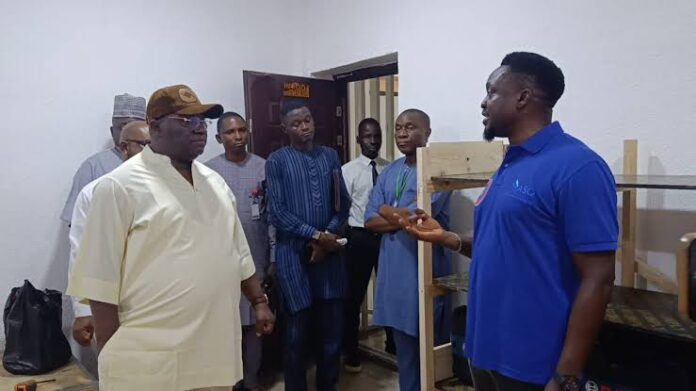
A former World Bank Senior Education Specialist, Dr Tunde Adekola, has called on Nigerian artisans to take advantage of the Industrial Training Fund’s (ITF) Skills-Upgrading Program for Advancement of the Informal Sector (SUPA) to strengthen their technical abilities and improve access to international opportunities.
Adekola made the call in Abuja on Wednesday during a joint tour of the ITF Model Skills Centre with the Fund’s Director-General, Dr Afiz Ogun.
He described SUPA as an important initiative for youth empowerment, job creation and poverty reduction, noting that vocational training and skills acquisition could help tackle unemployment while improving livelihoods across Nigeria.
During the visit, Adekola also expressed satisfaction with the practical projects being carried out by participants in the ongoing eight-week Train-the-Trainers Capacity Workshop at the centre.
He encouraged artisans to fully utilise the SUPA programme to enhance their technical skills and bring their work up to international standards.
According to him, improving technical and vocational capabilities would give Nigerian artisans a stronger position to compete for opportunities in international markets while also increasing their earning potential.
Adekola commended Ogun for his leadership in advancing the programme and urged relevant stakeholders to provide the necessary support for its implementation.
“Stakeholder support is necessary to achieve the objectives of the programme and expand its benefits to Nigerian artisans,” he said.
The ITF Director-General identified limited access to capital as one of the major obstacles confronting Nigerian artisans.
Ogun disclosed that the ITF was working with the Bank of Industry (BOI) to tackle financing difficulties affecting beneficiaries of the SUPA programme.
Participants at the training also spoke about the practical improvements they had gained through the programme.
Temitope Ojo, a carpenter participating in the training, said he had acquired knowledge of global best practices in making chairs and benches.
Ojo also said the programme had strengthened his understanding of workplace safety precautions in less than 10 days of participation.
Another participant, Mary Ann, who is receiving painting training, said the programme had exposed her to new techniques that were significantly different from those she had encountered through her previous field experience.
Similarly, Abubakar Badrin, who is participating in floor-tiling training, said the programme had enhanced his tiling abilities and taught him to place greater emphasis on safety for both himself and his clients.
The development underscores the focus on strengthening Nigeria’s informal sector through technical training, improved professional standards and greater access to finance.
For millions of artisans operating across Nigeria, programmes such as SUPA could create opportunities to formalise their businesses, raise productivity and compete more effectively in both domestic and international markets.
Source: MSME Africa Online
Do you want to share your impact stories or pitch the coverage of your CSR event to us? E-mail: editor@impactwatch.net or *Phone +234-806-795-0250 (Whatsapp &Text)


