

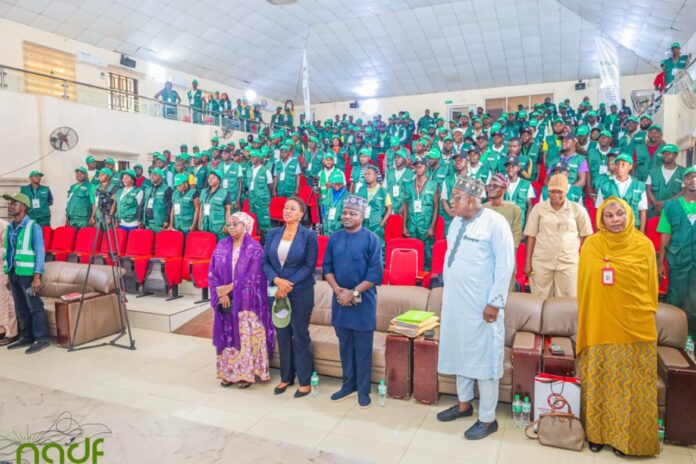
The National Agricultural Development Fund (NADF) has graduated the first cohort of participants under its National Agricultural Mechanisation Service Providers Training Programme, with about 250 tractor drivers and mechanics trained to support Nigeria’s agricultural mechanisation ecosystem.
The nationwide programme is designed to train 4,000 tractor drivers and mechanics, with the first phase bringing together participants from Nigeria’s six geopolitical zones.
NADF Executive Secretary and Chief Executive Officer, Mohammed Ibrahim, described the graduation as a significant milestone in the Federal Government’s efforts to modernise agriculture through mechanisation, innovation and human capital development.
In a statement issued by NADF, the fund said the programme is intended to achieve more than simply training machinery operators. It seeks to develop the technical expertise, operational systems and maintenance culture necessary to keep agricultural equipment functional and improve productivity throughout the agricultural value chain.
Participants underwent intensive training covering agricultural mechanisation service delivery, machinery and equipment management, occupational safety, enterprise development, sustainable maintenance and environmental conservation.
The programme also emphasised professionalism, an enterprise mindset and operational discipline.
According to NADF, the pilot cohort comprised about 232 trainees. Their certification by the Industrial Training Fund (ITF) will qualify them for inclusion in a national database of proficient agricultural mechanisation service providers being developed by the fund.
The database is expected to facilitate long-term public and private investment in agricultural machinery. It could also establish a framework for certified service providers to manage agricultural assets worth millions of naira.
Ibrahim said the effectiveness of agricultural mechanisation should not be judged simply by the number of tractors and other machines purchased, but by how efficiently the equipment is maintained and put to use.
He noted that some earlier agricultural mechanisation investments had not reached their full potential because of insufficient technical capacity, inadequate maintenance systems and accountability challenges.
“The future of agricultural mechanisation in Nigeria depends not only on acquiring machines, but on sustaining them through technical competence, accountability, and responsible asset and environmental stewardship,” he said.
The National Agricultural Mechanisation Service Providers (NAMSP) training is part of NADF’s wider interventions across Nigeria’s agricultural value chains.
The fund said its Farm Input Support Programme currently reaches 109,000 smallholder farmers. Its Grassroots Digital Extension Corps initiative has also trained 1,884 extension agents and food security specialists across the country.
Beyond these programmes, NADF is investing in agricultural research institutions through modern laboratories, digital extension infrastructure, biotechnology facilities, renewable energy systems, irrigation infrastructure and innovation platforms.
Ibrahim said the graduates represent a new generation of skilled agricultural mechanisation practitioners who can improve the utilisation of machinery, reduce equipment downtime, expand farmers’ access to mechanisation services and safeguard public and private investments in agricultural assets.
The National President of the Tractor Owners and Hiring Facilities Association of Nigeria, Abdullahi Mohammed, commended NADF for bringing participants from different parts of Nigeria together for the training.
He called for sustained capacity building, pointing out that machinery manufacturers and vendors may provide initial training but cannot always remain available at every location where tractors are deployed.
“We need much of this training. The service provider wants training; the operator and the mechanic also need this type of training,” he said.
Mohammed also urged NADF, machinery manufacturers, vendors and service providers to maintain collaboration while calling for government support to make agricultural machinery more affordable.
The initiative underscores the increasing importance of technical expertise and maintenance capacity to Nigeria’s agricultural mechanisation efforts as the country seeks to raise food production, strengthen food security and reduce losses linked to poorly maintained agricultural equipment.
Source: MSME Africa Online
Do you want to share your impact stories or pitch the coverage of your CSR event to us? E-mail: editor@impactwatch.net or *Phone +234-806-795-0250 (Whatsapp &Text)


