

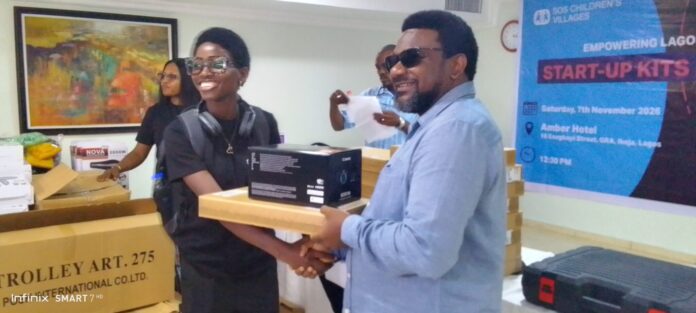
SOS Children’s Villages Nigeria has distributed vocational tools and equipment worth approximately €300,000 to 206 young people across Lagos State, bringing its two-year Empowering Lagos Youths (ELY) project to a close.
The distribution took place on Saturday, with recipients receiving equipment tailored to their respective vocational skills and career interests. Items included solar panel installation kits, HP laptops, Canon EOS cameras, hair styling equipment, tailoring machines and other information technology tools.
The initiative was designed to help young people overcome poverty, access decent employment opportunities and establish sustainable businesses.
Speaking at the event, Eghosa Erhumwunse, Country Director of SOS Children’s Villages Nigeria, explained that the programme commenced in January 2025 and is scheduled to end in December 2026. He said its objectives extended beyond providing equipment, with a broader focus on preparing young people for economic independence.
“Like you can tell from the name, it’s all about Empowering Lagos Youths, ELY. The idea is to accelerate the empowerment of young people to move them away from poverty and provide them with opportunity for decent job and also empower them to start up their own business,” he said.
He highlighted the importance of the intervention amid prevailing economic difficulties, noting that young people are often among those most affected by challenging economic conditions.
“It is very important considering the economic situation and how much young people are always on the receiving end. We as an organisation work with young people to ensure we help them, support them to achieve their aspiration so that they can become responsible individuals and be able to build their own family in the long run.”
According to Erhumwunse, all 206 participants completed extensive preparatory training before receiving their equipment. The programme combined vocational and entrepreneurship training with mental health and psychosocial support to prepare participants for challenges associated with employment and running businesses.
“These young people you have seen today, they’ve been tested and they are trusted. They have gone through a lot of training, vocational training skills. They’ve gone through entrepreneurship. They have gone through a whole lot of rigorous process including mental health and psychosocial support, because we often forget that young people face challenges.
“The training we’ve given to them is not enough for them to deal with situations they will face while even doing their own business or working as the case may be,” he added.
The project received funding from Children’s Villages Worldwide (CVW), the German sister organisation of SOS Children’s Villages. Local trainers, hairdressers, artisans and other partners also contributed to building a support network intended to help participants sustain their chosen trades after the programme.
Explaining the partnership approach, Erose said the organisation deliberately involved local professionals to strengthen the business environment in which the young people would operate.
“We believe in local partnership. We have trainers, hairdressers and all other artisans. So we’re able to work with them. It’s an ecosystem because it’s still the same environment these young people will find themselves. So why don’t we begin to enable the ecosystem so they can interact for the sustainability of whatever trade they decide to go into afterwards,” Erose explained.
SOS Children’s Villages Nigeria initially set a target of 200 participants but eventually reached 206, exceeding its original projection despite a few participants leaving the programme.
“We targeted 200 participants. We tried to avoid using the word beneficiaries. They are participants. In some instances, we got more than we needed. A few of them left, but at least we achieved more than what we targeted. Today we achieved more than 200, slightly more than 200. About 206 or thereabouts. So it’s a success for us.”
The equipment distribution reflected the different vocational paths pursued by participants, with each individual receiving tools based on their training and intended business activities.
“You have some who are into installation of solar panel. You have IT gurus. You can see the computers there. You have those who want to go into hair styling. You have those who want to go into tailoring. It’s personalised, not generic. Every individual decides what you want to do based on the outcome of your training.”
The initiative was implemented across Lagos State, with the organisation adopting an open application process to identify eligible participants. Erhumwunse said the selection exercise prioritised vulnerable young people, particularly those who are often difficult to reach.
“We advertised it. Young people applied. Those of you who understand what we do in SOS, you know we are very strict with our selection criteria. We put it out there for vulnerable young people, people who are hard to reach, to be able to have this opportunity. I believe that’s the right thing to do,” Erose said.
He disclosed that the two-year project had an overall budget of approximately €300,000.
Although the Lagos State Government did not provide financial support for the initiative, it collaborated with SOS Children’s Villages Nigeria through its development agenda. Erhumwunse said the organisation’s activities aligned with the state’s development priorities.
“We work with them. We came to their development agenda. And we are part and parcel of what Lagos State is doing.”
He also reaffirmed the organisation’s commitment to supporting children and young people through similar interventions, noting that SOS Children’s Villages operates in 136 countries.
“These are project-based. And we’ve been running a lot of projects. We’ll continue to run projects as far as it impacts children and young people. That’s why we’re here.”
Addressing concerns about the possibility of participants selling the equipment, Erhumwunse acknowledged that the organisation could not provide an absolute guarantee but said monitoring arrangements and post-empowerment support had been established.
“We have a mechanism in place. We cannot guarantee 100%. I mean, we are human. But we have a mechanism in place. And those who will follow through with them, who will support them, they’re also there. Post-empowerment support is there.”
Among the recipients was Celia Dalyop, a photographer who received a Canon EOS camera and an HP laptop to support her professional development.
Expressing appreciation for the support, she said:
“I didn’t pay anything for it, I didn’t pay a dime for it. I’m very, very grateful for this,” she said.
Dalyop learnt about the opportunity through a friend in Abuja who works with the SOS Abuja branch. She subsequently attended a training centre for three months before completing another three-month internship under a professional photographer.
She plans to use the equipment to improve her photography skills, establish her brand and grow her business.
“I intend to use it to build my skill, build myself, build my brand, build my business, to just capture moments and make money from it.”
Already active on social media, Dalyop also disclosed that she was working towards securing a studio space on the Island.
Another participant, Ashogbon Goodness Tibiebi, who trained in data analysis, described the experience as an important personal and professional milestone.
“I feel so happy. I don’t know how to express it, but I’m just happy for the milestone and everything, the journey so far,” she said.
Goodness discovered the programme through a relative and applied for admission. She completed six months of training despite having no substantial prior experience in data analysis.
Reflecting on her progress, she said the programme had significantly improved her confidence and understanding of the field.
“Before now, I had a little knowledge of data analysis, but I was very confused at first. If you walk up to me, I’m not really confident enough. But at this point, now, after this training, I’m bold enough. Data analysis doesn’t just stop here. It’s something I keep on learning. So I can beat my chest, that whatever comes my way now, I don’t have to start panicking.”
Goodness, who studies Accounting at Miva Open University, intends to continue developing her data analysis skills, support others and eventually teach the subject in schools and through a private academy.
SOURCE: BusinessDay
Do you want to share your impact stories or pitch the coverage of your CSR event to us? E-mail: editor@impactwatch.net or *Phone +234-806-795-0250 (Whatsapp &Text)


