

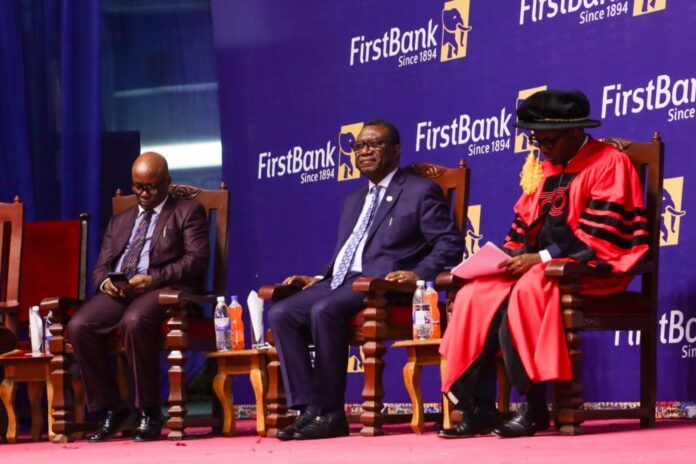
FirstBank Nigeria Limited and the University of Lagos (UNILAG) have reiterated their commitment to advancing business ethics, academic research and structured support for small and medium-sized enterprises in Nigeria.
The commitment was reinforced at the FirstBank Samuel Asabia Professorial Chair in Business Ethics Public Lecture, which took place at the George Ade Ajayi Auditorium, UNILAG, on September 3.
Themed “Ethical Paradoxes, Small Businesses, and the Informal Economy: Lessons for Tax Compliance and Accountability,” the lecture brought together academics and business leaders to examine ethical conduct, taxation and accountability within Nigeria’s informal economy.
Speaking during the event, FirstBank Group Managing Director and Chief Executive Officer, Olusegun Alebiosu, said Nigeria’s informal sector accounts for approximately 42.5 per cent of the country’s Gross Domestic Product, citing data from the National Bureau of Statistics.
He noted that traders, artisans, farmers and other small businesses support livelihoods and provide employment for millions of Nigerians, despite facing constraints including limited access to finance, infrastructure, capacity and formal business structures.
According to Alebiosu, many businesses in the informal sector depend on personal trust and reputation instead of formal regulatory systems. He therefore stressed the importance of ethical business practices in developing relationships with customers, employees, business partners and financial institutions.
Alebiosu further said the FirstBank Samuel Asabia Professorial Chair should generate research that reaches beyond large corporations and addresses the realities of businesses operating in markets, workshops and agricultural communities.
Delivering the inaugural lecture, Professor Kenneth Amaeshi, Chair in Business Ethics at UNILAG, called for the informal sector to receive greater recognition in policy discussions.
Amaeshi said micro-enterprises constitute a significant portion of direct employment and maintained that policies affecting small businesses should reflect the realities under which they operate.
He also examined the connection between informal businesses and taxation, noting that many small business owners understand their tax obligations but remain concerned about how government uses tax revenue.
“Tax accountability matters,” Amaeshi said, arguing that greater transparency over public spending could improve taxpayers’ confidence.
He observed that formalising informal businesses could provide access to finance, technical assistance and other structured forms of support. However, he cautioned that rigid taxation approaches could create challenges for small enterprises.
The Samuel Asabia Professorial Chair in Business Ethics is among 10 permanently restricted endowments funded by FirstBank across federal universities in Nigeria’s six geopolitical zones.
The initiative is designed to promote academic research and ethical leadership.
UNILAG Vice Chancellor, Professor Folasade Ogunsola, represented at the event by Deputy Vice Chancellor Professor Mathew Ilori, commended FirstBank for supporting the university.
She also said the university would continue to maintain an academic environment that encourages research and discussions around business ethics.
UNILAG had included the annual public lecture on its official events calendar for September 3, with Amaeshi scheduled to deliver the lecture under the chairmanship of FirstBank’s managing director and chief executive officer.
Source: msmeafricaonline
Do you want to share your impact stories or pitch the coverage of your CSR event to us? E-mail: editor@impactwatch.net or *Phone +234-806-795-0250 (Whatsapp &Text)


