

As Nigeria pursues industrialisation, digital transformation and greater global competitiveness, the country’s biggest infrastructure challenge may not be inadequate roads, unreliable electricity or congested ports. Instead, a fragile education system that produces too few work-ready graduates is emerging as a critical barrier to long-term economic growth.
With an estimated 10.5 million primary-school-age children currently out of school and only about one in four children aged between seven and 14 able to read a simple sentence or demonstrate basic numeracy skills, education has become far more than a social sector issue. It now represents a strategic national infrastructure priority.
Addressing this challenge requires moving beyond the traditional model of corporate philanthropy, where support is often limited to one-off donations, ceremonial scholarship presentations or isolated classroom construction projects. Greater emphasis is needed on interventions that strengthen every stage of the learning ecosystem.
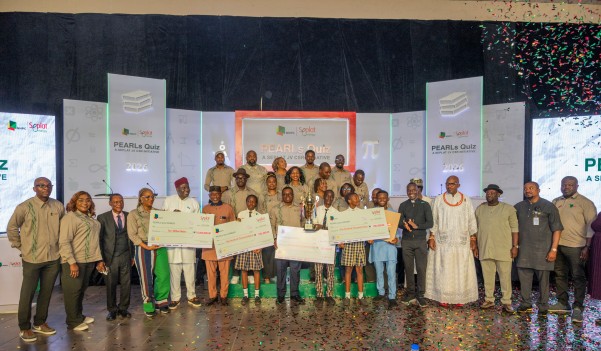
One example highlighted for its structured approach is the NNPC/Seplat Energy Joint Venture’s education programme, which combines teacher development, student academic competitions, school infrastructure support, scholarships and entrepreneurship training within a single framework. Its strength lies not only in its scale but also in treating education as an interconnected system rather than a standalone corporate social responsibility initiative.
Host community impact
The initiative has recorded measurable outcomes across several education programmes:
- 34% of Seplat’s 780 undergraduate scholarships have been awarded to students from host communities.
- The Seplat JV PEARLs Quiz currently serves secondary schools across Delta, Edo and Imo states, with plans for expansion into additional states.
- Since 2012, the PEARLs Quiz has reached 61,035 teachers and students.
- A total of ₦101 million in prize funding has supported school development projects, including libraries, classroom blocks and school buses.
- The Seplat Teachers Empowerment Programme (STEP) has trained 1,334 educators, comprising 1,232 secondary school teachers and 102 Ministry of Education personnel.
Rather than relying on isolated goodwill initiatives, the model addresses several educational pressure points simultaneously. Teacher capacity is strengthened through structured professional development, while student engagement is encouraged through academic competitions and recognition. Schools also receive infrastructure improvements, scholarships expand access to tertiary education, and entrepreneurship programmes help connect classroom learning with future economic opportunities.
This integrated approach recognises that educational challenges cannot be solved through a single intervention. Improvements in one area are reinforced by investments across the broader learning system.
The same philosophy extends to host communities and participating states. While the PEARLs Quiz celebrates academic excellence, it also leaves lasting investments that continue benefiting schools after each competition concludes. Similarly, STEP focuses on teacher development, recognising that while a scholarship may change the future of one student, a well-trained teacher can positively influence generations of learners.
The scholarship programme also reflects a balance between nationwide educational support and the company’s responsibility to communities located near its operations by ensuring a significant share of awards benefits students from host communities.
The broader policy implication is significant. Every major sector of Nigeria’s economy depends on a skilled workforce developed through quality education. The energy sector requires engineers and technicians, healthcare relies on trained professionals, agriculture and manufacturing demand technical expertise, while the digital economy depends on software developers, designers and analytical talent.
Weak educational outcomes today ultimately translate into lower productivity tomorrow. As a result, private-sector investment in education should increasingly be viewed not simply as corporate goodwill but as a strategic investment in future economic growth.
For policymakers, the priority is to create stronger partnerships that leverage private-sector funding and execution capacity alongside federal and state education authorities. Companies, meanwhile, are encouraged to shift from isolated charitable projects toward structured programmes that improve teaching quality, learning environments, school infrastructure and access to higher education. The media also has a role in distinguishing interventions that deliver lasting educational improvements from those designed primarily for publicity.
Seplat Energy’s education framework stands out because it links teachers, students, schools and future employment opportunities into a connected development model. As Nigeria seeks lasting solutions to its education challenges, the focus may need to shift from increasing the number of corporate interventions to improving how those interventions are designed.
Source: Star Connect Media
Do you want to share your impact stories or pitch the coverage of your CSR event to us? E-mail: editor@impactwatch.net or *Phone +234-806-795-0250 (Whatsapp &Text)


