

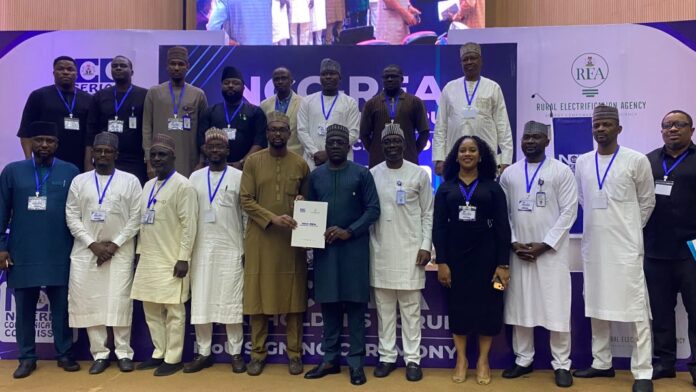
The Nigerian Communications Commission (NCC) and the Rural Electrification Agency (REA) have entered into a strategic partnership aimed at deploying renewable energy solutions to strengthen telecommunications infrastructure in rural and underserved communities across Nigeria.
The collaboration was formalised through the signing of a Memorandum of Understanding (MoU) during the NCC-REA Stakeholder Forum and MoU Signing Ceremony held in Abuja. The agreement represents a significant move toward integrating renewable energy systems with telecommunications infrastructure to improve service delivery nationwide.
Under the partnership, both agencies plan to reduce the telecommunications sector’s dependence on diesel-powered base stations by connecting telecom infrastructure to renewable energy-powered mini-grids. The initiative is also expected to improve network availability and support more reliable digital connectivity in areas without access to the national electricity grid.
The stakeholder forum, themed “Unlocking the Energy–Telecoms Nexus for Scalable Digital Infrastructure in Nigeria,” brought together government officials, telecommunications operators, tower companies, renewable energy developers, financiers, development partners and investors. Discussions focused on strategies for integrating electricity and telecommunications infrastructure to accelerate digital inclusion across the country.
Speaking after the signing ceremony, the Executive Commissioner, Technical Services at the NCC, Abraham Oshadami, described the partnership as evidence of the close relationship between the power and telecommunications sectors.
According to Oshadami, telecommunications infrastructure depends heavily on stable electricity to operate efficiently, while electricity consumers increasingly rely on telecommunications services for smart metering, digital payments and other technology-driven energy services.
Explaining how the initiative will work, he said, “Where you have mini-grids, we’re able to identify base stations that are close to them so that we’ll be able to take electricity supply from the closest mini-grids,” he said.
He noted that the arrangement would keep telecommunications facilities operational even in locations that are not connected to the national electricity grid, thereby improving service reliability while expanding digital access for millions of Nigerians.
Also speaking, the Executive Director, Technical Services at the Rural Electrification Agency, Umar Abdullahi, described the agreement as a major milestone that would bring an end to years of separate implementation by the two agencies.
He explained that while both organisations had independently recorded significant achievements in expanding access to telecommunications and electricity, working together would enable them to deliver greater impact.
“Prior to today, both agencies, NCC and REA, have been working in silos. They’ve achieved a lot in the telecom sector, and REA has achieved a lot in the power sector. By signing this MoU, we came together to have one agenda so that all our efforts are complementing each other,” he said.
Abdullahi further disclosed that an NCC-REA Collaboration Committee has already been established to oversee implementation of the agreement, develop pilot projects and recommend strategies for expanding the initiative across the country.
Source: Voice of Nigeria (VON)
Do you want to share your impact stories or pitch the coverage of your CSR event to us? E-mail: editor@impactwatch.net or *Phone +234-806-795-0250 (Whatsapp &Text)


