

By Akinlabi Hassan
When we look at a thriving, resilient community of the western world, it can be tempting to credit a single driving force; governance.
In Africa, it’s unfathomable to proudly praise a local government authority, but we marvel at a targeted humanitarian program, or applaud the generosity of a billionaire’s foundation. However, true sustainable societal progress is never a solo run and it shouldn’t be a privilege for the people. Instead, it relies on three distinct yet deeply interconnected forces: Governance in the form of public trust, interventions from sustainable businesses, and philanthropy by humanitarians.
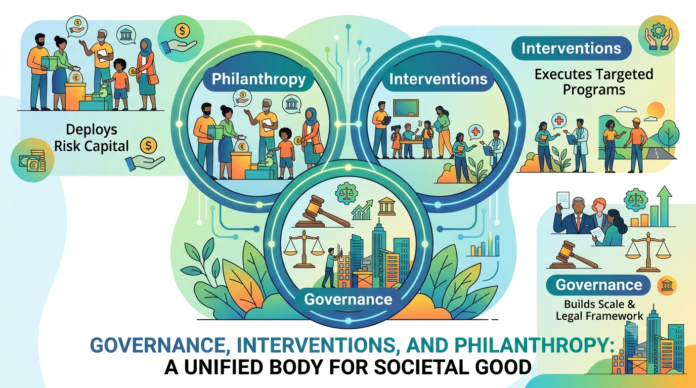
Though they come with different budgets, mandates, and operational styles, these three interrelated parts essentially form a body for the good of the society. They share the exact same DNA; a fundamental commitment to improving the standard of living of an average human, and none of them can truly reach their full potential without the other two.
Governance: The framework of Public Trust
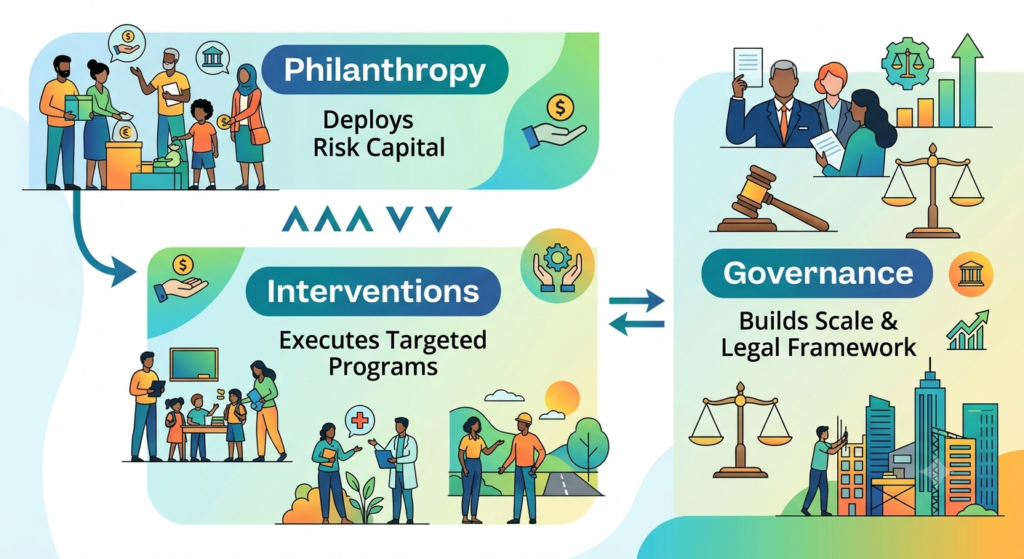
Governance is the structural framework that keeps society upright. It is the laws, policies, regulatory bodies, and public institutions that establish order, protect rights, and manage collective resources. Without solid governance, any other attempt to do good operates in a vacuum of chaos.
Think of governance as the skeleton. It isn’t fleshy, but it provides the essential structure. Effective governance creates predictable environments where schools can run, businesses can invest, and citizens can live safely. It scales solutions across millions of people through public policy and taxation.
Truly, governance has inherent limitations but at the same time has no direct business in interventionism or philanthropy.
It should face and continue to solve its hydra-like problems of bureaucracy, consensus, broad legislation, and government misappropriation which are characteristically slow to change. They struggle to address niche, hyper-local issues but are easy to quickly pivot to unexpected crises and this is the point where its other parts should step in.
Interventions: The Strength of Direct Action
If governance is the skeleton, interventions are the targeted muscle. An intervention is a deliberate, specific action designed to interrupt a negative cycle or accelerate a positive trend for the good of the community. These are programs on the ground: a non-profit’s clean water initiative, an emergency relief material distribution drive, agriculture inputs to local farmers, an intensive job-training program, entrepreneurship education or a public health campaign.
Interventions excel at precision because of the deliverability prowess private businesses deploy as part of their efficiencies. Most of these initiatives are designed by experts who understand the unique pain points of a specific community. They identify needs to improve the public safety net while ensuring that their activities are not negatively impacting their host communities, and close the gaps with a well-executed intervention steps directly into that gap. The challenge for interventions is sustainability and scale.
Sometimes, these sustainable businesses in collaboration with the grassroots organizations, authorities and NGOs often possess the perfect strategy but lack the permanent funding or institutional authority to keep the program running indefinitely. To cross the hurdles, they rely heavily on the rules set by governance and the fuel provided by philanthropy.
Philanthropy: The Lifeblood of sustained Innovation
Philanthropy is the voluntary deployment of private resources; time, talent, and treasure for the public good. Far more than just writing checks, true philanthropy acts as the society’s risk capital executed with social enterprise.
Governments should never be found gambling with taxpayer money on unproven ideas disguised as interventions and empowerment, while non-profits cannot risk their tight operational budgets on experimental programs. Philanthropy, however, has the unique freedom to take risks. It could even fund the rogue scientist looking for a breakthrough medical cure, seed-fund a radical new educational model, or back an ambitious agric or climate tech startup.
Philanthropy provides lifeblood. It spots an unaddressed crisis, funds the initial trial, and proves the concepts which are mostly aligned to the United Nations Sustainable Development goals, tackling the inherent targets one at a time. Once the concept works, it can be transformed into a repeatable intervention or adopted into permanent public policy by governance.
Why they should always form a whole?
While a government agency, a practical NGO, and a private business foundation might look entirely different on paper, they are structurally identical in their ultimate pursuit of good and progress of the society. They all exist to solve the failure of the market, policies and the humane sides of life, especially in the places, like Africa where the raw forces of capitalism or nature leave people behind.
Do you want to share your impact stories or pitch the coverage of your CSR event to us? E-mail: editor@impactwatch.net or *Phone +234-806-795-0250 (Whatsapp &Text)


