

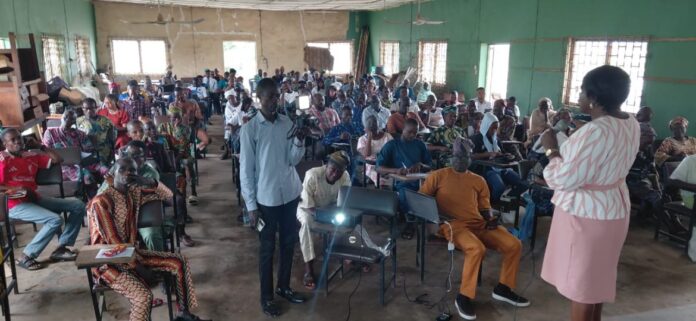
The Oyo State Government has commenced a Climate-Smart Agriculture training programme for 880 farmers and agricultural extension officers selected from different geopolitical zones of the State.
The initiative, which began on Wednesday, August 26, 2026, at the Fertilizer Store in Oyo, is aimed at increasing food production, strengthening farmers’ resilience to climate change and reducing post-harvest losses.
The programme is being implemented under the 2025 Business Enabling Reform Action Plan (BERAP) through the State Action on Business Enabling Reforms (SABER), an initiative focused on improving the ease of doing business and expanding business opportunities across the State.
Declaring the training open, the Commissioner for Agriculture and Rural Development, Barrister Olasunkanmi Olaleye, said Climate-Smart Agriculture had become essential to the future of food production, the economy and society amid challenges including climate change, soil degradation, unpredictable weather conditions and population growth.
Olaleye said the projected increase in the global population to nearly 10 billion by 2050 made it necessary to find ways of producing more food with fewer resources. He noted that conventional farming practices alone might not be adequate to satisfy rising food demand.
According to the Commissioner, Climate-Smart Agriculture combines modern technologies, innovation and scientific knowledge to improve efficiency, productivity and sustainability in farming while protecting the environment.
He identified satellite monitoring, sensors, mobile applications, artificial intelligence, drones, automated irrigation systems and data analytics as technologies that could support farmers in monitoring crop health, improving soil fertility management, controlling pests and making more efficient use of water and other agricultural inputs.
Olaleye further explained that smart agricultural practices could help farmers use fertilisers and pesticides more efficiently, limit waste and production expenses, improve profitability and reduce environmental pollution.
He also said the adoption of modern agricultural technologies could shift farming from a predominantly labour-intensive activity towards a technology-driven sector, while opening opportunities for young people and creating new jobs in agricultural technology.
However, the Commissioner stressed that a successful transition to smart agriculture would require collaboration between government, research institutions, private-sector partners, extension personnel and farmers.
He called for sustained investment in rural infrastructure, enabling policies, digital technology access, agricultural education and training, as well as financial support for smallholder farmers.
Olaleye assured that the State Government would provide farmers with the knowledge and tools needed to take part in the transformation, stressing that “no farmer should be left behind.”
He urged the participants to make effective use of the training and apply the knowledge acquired to strengthen agricultural production and extension services throughout the State.
The Commissioner said Climate-Smart Agriculture goes beyond the use of technology, describing it as an approach to developing a resilient, sustainable and profitable agricultural sector that can feed a growing population while conserving natural resources for future generations.
Olaleye said, “The future of agriculture lies not only in the soil but also in innovation, technology and collaboration,” adding that effective deployment of modern agricultural tools would create a thriving agricultural sector that benefits farmers, consumers and the entire nation.
Also speaking, the SABER Focal Person, Mr. Kilanko Olayemi, represented by Mr. Roland Adekunle, said 880 participants from across the geopolitical zones of the State would receive training under the project.
He explained that the initiative was specifically designed to address post-harvest losses within the agricultural sector.
Representing the President of the All Farmers Association of Nigeria (AFAN), the AFAN Zonal Coordinator, Oyo, Mr. Debo Fakayode, praised the Oyo State Government under the leadership of Engr. Seyi Makinde for its efforts to develop a vibrant and sustainable agricultural ecosystem.
Fakayode said the training involving extension personnel and selected farmers from across the State further demonstrated the government’s commitment to improving food security and strengthening the agricultural sector.
Source: Independent.ng
Do you want to share your impact stories or pitch the coverage of your CSR event to us? E-mail: editor@impactwatch.net or *Phone +234-806-795-0250 (Whatsapp &Text)


