

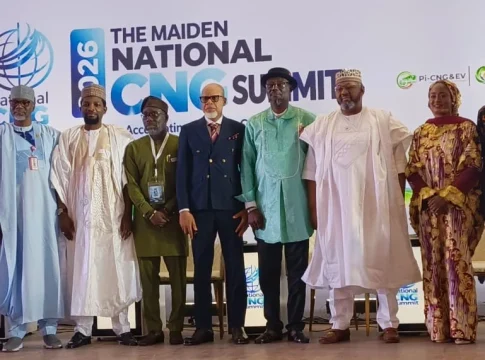
The Federal Government has announced plans to establish up to 1,000 additional Compressed Natural Gas (CNG) stations across Nigeria to expand access to alternative fuel and reduce transportation costs.
The Executive Chairman of the Presidential Initiative on CNG and Electric Vehicles, Mr Ahmad Ismael, disclosed this at the maiden National CNG Summit held in Abuja on Wednesday.
According to Ismael, Nigeria currently has 105 operational CNG stations, while another 127 facilities are at different stages of completion, bringing the total number of existing and planned stations to 232.
He explained that the proposed expansion would implement President Bola Tinubu’s directive for 500 additional stations, alongside another 500 subsequently announced to improve nationwide access to CNG.
“The government is working towards implementing President Bola Tinubu’s directive for 500 additional stations, alongside another 500 subsequently announced to improve nationwide access to CNG.
“Nigeria’s estimated 215 trillion cubic feet of proven natural gas reserves and vehicle population of about 12.6 million present significant opportunities for developing the CNG market,” he said.
Ismael also highlighted the financial pressure transportation costs place on households, explaining that wider adoption of CNG-powered vehicles could ease the burden.
“transportation accounted for between 15 and 22 per cent of household expenditure, noting that switching to CNG-powered vehicles could help reduce the financial burden on households.”
He identified inadequate infrastructure, limited gas supply networks and transportation logistics as major obstacles to expanding the CNG market. He stressed the importance of investments in pipelines, compression facilities and virtual pipelines to address these challenges.
Meanwhile, the convener of the National Compressed Natural Gas Forum (NCNG-F), Mr Faruk Abdullahi, called on the government and private sector to turn Nigeria’s extensive gas resources into economic opportunities through affordable energy, employment generation and industrial development.
Delivering the keynote address, Abdullahi described Nigeria’s situation as a paradox, noting that its substantial gas reserves had not translated into affordable energy, stronger industrial competitiveness or improved living standards.
He emphasised that the success of the CNG transition should be assessed by its wider economic and social benefits, rather than infrastructure expansion and vehicle conversions alone.
“The success of CNG transition should not be measured only by the number of vehicles converted or refueling stations established, but by its impact on transportation costs, employment, business growth and household welfare.
“Behind every energy policy is a human story. When we discuss CNG, we are discussing the commercial driver whose daily earnings are consumed by the cost of fuel.
“We are talking about the trader whose transportation expenses influence the price of goods; the farmer whose produce must travel long distances to reach the market,” he said.
Abdullahi commended President Tinubu for establishing the Presidential Initiative on CNG and Electric Vehicles but urged the government to move beyond its initial interventions towards building a self-sustaining industry supported by private investment.
He further identified high vehicle conversion costs, limited access to credit, inadequate infrastructure, gas availability, regulatory clarity, technical standards and low public awareness as issues requiring urgent attention.
To improve safety and public confidence, he also advocated the use of certified equipment, accredited vehicle conversion centres and properly trained technicians.
Source: von.gov
Do you want to share your impact stories or pitch the coverage of your CSR event to us? E-mail: editor@impactwatch.net or *Phone +234-806-795-0250 (Whatsapp &Text)


