

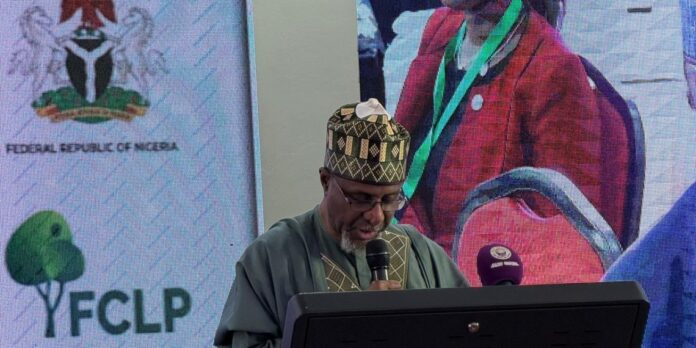
The Federal Government of Nigeria has launched the Securing Nigeria’s Forest Future (SNFF) Country Package, a 10-year strategic framework designed to mobilise about $1 billion in blended finance, restore two million hectares of degraded forests and generate 1.5 million green jobs across the country.
The framework is also expected to deliver a 20 per cent reduction in deforestation while strengthening climate resilience for more than five million Nigerians. It further seeks to protect biodiversity and support sustainable livelihoods based on forest resources.
Speaking at the launch in Abuja, Minister of Environment, Balarabe Abbas Lawal, described the SNFF as a national framework for coordinating Nigeria’s priorities in forest restoration, biodiversity conservation, climate action and investment over the next decade.
According to Lawal, Nigeria’s forests are facing growing pressure from agricultural expansion, unsustainable exploitation of natural resources and rapid urbanisation. He stressed that meeting the framework’s targets would depend on cooperation among federal and state governments, local communities, private investors, development partners, civil society organisations and financial institutions.
The minister also urged increased participation from the private sector, saying government funding alone would not be sufficient to meet the scale of intervention required. He said the government would improve the conditions for private investment, blended finance and carbon finance, alongside efforts to expand forest-based livelihoods and increase the participation of women and young people in the green economy.
Lawal said the ministry would also improve forest monitoring and reporting systems to generate dependable information on forest loss, degradation and restoration. He added that progress would be assessed through bankable investment pipelines, resources mobilised, measurable restoration outcomes and accountability.
The European Union’s Head of Partnerships, Massimo De Luca, said forest protection was strongly connected to agriculture, livelihoods, trade and broader economic development.
De Luca called for stronger institutions, greater community participation, sustainable agricultural practices and responsible approaches to land use.
He also pointed to the European Union Deforestation Regulation as both a challenge and an opportunity for Nigeria, particularly its cocoa industry. According to him, stronger forest governance, traceability at farm level and dependable geospatial data could assist Nigerian producers in retaining access to the European market.
The Food and Agriculture Organisation of the United Nations (FAO) also expressed support for the framework, noting that forests are essential to Nigeria’s food and water security, biodiversity, climate resilience and livelihoods.
Representing the FAO Representative in Nigeria and ECOWAS, Dr Hussein Gadain said the SNFF could provide a single national framework for bringing together forest restoration, sustainable land management, climate action, investment and livelihoods.
FAO said it was prepared to assist Nigeria with developing bankable programmes and gaining access to international climate and environmental financing through mechanisms such as the Global Environment Facility, Green Climate Fund and Adaptation Fund.
The launch was attended by government officials, development partners, financial institutions, private-sector representatives, civil society organisations and researchers.
The Federal Government urged stakeholders to move quickly beyond the launch of the framework and begin implementation of its 10-year strategy.
Source: msme Africa online.
Do you want to share your impact stories or pitch the coverage of your CSR event to us? E-mail: editor@impactwatch.net or *Phone +234-806-795-0250 (Whatsapp &Text)


