

The Lagos State Government is expanding food infrastructure through a network of food hubs and a N500 billion offtake guarantee scheme, to reduce the state’s reliance on food supplies from other parts of Nigeria, stabilising prices and opening new opportunities across the agricultural value chain.
With more than 25 million people to feed and over 70 per cent of its food supplies coming from outside Lagos, Governor Babajide Sanwo-Olu said the state was pursuing a long-term strategy to evolve from a predominantly consumption-driven market into an integrated centre for food production, processing, logistics and distribution.
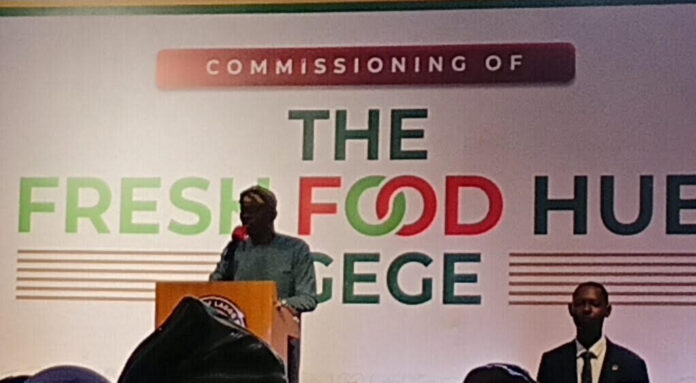
Sanwo-Olu spoke at the commissioning of the Lagos Fresh Food Hub in Agege, where he said the state was developing a food economy capable of handling more than 1.5 million metric tonnes of food annually, supporting 1,500 food trucks every day and unlocking a N500 billion market guarantee for farmers through the Produce for Lagos Programme.
The governor said Lagos could no longer depend on fragmented food supply chains to meet the needs of its growing population. He noted that reliance on food transported from other states exposes the market to transportation costs, post-harvest losses, inadequate storage and price volatility.
According to Sanwo-Olu, the emerging food hub network will bring farmers, aggregators, traders, processors and consumers into a more coordinated market structure.
The expansion of food infrastructure is being supported by the N500 billion Offtake Guarantee Fund under the Produce for Lagos Programme. The scheme is designed to tackle two major challenges confronting farmers: access to finance and dependable markets.
By guaranteeing a market for agricultural produce, the initiative is expected to provide farmers with greater confidence to increase production while creating opportunities for businesses involved in aggregation, processing, storage, transportation and distribution.
Sanwo-Olu disclosed that the Mushin food hub, which was commissioned in December 2023, had recorded more than N4 billion in transactions across 228 market days. The facility had also created over 7,000 direct and indirect jobs and attracted more than 850 registered vendors.
Similar facilities are being developed in Opebi, Agege, Ikorodu and Bombata, with plans to eventually extend the food hub network across all Local Government Areas and Local Council Development Areas in Lagos.
At the centre of the strategy is the Lagos Central Food Systems and Logistics Hub at Ketu-Ereyun, Epe.
The facility is designed to process more than 1.5 million metric tonnes of food annually and service more than 1,500 food trucks daily.
Its planned facilities include cold and dry storage, processing and repackaging areas, quality-control laboratories, warehouses, logistics bays and digital trading platforms.
Sanwo-Olu said construction of the facility was at an advanced stage and that it would be completed and commissioned before the end of his administration.
The governor also said the wider food transformation programme could eventually position Lagos to move beyond satisfying its own food requirements and become an exporter of agricultural commodities.
The Commissioner for Agriculture and Food Systems, Abisola Olusanya, said the newly commissioned Lagos Fresh Food Hub in Agege is projected to facilitate more than N5 billion worth of food transactions annually.
The Agege facility was developed as a middle-level food hub linked to the state’s broader Central Food Security Systems and Logistics Hub.
Olusanya explained that Lagos was adopting a hub-and-spoke distribution model, under which the central logistics hub would serve as the main facility while smaller hubs would be located closer to consumers and major trading centres.
The Agege hub, together with the existing Mushin facility and other hubs under development, will function as interconnected nodes within the network.
The model is also intended to tackle problems associated with traditional food markets, including poor handling and storage, post-harvest losses, traffic congestion, poor sanitation and difficult trading conditions.
Developed in partnership with Origin Tech Group, the Agege facility occupies approximately 7,000 square metres. This includes a 4,000-square-metre trading floor with capacity for between 350 and 400 vendors.
The hub also has approximately 1,200 square metres of dry storage, with capacity for about 800 metric tonnes, alongside cold storage capacity of approximately 300 metric tonnes.
Additional facilities include a dedicated seafood section, parking space for between 80 and 90 vehicles and 10 electric vehicle charging points.
The scale of the facility could provide opportunities for MSMEs operating in food trading, aggregation, processing, logistics, cold-chain services, packaging, storage, transportation and technology.
Olusanya said the hub is expected to facilitate more than N5 billion in food transactions annually, based on its trading capacity and the volume of food it can handle.
The state has also produced a 351-page operating framework to guide the management and day-to-day operations of the facility.
Under the framework, produce will enter the hub through farmers, aggregators, processors, suppliers and bulk dealers before moving to commissioned agents, retailers and institutional buyers.
Cold and dry storage facilities will enable businesses to preserve produce where immediate sales are not required, while quality control, inventory management, sanitation and waste management systems are expected to support more organised operations.
The food hub network is also expected to give the Lagos State Government improved data on food flows across the state.
Such information could help policymakers and businesses better understand demand, supply patterns, storage needs and gaps in distribution.
For farmers and agribusinesses, the more organised system could improve access to buyers and reduce some losses associated with transporting perishable products through fragmented supply chains.
The Agege Local Government Chairman, Abdul-Ganiyu Obasa, said the facility would strengthen Agege’s position within Lagos’ expanding food economy while creating opportunities for traders, processors, transport operators, farmers and other businesses.
He described the project as strategic infrastructure capable of improving food distribution and attracting greater private-sector investment to the area.
As Lagos expands its food hub network and implements the N500 billion offtake guarantee scheme, the programme is positioned around connecting production, finance, storage, processing, logistics and retail within a more coordinated food system.
For MSMEs, the development creates opportunities beyond farming, with demand expected to grow for services that support the movement, storage, processing, financing and marketing of food across Lagos.
Source: MSME Africa Online
Do you want to share your impact stories or pitch the coverage of your CSR event to us? E-mail: editor@impactwatch.net or *Phone +234-806-795-0250 (Whatsapp &Text)


