

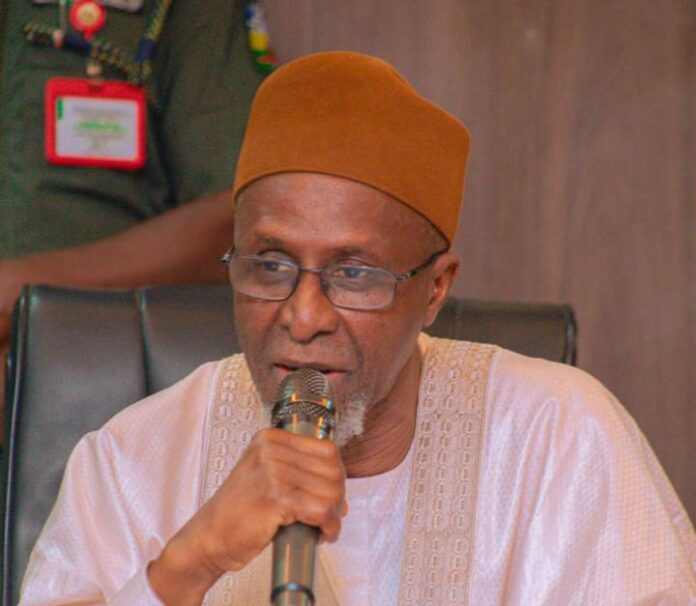
Nigeria’s Minister of Environment, Balarabe Abbas Lawal, has called on state governments to strengthen climate governance, integrate climate priorities into budgets and development plans, and attract investment to accelerate climate action nationwide.
Lawal made the call in Abuja at the launch of the third edition of the Subnational Climate Governance Performance Rating and Ranking Report (SCGPRR 3.0), stressing that effective implementation at state and community levels is essential to achieving Nigeria’s climate ambitions.
He said the Federal Government could not address the country’s climate challenges alone, describing climate change as a development, economic, social and security imperative rather than a distant environmental concern.
According to the minister, the effects are increasingly visible in flooding, extreme heat, drought and mounting pressure on agriculture, food systems, water resources, infrastructure, livelihoods and human settlements.
The SCGPRR provides an evidence-based framework for assessing how states manage climate governance, measure progress and identify areas requiring improvement. It examines whether states have functional climate institutions, incorporate climate priorities into budgets and development plans, mobilise resources, implement projects and deliver measurable benefits to citizens.
Lawal highlighted progress recorded through the initiative, including stronger climate institutions, improved policy and planning frameworks, better coordination and increased implementation of climate-resilient and low-carbon initiatives.
He noted that the third edition represents a shift from assessing institutional structures and policies towards greater emphasis on implementation, investment and measurable outcomes.
The minister identified several priorities for state governments, including strengthening climate institutions, embedding climate considerations in development plans and budgets, mobilising more climate finance, developing bankable projects and implementing effective adaptation and mitigation measures.
He stressed that climate interventions must produce tangible improvements in people’s lives and urged governors to make climate action central to their development and investment agendas.
Lawal also called on state governments to strengthen the institutions responsible for implementation and establish conditions that encourage climate finance, private investment and strategic partnerships.
He urged every state to establish a clear process linking policy to budget allocations, budgets to projects, and projects to measurable results.
The minister said the ranking should serve as more than a performance scorecard, describing it as a strategic management and accountability instrument for identifying governance gaps, monitoring progress and accelerating climate action.
While commending states that performed well, he encouraged them to strengthen implementation further and share successful approaches with other states. He also urged states still developing their climate governance systems to consolidate existing progress and accelerate their efforts.
Lawal emphasised that the assessment was intended to encourage improvement rather than stigmatise states.
He reaffirmed the Federal Government’s commitment, under President Bola Ahmed Tinubu’s Renewed Hope Agenda, to supporting state governments through technical assistance, capacity development and collaboration with relevant stakeholders.
The minister urged commissioners of environment and other state institutions to translate climate leadership into practical outcomes through stronger coordination, credible project pipelines, effective monitoring and reporting.
He also called on development partners, financial institutions, private sector organisations, academic institutions and civil society groups to help move climate policies towards investment, innovation and large-scale implementation.
Emphasising the importance of community participation, Lawal said climate interventions must reflect local realities and improve livelihoods. He identified women, young people, farmers, businesses and vulnerable groups as essential partners in building climate resilience.
The minister further highlighted the importance of effective implementation at the state level as Nigeria advances its Nationally Determined Contributions (NDCs), National Adaptation Plan and other national climate priorities.
He said achieving the country’s climate objectives would require stronger institutions, better planning, increased investment, faster implementation and measurable results.
Lawal urged stakeholders to use the third edition of the ranking to encourage constructive learning, strengthen accountability and translate climate commitments into tangible outcomes.
He commended all 36 states and the Federal Capital Territory (FCT) for participating in the initiative, reiterating the importance of collective action in building a more resilient, low-carbon and prosperous Nigeria.
The Subnational Climate Governance Performance Rating and Ranking Report is an initiative of the Society for Planet and Prosperity (SPP), established to assess and promote climate governance performance across Nigeria’s states and the FCT.
Source: The Guardian
Do you want to share your impact stories or pitch the coverage of your CSR event to us? E-mail: editor@impactwatch.net or *Phone +234-806-795-0250 (Whatsapp &Text)


