

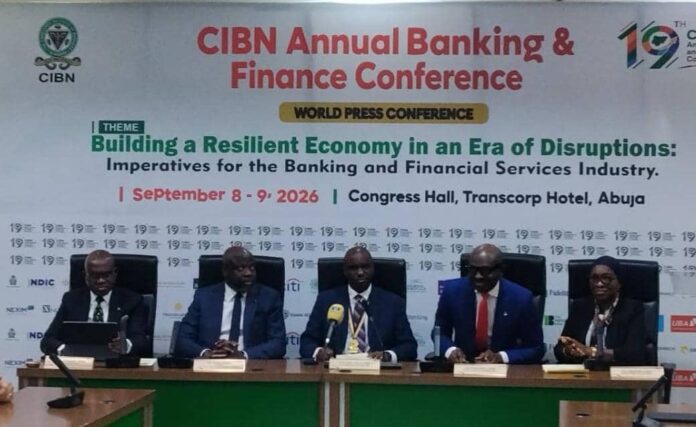
The Chartered Institute of Bankers of Nigeria (CIBN) has called on banks to deploy their stronger capital base towards financing micro, small and medium-scale enterprises (MSMEs), describing the sector as essential to Nigeria’s economic growth and job creation.
CIBN President and Chairman of Council, Dr Dele Alabi, made the call during a media briefing ahead of the institute’s 19th Annual Banking and Finance Conference, scheduled to take place on September 8 and 9, 2026, in Abuja.
Alabi said the recent recapitalisation of banks had strengthened their ability to withstand economic shocks. However, he stressed that the additional capital should translate into increased financing for productive sectors of the economy.
According to him, banks can no longer rely heavily on government securities or focus their lending predominantly on large corporations, particularly as yields on government securities decline and margins within the top-tier corporate sector become thinner.
“Smart bankers, smart bank CEOs have to think of a more ingenious way of utilising this capital. It entails going down a little bit down the ladder to lend to the MSMEs. That is what we are focusing on,” he said.
Alabi acknowledged that financing MSMEs comes with challenges, noting that many businesses have weak corporate governance structures, inadequate financial records and poor accounting systems, factors that can make them difficult for banks to finance.
To address these challenges, he said CIBN would establish MSME forums to bring entrepreneurs and banks together and ensure that discussions progress into actual transactions.
The institute will also organise SME clinics aimed at strengthening the capacity of businesses and improving their ability to access bank financing.
The CIBN president further disclosed that the institute was working with the Lagos State Government to establish an SME hub in the state as part of efforts to promote financial inclusion.
He maintained that lending to MSMEs could be profitable and secure when banks employ effective risk-management systems and appropriate lending infrastructure.
Alabi also said CIBN was pursuing generational inclusion through initiatives such as its Generation Next programme.
The programme provides young Nigerians with opportunities to interact with industry leaders, develop ideas and explore innovation.
Speaking about the forthcoming Annual Banking and Finance Conference, a member of the Conference Consultative Committee, Mr Segun Opeke, said the event would bring together policymakers, regulators, financial institutions, development partners, technology providers, academics and business leaders.
He said the gathering would provide a platform for stakeholders to develop practical solutions to challenges confronting the economy.
The conference will focus on “Building a Resilient Economy in an Era of Disruptions: Strategic Imperatives for the Banking and Financial Services Industry.”
According to Opeke, discussions at the conference will cover geopolitical uncertainties, technological disruptions, cyber threats, climate risks, changing customer expectations and evolving regulatory requirements.
The conference will be held physically in Abuja, while stakeholders in Nigeria and other parts of the world will have access to virtual participation.
Opeke added that resolutions reached during the conference would be compiled into a communiqué and forwarded to relevant policymakers and stakeholders to support informed decision-making and policy formulation.
The event is expected to attract more than 10,000 participants, including banking executives, regulators, government officials, development partners, academics, fintech leaders, investors and other stakeholders across the financial ecosystem.
The CIBN president said the institute would continue monitoring the implementation of recommendations emerging from its annual conferences.
According to him, this would be done through a structured checklist outlining responsibilities, milestones and timelines.
Alabi identified improved coordination between monetary and fiscal authorities as one of the key outcomes arising from recommendations made at last year’s conference.
He said CIBN remained committed to supporting policies and initiatives capable of strengthening Nigeria’s financial system and promoting sustainable economic growth.
Source: MSME Africa Online
Do you want to share your impact stories or pitch the coverage of your CSR event to us? E-mail: editor@impactwatch.net or *Phone +234-806-795-0250 (Whatsapp &Text)


