

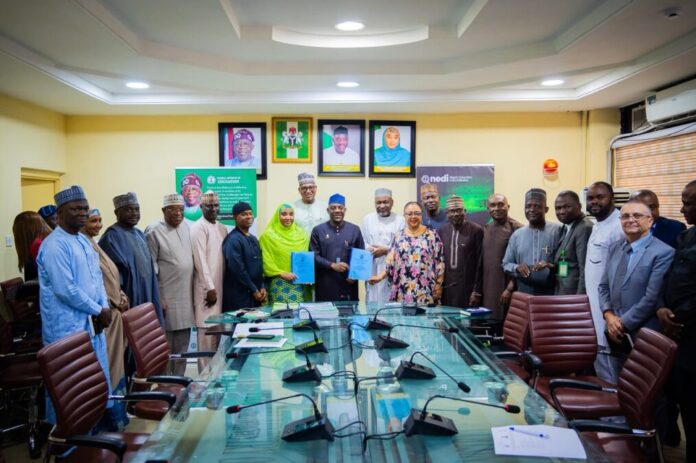
The Federal Government has revised agricultural curricula for tertiary institutions across Nigeria, increasing the emphasis on practical training in a move aimed at equipping young Nigerians with job-ready skills for the agricultural sector.
The Minister of Education, Maruf Tunji Alausa, disclosed this while receiving the report of the National Implementation Committee on the Review and Development of Agricultural Curricula for Tertiary Institutions in Nigeria.
A statement signed by Ikharo Attah, Special Adviser to the Minister on Media and Communications, said the revised curricula will replace the previous 70 per cent theoretical and 30 per cent practical structure with an 80 per cent practical and 20 per cent theoretical model.
Alausa said the reform is part of President Bola Ahmed Tinubu’s efforts to reposition agriculture as a skills-based sector capable of generating productive opportunities for young Nigerians.
He explained that increasing the practical component would provide students with more hands-on experience and help them apply what they learn beyond the classroom.
“The shift to 80 per cent practical training is a major step towards equipping Nigerian youths with relevant skills and advancing the economic objectives of the Renewed Hope Agenda,” the minister said.
Alausa expressed optimism that the revised approach would produce a better-trained workforce, build capacity across the agricultural sector and transform education into productive economic activity.
He also urged stakeholders to support a comprehensive rollout of the revised curricula, emphasising the need to sensitise industry players, academics, teachers and other relevant stakeholders about the objectives of the reforms.
The minister said adequate teacher training and institutional support would be essential to enabling tertiary institutions to effectively deliver the practical-focused curricula.
The Minister of State for Education, Suwaiba Sa’id Ahmad, also praised members of the implementation committee for their contributions to the exercise.
Ahmad recognised the roles played by the National Board for Technical Education (NBTE), Skills Council, industry representatives and academics in reviewing the curricula. She noted that their collaboration helped develop curricula that more closely address the requirements of Nigeria’s agricultural sector.
She called for continued engagement with stakeholders and the public to promote understanding and acceptance of the reforms, particularly the stronger focus on practical training.
Presenting the committee’s report, the Executive Secretary of NBTE, Idris Muhammad Bugaje, disclosed that the review resulted in 36 new and reviewed National Diploma (ND) and Higher National Diploma (HND) curricula.
The exercise also delivered three National Certificate in Education (NCE) curricula and 31 National Occupational Standards.
Bugaje explained that 27 of the occupational standards were newly developed, while four existing standards were reviewed, thereby expanding the framework supporting agricultural skills development.
He said the assignment had been completed and that the resulting documents had been considered and approved by the relevant regulatory bodies.
The NBTE executive described the outcome as a significant boost to agricultural skills development and said the complete set of curricula would be formally presented at a later public event.
Alausa assured stakeholders that the Ministry of Education would collaborate with NBTE, tertiary institutions, industry players and other stakeholders to ensure the effective implementation of the revised curricula.
The minister said the government’s priority remains equipping young Nigerians with practical skills, strengthening the agricultural workforce and converting Nigeria’s agricultural potential into productive opportunities.
The reform is expected to deepen the connection between agricultural education and industry requirements by exposing students to practical skills that can support employment, entrepreneurship and participation throughout Nigeria’s agricultural value chain.
Source: MSME Africa Online
Do you want to share your impact stories or pitch the coverage of your CSR event to us? E-mail: editor@impactwatch.net or *Phone +234-806-795-0250 (Whatsapp &Text)


