

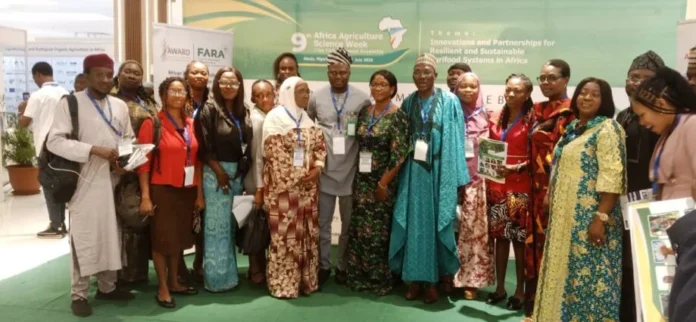
The African Women in Agricultural Research and Development (AWARD) Gender Responsive Agricultural Systems Policy (GRASP) Fellows have advocated the integration of women into agricultural policymaking, saying inclusive policies are essential to improving productivity, livelihoods, incomes and food security.
The call was made on the sidelines of the 9th Africa Agriculture Science Week and the 10th General Assembly of the Forum for Agricultural Research in Africa (FARA), held in Abuja.
The session, themed “Beyond Participation, Financing and Policy Access for Women in Agriculture,” brought together stakeholders to examine policy shortcomings affecting women across key agricultural sectors, including tree cash crops, nutrition and agricultural extension.
Dr Yetunde Oladokun, leader of the third cohort of AWARD GRASP Fellows and Principal Research Officer at the Cocoa Research Institute of Nigeria (CRIN), said the gathering was designed to identify existing policy gaps and promote more inclusive agricultural frameworks.
According to Oladokun, women contribute more than 70 per cent of smallholder food production, yet they remain insufficiently represented in agricultural and nutrition policy development.
She explained that the policy deficiencies have continued to restrict women’s access to land, finance, extension services and other productive resources required to improve their livelihoods while strengthening national food and nutrition security.
Oladokun identified the National Gender Policy on Agriculture, the National Agricultural Technology and Innovation Policy (NATIP) 2022–2027 and the Zero Oil Palm Initiative as examples of policies that do not sufficiently address the needs of women farmers.
She added that these shortcomings have limited women’s access to and control over productive resources, reducing their capacity and overall welfare.
“We are here to discuss how gender gaps in agricultural policies can be addressed so that women can participate fully and access opportunities in agriculture.
“The fellows are presenting policy innovation projects covering tree cash crops, nutrition, extension and other areas, with the aim of identifying gender gaps and promoting inclusive policy formulation,” she said.
According to Oladokun, AWARD is committed to advancing gender-responsive solutions that support equitable agri-food systems for both women and men.
Speaking about her policy innovation project, “Advancing Gender-Responsive Policies for Inclusive and Sustainable Tree Cash Crop Development in Nigeria,” she said the initiative seeks to generate evidence that will support the development of a gender-responsive national tree crops policy.
She noted that although successive governments have introduced agricultural policies aimed at increasing productivity and promoting economic diversification, Nigeria still lacks a dedicated policy framework for tree crops such as cocoa, coffee and cashew.
Oladokun further observed that existing gender-focused agricultural policies concentrate mainly on arable crop production, leaving women participating in tree crop value chains largely overlooked.
She said tree crops remain Nigeria’s second-largest agricultural export earners, yet women who represent a significant share of smallholder producers continue to face challenges, including limited access to land, finance, agricultural inputs, extension services, markets and fair remuneration.
Another AWARD Fellow, Mrs Nuhu James, also presented a policy innovation project titled “Strengthening Disability Inclusion and Gender-Responsive Agri-food Systems in Taraba State.”
James said that while agriculture remains central to livelihoods in Taraba State, persons with disabilities, particularly women, continue to experience exclusion from land ownership, agricultural inputs, finance, extension services, training and other critical opportunities.
Representing the Federal Government/International Fund for Agricultural Development (IFAD) Value Chain Development Programme, James said findings from her research revealed that 84.8 per cent of persons with disabilities are engaged in agriculture, although the majority remain subsistence farmers.
According to her, about 71 per cent earn N300,000 or less annually, while existing disability and gender policies have not translated into accessible and accountable agricultural services at the state level.
She said the project is expected to support the development and adoption of gender-responsive and disability-inclusive agricultural policy guidelines for Taraba State.
According to James, the proposed guidelines will promote accessible service delivery, equitable resource allocation, participation, budgeting, monitoring and stronger institutional accountability.
She added that the expected outcome is a disability-inclusive agricultural policy framework capable of improving participation, access to agricultural services and markets, while strengthening the economic resilience of persons with disabilities, especially women.
The News Agency of Nigeria (NAN) reports that the GRASP Fellowship is a career development programme for mid-career African women working in agricultural policy.
Funded by the United States Agency for International Development (USAID), the initiative is designed to strengthen the formulation and implementation of gender-responsive agricultural policies across Africa while advancing gender equality and women’s empowerment.
Other fellows participating in the programme include Mrs Obasi Otutu of IFAD-Livelihood Improvement and Family Enterprises in Niger Delta, Aremu Bukola, Zonal Coordinator of the Nigerian Stored Products Research Institute, Dr Rukayat Fadodun, Agrifood Researcher and Consultant, among others.
Source: NAN (via nannews.ng)
Do you want to share your impact stories or pitch the coverage of your CSR event to us? E-mail: editor@impactwatch.net or *Phone +234-806-795-0250 (Whatsapp &Text)


