

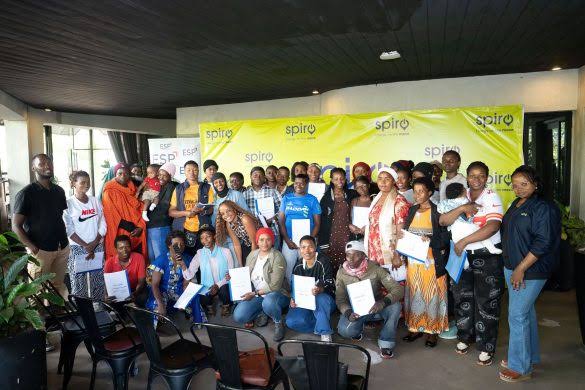
Announced in Kigali on 28 October, the Women in E-Mobility programme aims to help women become professional electric motorcycle riders, establish transport-related businesses and generate sustainable incomes.
Under the partnership, Spiro will provide electric motorcycles and access to its battery-swapping network, while ESP will deliver entrepreneurship training, financial literacy, digital skills and business development support.
The programme also seeks to improve women’s access to financing and commercial opportunities within Africa’s growing electric mobility sector.
In Rwanda, women account for approximately 4% of transport workers, according to figures cited by the programme’s organisers. The initiative is designed to address barriers limiting women’s participation in motorcycle-based businesses, including access to vehicles, financing, technical training and customer networks.
A 2025 study published in Research in Transportation Business & Management found that 47.7% of 306 women surveyed in Kigali expressed interest in working as motorcycle taxi drivers.
The research, conducted by Marc Hasselwander, Emilie Martin, Liberata Mukamana, Viktoriya Kolarova, Naomi Mwaura and Tim Schwanen, identified safety and security concerns, family responsibilities and limited access to financial resources as barriers to participation.
As part of the programme, participants will receive practical motorcycle riding and road safety instruction, alongside training in financial management, digital tools and small-business operations.
The initiative will also provide affordable financing arrangements, including lease-to-own options, to support participants in acquiring electric motorcycles.
To create access to income-generating opportunities, Spiro and ESP plan to connect participants with ride-hailing, delivery and logistics platforms, enabling them to access commercial opportunities within the transport sector.
Anant Badjatya, group chief executive officer of Spiro, said the programme was designed to ensure women could participate in the economic opportunities emerging from electric mobility.
He said the partners wanted to equip women with the tools to become professional drivers, establish businesses and generate income as the sector expands.
Eric Kacou, co-founder and chief executive of ESP, said access to motorcycles needed to be accompanied by relevant skills, financing, customers and ongoing business support.
The collaboration combines Spiro’s electric vehicles, energy infrastructure and mobility ecosystem with ESP’s experience in entrepreneurship development.
Rwanda was selected as the programme’s starting market because of its developing electric mobility ecosystem and Spiro’s existing operations in the country, including motorcycle assembly and battery-swapping infrastructure.
The initial pilot will enable the partners to assess participants’ progress, income generation and business performance before determining the programme’s expansion.
Spiro and ESP plan to extend the initiative to other African markets where Spiro operates between 2027 and 2030, with the overall target of reaching 5,000 women entrepreneurs by 2030.
To support the expansion, the partners are seeking engagement with development finance institutions, impact investors, governments and commercial organisations.
The proposed partnerships are expected to support training, financing facilities and the infrastructure required to increase women’s participation in electric mobility.
The announcement did not disclose the total funding required for the programme, financing commitments secured or a detailed country-by-country rollout schedule.
Through the Women in E-Mobility programme, Spiro and ESP are seeking to increase women’s access to professional opportunities and entrepreneurship within Africa’s electric mobility industry.
With 50 women beginning training in October 2026 and an initial pilot target of 500 participants in Rwanda, the partners aim to build a programme that can be extended to 5,000 women across African markets by 2030.
SOURCE: Africa Sustainability Matters
Do you want to share your impact stories or pitch the coverage of your CSR event to us? E-mail: editor@impactwatch.net or *Phone +234-806-795-0250 (Whatsapp &Text)


