

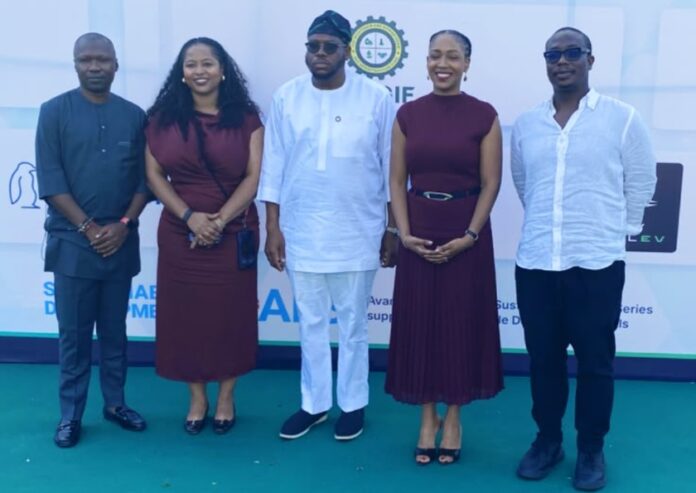
Nigerian startups have urged investors and financial institutions to increase funding for technology, infrastructure and sustainable business models to tackle food insecurity, reduce construction emissions and improve resource management.
The call came during the innovation pitch competition marking the 10th anniversary of the Sustainability Table Discourse Series (STS @10), held at the Balmoral Convention Centre, Lagos, on October 15 and 16, 2026.
The conference’s second day focused on investment, bringing together emerging businesses, investors, financial institutions and development partners to explore funding opportunities for enterprises addressing environmental and economic challenges.
Participating startups included QiQi Farms, an agricultural technology and food distribution business, and CutStruct Technology, which provides digital procurement and financing solutions for building materials. The competition aimed to connect sustainable businesses with potential investors and accelerate solutions supporting Nigeria’s progress towards the Sustainable Development Goals (SDGs).
Favour Okikijesu Adeleke, Founder of QiQi Farms, said Nigeria needed sustainable agricultural systems capable of maintaining food production throughout the year to address food insecurity.
He identified seasonal farming, inadequate infrastructure, insecurity and inconsistent government policies as persistent barriers to agricultural productivity and local producers’ ability to meet domestic demand.
“Food security is the basis of security,” he said. “We need to create a model that ensures that food production is sustainable.”
Adeleke called for a shift from reliance on seasonal farming to commercially viable agricultural models that ensure a consistent food supply.
He also highlighted the potential of artificial intelligence (AI) to help farmers anticipate market demand, forecast harvests and identify production challenges early.
“AI makes it very easy for customers to understand what they’re expecting, the demand in the market,” he said. “Farmers can use AI to have intelligence in terms of what they should expect from their harvest, the kind of issues they should project to solve on time.”
CutStruct targets construction emissions
John Oamen, Chief Executive Officer and Co-founder of CutStruct Technology, said digital procurement could reduce the construction sector’s environmental footprint while improving transparency in project financing.
He explained that transporting building materials from suppliers to construction sites contributes to carbon emissions, as projects rely heavily on trucks for deliveries.
CutStruct is addressing the problem by consolidating material orders and optimising deliveries through its technology platform. Oamen said the company had recorded an estimated 38 per cent reduction in the number of trucks transporting building materials for demand managed through its platform over the previous two years.
“In the last two years, we’ve reduced the number of trucks on the road currently carrying building materials, as far as our own demand is concerned, by about 38%,” Oamen said.
He said the approach enables the company to coordinate substantial volumes of building materials while reducing the environmental impact of transportation.
Oamen added that CutStruct was developing a carbon emissions tracking feature to help developers assess the environmental impact of their building material purchases.
“The proposed capability would allow developers to compare alternative materials and generate data that could support applications for green financing,” he said. “Access to reliable environmental performance data could also help financial institutions identify construction businesses implementing sustainable practices.”
Pakam advocates circular economy
Wunmi Ogunde, Co-founder and Chief Operating Officer of Pakam Technology, said Nigeria needed to prioritise resource recovery, recycling and circular economy practices to advance its transition to a sustainable economy.
She argued that waste should be treated as a resource with economic value rather than discarded.
“Waste first of all needs to be seen as a resource, and that way it already makes it an asset,” she said.
Ogunde noted that plastics, aluminium, cans and other recyclable materials could generate additional economic value if effective recovery and reuse systems were established.
STS seeks stronger investor connections
Kayode Olaniyan, Convener of the Sustainability Table Discourse Series and Chief Executive Officer of Avant Garde Limited, said the initiative was increasingly focused on connecting entrepreneurs with the capital needed to expand their businesses.
“Nigeria doesn’t have a shortage of ideas, Africa doesn’t have a shortage of ideas, and the world certainly doesn’t have a shortage of capital,” Olaniyan said.
He disclosed that 20 enterprises participated in the innovation pitch sessions on the conference’s investment-focused second day.
According to Olaniyan, the priority is to strengthen connections between entrepreneurs developing sustainable solutions and investors able to finance their growth.
The two-day anniversary programme ended with calls for increased private sector investment, stronger institutional support and practical partnerships to accelerate Nigeria’s transition towards a more sustainable economy
Source: The Independent
Do you want to share your impact stories or pitch the coverage of your CSR event to us? E-mail: editor@impactwatch.net or *Phone +234-806-795-0250 (Whatsapp &Text)


