

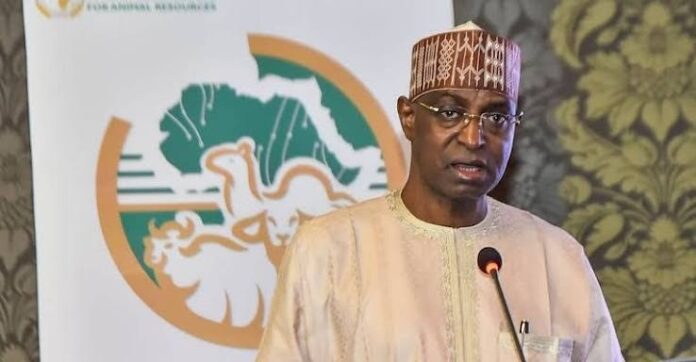
The Minister of Livestock Development, Idi Maiha, made the appeal on Thursday in Abuja at AGROMEQA Expo 2026, themed “Technology and Investment for Agro-Expo”.
The event was organised by the Agricultural Trade Group of the Abuja Chamber of Commerce and Industry (ACCI), in partnership with JMT Plus Farms and Agro-Allied, to promote agricultural mechanisation, innovation and export development.
Maiha said Nigeria’s sizeable domestic market offered substantial opportunities for livestock businesses to expand production and meet growing demand. However, he stressed that improving animal identification, disease surveillance, laboratory testing and traceability systems was essential to product safety and compliance with international export standards.
He cited Uganda, Kenya and Tanzania as examples of African countries advancing dairy and red meat production through investment and effective industry organisation.
The minister also highlighted leather manufacturing as an area with considerable potential for Nigerian businesses, noting that the country already supplies leather to European and Asian markets.
According to Maiha, an earlier assessment valued the leather industry’s potential at more than $1 billion. He urged investors to move beyond semi-processed leather and venture into finished products, including footwear, bags and upholstery.
He said this would require better hide preservation methods, modern tanning equipment and advanced manufacturing technologies to strengthen local production and capture more value within the country.
Fodder production was another investment opportunity identified by the minister, who said it could support livestock development and generate employment across Nigeria.
Maiha explained that fodder production, meat processing and leather manufacturing could complement one another across the livestock value chain. He added that an abattoir processing approximately 500 cattle daily could generate an estimated 10,000 direct jobs, depending on its operating model.
“Livestock investment can improve food security, conserve foreign exchange, expand non-oil exports and create opportunities for women and young people,” Maiha said, calling on investors to contribute capital, technology and expertise.
He reaffirmed the ministry’s commitment to improving animal health systems, establishing standards and creating a more supportive investment environment through collaboration with industry stakeholders.
Also addressing participants, Olasetemi Thompson, Vice-President of ACCI on Agriculture and Livestock and Chairman of JMT Plus Group of Companies, said the expo could help tackle insecurity by generating economic opportunities through agriculture and livestock development.
Thompson said the initiative would promote productive use of farmlands and reduce communities’ vulnerability to criminal activities. He also disclosed that the maiden edition was intended to become an annual event.
The President of the Nigerian Association of Chambers of Commerce, Industry, Mines and Agriculture (NACCIMA), Jani Ibrahim, called for greater private-sector investment in agricultural mechanisation, processing and export infrastructure.
Ibrahim cited figures from the Nigerian Export Promotion Council showing that Nigeria’s non-oil exports reached a record $6.1 billion in 2025, compared with $5.46 billion in 2024.
Agricultural commodities accounted for a significant share of the performance. Cocoa beans generated approximately $1.99 billion, while cashew nuts contributed $456.9 million and sesame seeds $300.3 million.
He said investment in tractors, harvesters, irrigation systems and precision agriculture could raise productivity. He also advocated machinery leasing to make modern agricultural equipment more accessible to smallholder farmers.
Ibrahim identified inadequate storage, processing and transportation facilities as major constraints on the sector. He called for investment in drying facilities, cold rooms, warehouses and food-processing plants to minimise post-harvest losses.
He further urged banks, investors and development finance institutions to expand equipment leasing, warehouse-receipt financing and other funding arrangements tailored to farmers and agribusinesses.
According to the NACCIMA president, improved quality assurance, certification, traceability technology and logistics would help Nigerian exporters comply with international standards, reduce product rejections and secure long-term supply contracts.
He called for closer cooperation among government agencies, investors, financial institutions and technology providers to transform agriculture into a technology-driven, export-oriented industry that creates jobs and supports economic diversification.
Meanwhile, Ewaen Imohe, Executive Director of Operations at the Nigeria Incentive-Based Risk Sharing System for Agricultural Lending (NIRSAL), highlighted Nigeria’s mechanisation gap, stating that the country had fewer than one tractor per 1,000 hectares of arable land.
Imohe said organising farmers into cooperatives could improve their access to machinery, irrigation and financing. He also disclosed that NIRSAL’s Land Bank Initiative had mapped more than 100,000 hectares for commercial agricultural production.
He urged stakeholders to develop innovative financing models and digital platforms to improve equipment utilisation, lower production costs and strengthen agricultural exports, particularly within the African Continental Free Trade Area (AfCFTA).
Discussions at the expo highlighted investment opportunities spanning livestock production, agricultural technology, food processing and export infrastructure as Nigeria seeks to diversify its economy and expand employment.
SOURCE:MSME Africa Online
Do you want to share your impact stories or pitch the coverage of your CSR event to us? E-mail: editor@impactwatch.net or *Phone +234-806-795-0250 (Whatsapp &Text)


