

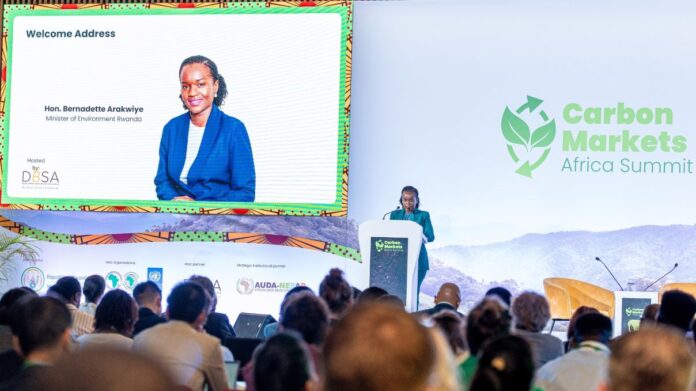
African countries must convert their carbon market potential into bankable projects, long-term investment and measurable community benefits, policymakers and investors said at the opening of the Carbon Markets Africa Summit (CMAS) 2026 in Kigali, Rwanda.
The summit opened on October 14, bringing together representatives from 45 countries, including 21 African nations, as stakeholders sought to accelerate investment, verified emissions reductions and economic development through carbon markets.
Rwanda’s Minister of Environment, Dr Bernadette Arakwiye, said African countries had made progress in developing carbon market frameworks, authorising projects and negotiating bilateral agreements. However, she warned that activity remained concentrated in a limited range of project types.
She called for broader investment in renewable energy, electric mobility, waste management, industrial decarbonisation, agriculture and nature-based solutions.
“The question before us is therefore no longer simply whether Africa is ready. It is whether we can deliver at scale, with integrity and with innovation,” Arakwiye said.
She identified three priorities for market expansion: developing methodologies suited to African conditions, securing financing to prepare projects for investment, and building sustained demand at prices that reflect the value of African carbon credits.
“Trust is the currency of this market,” she said, urging buyers and investors to support credible projects through fair pricing, long-term demand and patient capital.
Tanzania’s Minister of State in the Vice President’s Office responsible for Union Affairs and Environment, Hamad Yusuf Masauni, said African countries needed to demonstrate results rather than rely on their potential.
He argued that progress should be judged by the number of high-quality projects that complete verification, secure credit issuance and obtain offtake agreements, rather than by announcements or project development alone.
“Credibility is built one verified tonne, one closed deal and one community that sees real benefit at a time,” Masauni said.
Maxwell Gomera, UNDP Resident Representative in South Africa and Director of the Africa Sustainable Finance Hub, stressed that carbon market systems must ensure financial benefits reach the people and communities involved in projects.
He called for stronger community rights, enforceable benefit-sharing agreements, early-stage funding and partnerships that connect international buyers directly with local producers.
Perumal Arumugam of the United Nations Framework Convention on Climate Change (UNFCCC) also emphasised integrity, saying Africa should compete on the credibility and sustainability of its carbon credits rather than price alone.
“Africa should not compete simply by offering the cheapest tonnes,” he said, arguing that success should be measured by investment mobilised, emissions reductions achieved, benefits delivered to communities and the extent to which African countries retain control over their climate transitions.
Representing the African Union Development Agency-NEPAD, Esterine Fotabong called for predictable project authorisations, functional carbon registries and reliable monitoring, reporting and verification systems.
She also highlighted the need to strengthen African expertise in project validation and verification and expand access to carbon finance in sectors such as agriculture.
International buyers are also expected to place greater emphasis on the quality of carbon credits. Lukas Visek, Deputy Head of the European Commission’s Directorate-General for Climate Action Task Force for Carbon Pricing and Carbon Markets, pointed to opportunities for international carbon credits in Europe but warned that projects would need strong environmental credentials.
“Additionality and permanence are not negotiable,” he said. “Quality, however, will be rewarded.”
The requirements mean African project developers seeking international buyers must demonstrate that their projects deliver additional emissions reductions, sustain those benefits over time and align with national climate priorities.
Financing was another major issue discussed at the summit, with representatives of the African Development Bank (AfDB), the Development Bank of Southern Africa (DBSA) and Kigali International Financial Centre examining obstacles to investment.
AfDB Director of Climate Change and Green Growth Anthony Nyong said carbon market initiatives should be judged by their contribution to broader development.
“We don’t have carbon projects. We have development projects,” he said.
DBSA Chief Investment Officer Greg Fyfe highlighted the role of development finance institutions in preparing projects for investment, providing patient capital and sharing risks that could otherwise discourage private investors.
The opening discussions underscored the challenge of turning Africa’s climate assets into credible, financeable projects while ensuring that economic and environmental gains are distributed fairly.
The next test for African carbon markets will be whether supportive policies, a strong pipeline of projects and sustained international demand can produce completed transactions and lasting benefits for local communities.
Source: 256BusinessNews
Do you want to share your impact stories or pitch the coverage of your CSR event to us? E-mail: editor@impactwatch.net or *Phone +234-806-795-0250 (Whatsapp &Text)


