

African countries must translate climate commitments into tangible improvements in citizens’ lives through increased private investment, stronger accountability and public-interest journalism, stakeholders have said at the fourth Africa Climate Forum in Abuja.
Policymakers, business leaders, development partners and media practitioners at the gathering called for closer collaboration to bridge the gap between climate policies and practical results for communities across the continent.
Held under the theme “Implementing in Lockstep: Public-Private Action for Green Outcomes,” the forum examined coordinated responses to flooding, drought, food insecurity, unreliable electricity and environmental degradation, alongside opportunities for green industrialisation, job creation and sustainable development.
George Nwangwu, convener of the forum and Director-General of the Global Centre for Law, Business and Economy, said Africa’s primary climate challenge was no longer a lack of commitments but the difficulty of converting them into meaningful outcomes.
“The real measure of climate ambition is not the number of commitments we make, but the outcomes we deliver,” Nwangwu said.
He stressed that governments, businesses, financial institutions, researchers and local communities must work together to accelerate climate action. Public spending and development assistance alone, he noted, could not provide the financing required for resilient infrastructure, clean energy, climate-smart agriculture and green industries.
According to Nwangwu, governments should provide effective policies and institutions, businesses should drive investment and innovation, while development finance institutions should help reduce investment risks and mobilise long-term capital.
He identified high financing costs, currency risks, regulatory uncertainty, inadequate project preparation and limited access to affordable finance as key obstacles preventing viable climate projects from securing investment.
Nwangwu called for predictable, accessible climate finance and stronger cooperation among African countries to advance the continent’s priorities in international climate negotiations. He said the forum was designed to move beyond discussions by promoting policy dialogue, investment facilitation, innovation and storytelling.
The gathering also introduced Climate Stories, an initiative intended to highlight the human consequences of climate change and showcase solutions developed by African communities, particularly the contributions of women, young people and local entrepreneurs.
“We are not simply building a conference; we are building a platform for action,” he said.
Oge Modie, Founder and Executive Chair of Avocado Holdings, represented by Chioma Ikenna-Ibeh, Head of Business at Radah Media Company, also emphasised that climate interventions must improve energy access, food security, infrastructure, economic opportunities and community well-being.
Modie warned that convening stakeholders without clearly assigned responsibilities, common priorities and accountability mechanisms could weaken implementation efforts.
She further identified strategic communication as essential to improving public understanding, strengthening institutional trust and encouraging community participation in climate initiatives.
“Communication is not merely how we report progress. It is one of the ways we make progress possible,” she said, urging participants to prioritise defined responsibilities and measurable outcomes rather than merely identifying problems and proposing solutions.
The Regional Director of the United Nations Industrial Development Organisation (UNIDO), Ambassador Philbert Abaka Johnson, represented by the organisation’s National Programme Officer, Mr Reuben, called for investment in bankable climate projects, effective risk-sharing arrangements and clean technologies to accelerate green industrialisation.
He disclosed that three cohorts of Nigerian clean technology startups supported between 2022 and 2024 attracted more than $17 million in investments and created over 7,000 jobs, illustrating the economic opportunities associated with climate innovation.
Barrister Ismail Ahmed, Executive Chairman of the Presidential Initiative on Compressed Natural Gas and Electric Vehicles, similarly advocated increased investment in cleaner transportation.
Ahmed said Nigeria’s transition to compressed natural gas and electric vehicles required supportive policies, adequate infrastructure, affordable financing and local manufacturing. These measures, he said, were necessary to reduce emissions, generate employment and strengthen the national economy.
Participants also warned that financing and technology alone would not guarantee progress without informed citizens, sustained public engagement and closer scrutiny of government policies.
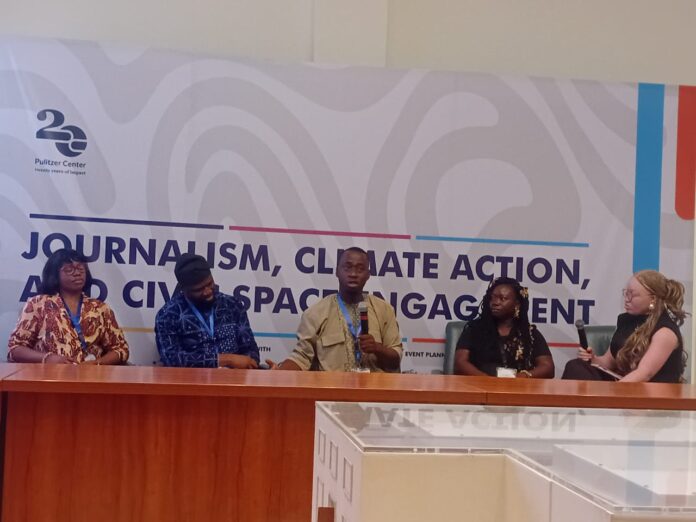
At a Pulitzer Center side event titled “Journalism, Climate Action, and Civic Space Engagement,” media and journalism experts called for more prominent climate reporting that connects environmental challenges to everyday experiences and promotes accountability.
Afy Malungu, Africa Outreach Senior Programme Manager at the Pulitzer Center, said journalism should extend beyond publishing stories to engaging audiences and stakeholders capable of influencing solutions.
She explained that the centre identifies communities affected by issues highlighted in its reporting and connects them with relevant stakeholders who can help address the problems.
“We do not simply allow a story to appear in the media and leave it there,” Malungu said, stressing that audience engagement could help transform investigative reporting into public discussion and action.
Opeyemi Alaran, Africa Education Freelancer at the Pulitzer Center, said climate journalism could strengthen climate literacy by helping students understand how environmental changes affect livelihoods, health and security.
He cited a report by Abdulaziz Okumor on fish resources in the Niger Delta, which explored the economic challenges facing fishermen. The report informed classroom activities in 2024 examining the connections between climate change, economic hardship, migration and insecurity.
Alaran also referenced a report by Precious Williams on poorly designed drainage systems and flooding. The report highlighted the health consequences of floods and the pressure they place on hospitals.
According to him, such reporting makes complex climate issues easier to understand and helps students identify practical responses. He noted that architects, urban planners and engineers all have roles to play in strengthening climate resilience.
Alaba Adeyemi, Head of News and Current Affairs at Hi-Power 102.7 FM, expressed concern that climate change coverage remained limited across many media organisations and was frequently relegated to less prominent newspaper pages.
He urged journalists to explain climate change beyond technical details by showing its effects on health, livelihoods, household finances, infrastructure and governance.
Adeyemi also called for climate reporting in indigenous languages, including Hausa, to make relevant information accessible to wider audiences.
While advocating stronger scrutiny of government responses to climate-related challenges, he said journalists should also encourage shared responsibility among authorities, communities and individuals.
The session was moderated by Francesca Ekondaho, Africa Outreach Programme Coordinator at the Pulitzer Center. Discussions focused on how public-interest journalism could strengthen climate accountability, amplify the experiences of affected communities and encourage citizens to participate in climate decision-making.
Source: New Telegraph
Do you want to share your impact stories or pitch the coverage of your CSR event to us? E-mail: editor@impactwatch.net or *Phone +234-806-795-0250 (Whatsapp &Text)


