

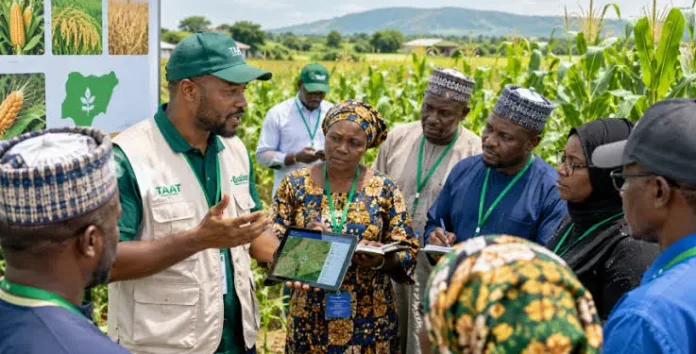
The Federal Government of Nigeria, alongside agricultural development organisations, has launched a week-long capacity-building programme for 100 agricultural extension master-trainers aimed at accelerating the adoption of modern farming technologies across Nigeria.
The training commenced in Dutse, Jigawa State, under the Technologies for African Agricultural Transformation (TAAT), in collaboration with the Federal Ministry of Agriculture and Food Security, CGIAR’s Scaling for Impact Programme, Jigawa Agricultural Transformation Agency (JATA), National Agricultural Growth Scheme–Agro-Pocket (NAGS-AP) and other research organisations.
Participants were selected from Jigawa, Kaduna, Kano, Katsina, Kebbi, Sokoto and Zamfara states, representing both public and private agricultural organisations.
The programme, themed “Empowering Extension to Scale Agricultural Innovations,” is focused on strengthening agricultural extension services while tackling persistent challenges such as insufficient extension personnel, inadequate funding, limited technical capacity, logistics difficulties and poor access to digital advisory platforms.
The 100 master-trainers will subsequently train frontline extension workers and farmer organisations through a cascade training model, with the initiative potentially reaching at least 500,000 farmers.
For smallholder farmers and agribusinesses, the programme is expected to expand access to practical information about technologies capable of improving productivity, reducing production losses and strengthening responses to climate and market-related challenges.
Speaking at the opening of the workshop, Director-General of JATA, Dr Saifullahi Umar, stressed the importance of stronger extension services in bridging the gap between agricultural research and farmers.
Representing the Jigawa State Government, Umar noted that Nigeria already has several improved agricultural technologies, but significant challenges remain in ensuring farmers receive appropriate information when they need it.
He listed improved maize hybrids, stress-tolerant rice and wheat varieties, climate information, mechanisation, integrated pest management, irrigation and improved post-harvest practices among the technologies capable of increasing farm productivity.
According to Umar, Jigawa has recruited and trained 1,700 extension personnel and supplied motorcycles to enhance their mobility and improve their contact with farmers.
The state is also setting up Agricultural Development and Farm Service Centres, which will provide farmers with access to extension advice, agricultural inputs, mechanisation services, market information and financial referrals.
Umar further said Jigawa had established a farm mechanisation company equipped with 400 tractors, harvesters and other equipment. In addition, 6,000 solar-powered irrigation systems are being deployed to support dry-season farming.
The training curriculum covers climate-smart agriculture, soil health, improved seed systems, pest and disease management, digital agriculture, market linkages and farmer-centred extension.
Participants will also receive training in mobile advisory platforms, geographic information systems, remote sensing and data tools. These technologies are expected to provide extension personnel with additional digital resources for supporting farmers and improving access to agricultural information.
Head of the TAAT Clearinghouse, Dr Solomon Gizaw, said stronger extension services were essential to translating agricultural innovations into improved productivity and livelihoods.
The initiative is connected to the African Development Bank’s $1.5 billion African Emergency Food Production Facility and Nigeria’s NAGS-AP programme, reinforcing efforts to increase food production while supporting farmers and businesses throughout the agricultural value chain.
Source: msmeafricaonline
Do you want to share your impact stories or pitch the coverage of your CSR event to us? E-mail: editor@impactwatch.net or *Phone +234-806-795-0250 (Whatsapp &Text)


