

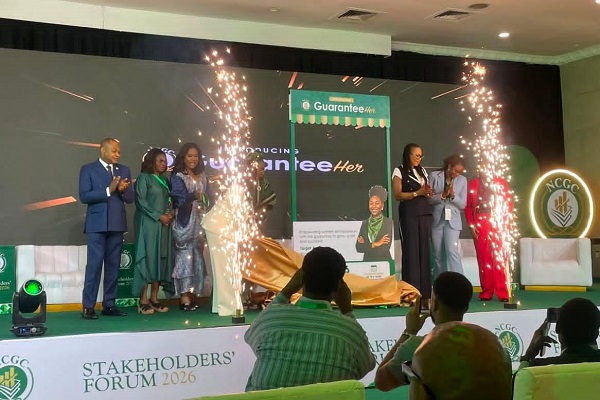
The Federal Government of Nigeria has thrown its support behind the National Credit Guarantee Company’s (NCGC) GuaranteeHer initiative, a gender-responsive credit guarantee scheme targeting more than N100 billion in financing for women-owned and women-led businesses over the next five years.
The programme is expected to benefit more than 20,000 women-owned and women-led micro, small and medium enterprises (MSMEs) while creating or sustaining over 150,000 direct and indirect jobs across Nigeria.
GuaranteeHer was unveiled at an NCGC stakeholders’ forum held in Lagos on Thursday, September 3, 2026. The forum, themed “Credit Guarantees as a Catalyst for Inclusive Economic Growth,” brought together government officials, banks, financial institutions, industry experts and development partners.
Speaking at the event, the Minister of Finance and Coordinating Minister of the Economy, Taiwo Oyedele, identified limited access to affordable capital as one of the key challenges confronting Nigerian businesses. He noted that women-led enterprises are particularly affected, often relying on personal savings, support from family members and informal financing sources.
Oyedele said the effectiveness of GuaranteeHer should ultimately be assessed by the amount of credit that reaches businesses, the reduction in collateral requirements, the affordability of the loans and the suitability of repayment terms for businesses.
He added that the wider goal was to support businesses as they progress from micro to small enterprises, then from small to medium and eventually medium to large businesses, with the process contributing to job creation and increased economic activity.
The Minister of Women Affairs and Social Development, Imaan Suleiman-Ibrahim, represented at the event by the Chief Executive Officer of Odio Mimonet, Odio Oseni, said women continue to encounter financial barriers despite their entrepreneurial capacity.
She explained that the partnership between the ministry and NCGC would bring together the government’s policy mandate and grassroots reach with the credit guarantee company’s financial structure. The collaboration is intended to reduce lending risks and improve women entrepreneurs’ access to formal financing.
Also speaking through Bassey Philip, the Minister of State for Budget and National Planning, Doris Udoka-Anile, described GuaranteeHer as economic infrastructure for inclusion. She stressed that providing financing for women-owned businesses should be treated as an economic growth strategy rather than welfare.
Earlier, NCGC Managing Director and Chief Executive Officer, Bonaventure Okhaimo, disclosed that the company had enabled 67,112 enterprises to obtain financing during its first year of operations.
According to Okhaimo, about N6.5 trillion in funding had been made available during that period, while 601,209 direct and indirect jobs had been created or sustained.
He further disclosed that more than 66 per cent of the credit supported priority sectors, including agriculture, manufacturing, trade, technology, renewable energy, transport and healthcare. He added that over 11,374 women-owned businesses had already benefited from NCGC interventions during its first year.
NCGC said GuaranteeHer would build on those interventions by establishing a framework designed to encourage financial institutions to extend credit to women-owned businesses while reducing the risks associated with such lending.
The company said the initiative would also target barriers that have traditionally limited access to finance, including inadequate collateral, informal business documentation and perceived lending risks.
Under the five-year programme, NCGC projects that more than N100 billion in financing will be facilitated, with over 20,000 women-owned and women-led businesses reached and more than 150,000 jobs created or sustained if the initiative is successfully implemented.
For women entrepreneurs, the scheme is intended to expand access to formal credit and provide viable businesses with greater capacity to grow, invest in productive assets, employ additional workers and make a stronger contribution to Nigeria’s economic growth.
Source: msmeafricaonline
Do you want to share your impact stories or pitch the coverage of your CSR event to us? E-mail: editor@impactwatch.net or *Phone +234-806-795-0250 (Whatsapp &Text)


