

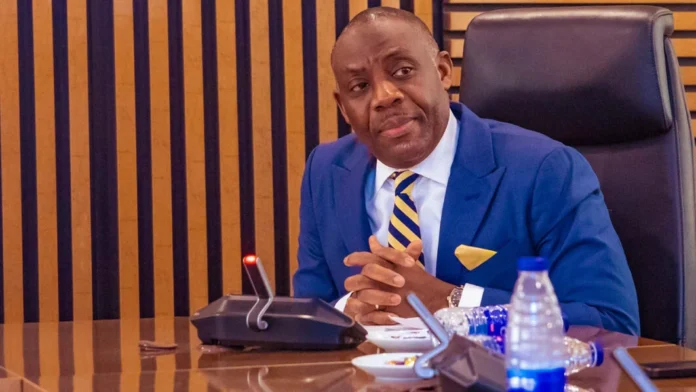
The Federal Government of Nigeria has commenced a review of its foreign scholarship and bilateral education arrangements as it seeks to reduce unnecessary spending and channel more public resources into strengthening tertiary institutions in Nigeria.
Minister of Education, Dr Tunji Alausa, said the government could no longer justify using scarce public funds to sponsor Nigerians to study courses overseas when equivalent programmes are already available in the country’s universities, polytechnics and colleges of education.
Alausa explained that the review of overseas scholarship arrangements was driven by the need to develop domestic capacity and ensure that government expenditure on education delivers greater value.
The minister recalled that shortly after taking office, he received a proposal for about 100,000 Nigerian students to travel to Morocco to study English-taught programmes, including mass communication and journalism.
According to Alausa, the proposal raised concerns because the programmes were already available in Nigerian tertiary institutions. He also noted that the students would have been required to spend their first year learning French before beginning their chosen programmes.
Alausa said, “Number one, we have all those courses in Nigeria. And yet, number two, they were going to spend the first year learning French before they started the programme.”
He argued that the financial implications of supporting such a large number of students abroad could not be justified given the capacity Nigeria had developed across its tertiary education system.
“And number three, in the position of a few million to support this in Nigeria, we support thousands of them,” he said.
The minister said the government subsequently determined that maintaining the arrangement in its previous form would constitute an inefficient deployment of public funds.
“So the Bilateral Education Agreement was not making sense, again, to us in government. It was a way to waste government funds,” Alausa said.
He added, “And this President will not waste any public funds.”
The latest position follows the Federal Government’s earlier decision to discontinue government-funded Bilateral Education Agreement scholarships while maintaining support for beneficiaries who were already studying under the previous arrangements.
The government has clarified that existing beneficiaries will continue receiving assistance until they complete their studies and will not be abandoned. However, new government-funded awards under the arrangement were discontinued after the programme underwent a review.
The policy is not a blanket prohibition on Nigerian students receiving scholarship opportunities from foreign governments. Countries willing to sponsor Nigerian students can continue doing so, although the Federal Government intends to adopt a more selective approach when deciding whether Nigerian public funds should be committed to overseas education.
Alausa similarly stated that foreign governments prepared to continue sponsoring Nigerian students could do so without necessarily requiring financial contributions from the Nigerian government.
The minister said the circumstances that originally prompted the country to send large numbers of students abroad had changed significantly.
“When those programmes were set up 20 years ago, they were meant to get students to go to the government colleges where we did not have capacity.
“But in the last 20 years, we’ve built a number of capacities in the tertiary institutions — universities, polytechnics and colleges,” he added.
The review forms part of wider reforms being pursued by the Federal Ministry of Education to reposition Nigeria’s education sector under President Bola Ahmed Tinubu’s Renewed Hope Agenda.
The reforms have increasingly centred on strengthening local tertiary institutions, expanding technical and vocational education and training, improving digital education, encouraging research and innovation, and aligning education more closely with the requirements of the economy.
The Federal Government has also stepped up efforts to improve technical and vocational education and training through measures focused on modernising curricula, building industry-relevant skills and enhancing institutions’ ability to produce graduates capable of contributing directly to economic development.
Alausa has repeatedly maintained that education expenditure should deliver measurable results, particularly against Nigeria’s competing development priorities and limited public resources.
The effort to keep a greater share of education spending within Nigeria is also linked to the government’s broader aim of developing domestic institutions instead of relying excessively on opportunities abroad.
Alausa stressed that the policy was not simply about withdrawing foreign scholarships, but about directing public funds to areas where they could generate the greatest impact.
He cited a case involving scholarship beneficiaries who were supposed to be studying abroad but were instead enrolled in Nigerian universities, saying such circumstances further underscored the need to reassess the existing system.
“So we have to start with Nigerians,” the minister said.
Alongside the scholarship review, the Federal Government has been expanding domestic support for students through scholarships and bursaries for Nigerian students, as well as the Nigerian Education Loan Fund, which provides financial assistance to students attending tertiary institutions.
Alausa said the wider objective was to establish a tertiary education system capable of producing the skills, research and innovations needed to support national development.
He recently inaugurated the Tertiary Institution National Gallery Prize Committee, which is intended to recognise outstanding academic research and innovation, particularly work with potential for commercialisation and industrial application.
“We want undergraduate researchers to see a clear pathway from academic research to industrial application, enterprise, innovation, and national development,” he said.
The minister maintained that the performance of Nigeria’s education system could no longer be judged solely by the number of certificates it produces.
“The most successful nations of the 21st century will not necessarily be those endowed with greater natural resources. They will be those that can systematically transform knowledge into solutions, research and intellectual capital into economic and industrial value,” Alausa said.
Source Punch
Do you want to share your impact stories or pitch the coverage of your CSR event to us? E-mail: editor@impactwatch.net or *Phone +234-806-795-0250 (Whatsapp &Text)


