

The Federal Government has introduced the National Agricultural Mechanisation Policy and the National Agricultural Mechanisation Investment Strategy, alongside plans to establish a mega tractor assembly plant capable of producing between 2,000 and 4,000 tractors annually.
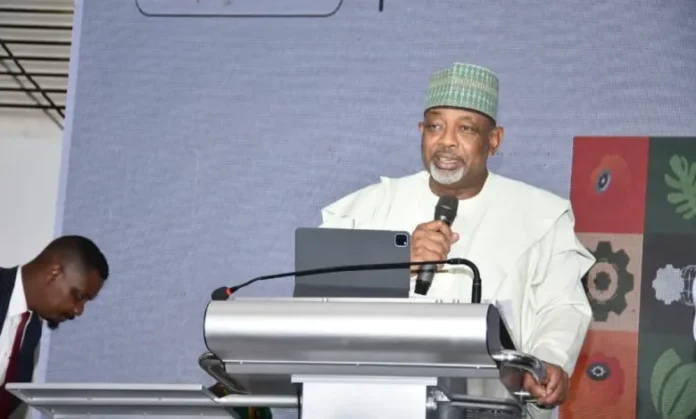
The Minister of Agriculture and Food Security, Senator Abubakar Kyari, disclosed this on Wednesday at the High-Level National Policy Dialogue on Agricultural Mechanisation in Abuja.
According to Kyari, the two policy instruments are intended to raise agricultural productivity, close Nigeria’s mechanisation gap and accelerate the development of a commercially driven agricultural sector.
He said the government’s ambition was to move Nigeria “from agricultural potential to agricultural powerhouse; from mechanisation deficit to mechanisation leadership; and from food vulnerability to food sovereignty.”
Kyari explained that agricultural mechanisation extends far beyond tractor ownership. It encompasses land preparation, planting, irrigation, crop protection, harvesting, processing, storage, logistics, precision agriculture, digital technologies, financing, insurance, maintenance and after-sales services.
“Our ambition, therefore, must be larger than equipment ownership. We must build a Mechanization-as-a-Service economy in which technology reaches the farmer when and where it is needed, at a cost that is commercially viable and sustainably financed. This is the direction in which the government is moving,” he said.
Under the Renewed Hope National Agricultural Mechanisation Programme, the Federal Government has begun procuring and deploying 2,000 tractors, alongside more than 9,000 assorted implements and spare parts.
Kyari described the intervention as the largest single agricultural mechanisation programme ever undertaken in Africa.
However, he stressed that its performance should not be judged merely by the number of machines acquired. The more important measure, he said, would be whether the equipment becomes productive economic assets that farmers can access, finance, maintain and use efficiently.
The proposed mega tractor assembly plant is expected to reduce Nigeria’s dependence on imported agricultural machinery while encouraging local manufacturing, creating jobs and supporting businesses throughout the agricultural equipment value chain.
For MSMEs, the emerging market could create opportunities in tractor leasing, equipment maintenance, spare-parts production, logistics, machinery operation, equipment financing and other agricultural technology services.
Kyari called on investors, young people and women to participate in the emerging mechanisation economy.
“Nigeria is open for investment in agricultural mechanization. We are not seeking capital merely to purchase machines. We are seeking partners to build an enduring agricultural technology and services ecosystem,” he said.
He added that agriculture was increasingly becoming a sector for enterprise, technology and wealth creation, urging young Nigerians to participate as owners, operators and innovators.
The Federal Government plans to implement the policy through a shared responsibility framework.
Under the proposed structure, the Federal Government will provide policy, standards and coordination, while state governments will support land access, infrastructure and implementation.
The private sector is expected to invest in and deliver mechanisation services, while financial institutions will develop financing and risk-sharing products to make agricultural machinery more accessible.
Development partners and research institutions are expected to provide technical support.
The Permanent Secretary of the Federal Ministry of Agriculture and Food Security, Marcus Ogunbiyi, said mechanisation should no longer be regarded simply as the purchase of tractors and other farm equipment.
He identified it as an important element of food security, agricultural productivity, rural prosperity, youth employment, women’s economic empowerment, private-sector investment and national competitiveness.
“A tractor without an operator is an idle asset. A machine without maintenance is a depreciating investment. Equipment without finance cannot reach the farmer,” Ogunbiyi said.
He said the government’s objective was to establish a national mechanisation ecosystem connecting machinery with finance, trained operators, maintenance services, spare parts, digital systems, research, standards, farmers and markets.
Ogunbiyi also stressed the importance of matching machinery to farmers’ specific requirements. He noted that equipment should be appropriate for farm size and terrain, while financing arrangements should reflect farmers’ cash flow.
The new policy could create investment opportunities for small and medium-sized enterprises across several sections of the agricultural value chain.
Ogunbiyi identified machinery assembly and leasing, mechanisation service provision, maintenance, spare-parts manufacturing, digital fleet management, operator training, irrigation, post-harvest technology and agro-processing as areas with investment potential.
The approach could gradually move Nigeria away from a system in which farmers are expected to individually purchase expensive machinery towards a service-based model where farmers pay to access equipment when they need it.
Such a model could be particularly relevant to smallholder farmers who cannot afford to acquire and maintain tractors and other agricultural machinery.
Under a Mechanisation-as-a-Service model, entrepreneurs can own agricultural equipment and provide services to multiple farmers. This could improve equipment utilisation while reducing the financial burden placed on individual farmers.
The government cited TracTrac Mechanisation Services Limited as an example of the kind of private-sector enterprise it wants to expand.
The company’s Chief Executive Officer, Godson Ohuruogu, said TracTrac had reached more than 500,000 farmers, catalysed over N2 billion in investment, trained more than 6,000 youths, women and persons with disabilities, created more than 3,000 jobs and established 567 cooperatives.
The company has also deployed tractors and labour-saving devices through its operations and the ISSAM Project with the Mastercard Foundation.
Ohuruogu said the company’s experience showed that collaboration between government and private businesses could deliver measurable outcomes when mechanisation services are designed around farmers’ needs.
He stressed that the national policy should ultimately be assessed by its effect on farmers, including whether mechanisation services reach them on time and at affordable prices.
The Federal Government is also presenting the mechanisation programme as an avenue for young Nigerians and women to participate in agriculture beyond traditional farming.
Participation in the emerging ecosystem is not expected to be limited to farmers. Opportunities could also emerge for entrepreneurs who operate machinery, manage equipment fleets, provide repairs, manufacture spare parts, develop digital solutions or operate mechanisation service centres.
The ecosystem could support youth employment through skilled roles in equipment operation, technology, engineering, logistics and maintenance.
The emphasis on women-led cooperatives and businesses could similarly create opportunities for women to participate in agricultural technology and service delivery rather than remaining concentrated only at the production end of the value chain.
Kyari cited Borno State as an example of state-level commitment to agricultural development.
He noted that Governor Babagana Zulum had delivered 200 truckloads of fertiliser to farmers and supported more than a dozen solar-powered irrigation systems and sites designed to extend the farming season.
Such investments could complement mechanisation by addressing other constraints affecting farmers, including irrigation, access to agricultural inputs and the ability to cultivate beyond the traditional rainy season.
The Federal Government has ratified the National Agricultural Mechanisation Policy and inaugurated its Implementation Taskforce, signalling the start of the policy’s implementation phase.
The focus for Nigeria’s agricultural sector will now shift from policy development to execution.
The success of the strategy will depend on whether farmers, particularly smallholders, can access affordable mechanisation services and whether private businesses can develop sustainable enterprises around equipment, finance, technology and agricultural services.
If effectively implemented, the policy could support a broader agricultural business ecosystem in which tractors represent only one component of a much larger market involving MSMEs, financial institutions, technology companies, service providers and farmers.
For entrepreneurs, the opportunity therefore extends beyond tractor ownership to building the businesses and services capable of making agricultural mechanisation accessible, affordable and sustainable across Nigeria.
Source: MSME Africa Online
Do you want to share your impact stories or pitch the coverage of your CSR event to us? E-mail: editor@impactwatch.net or *Phone +234-806-795-0250 (Whatsapp &Text)


