

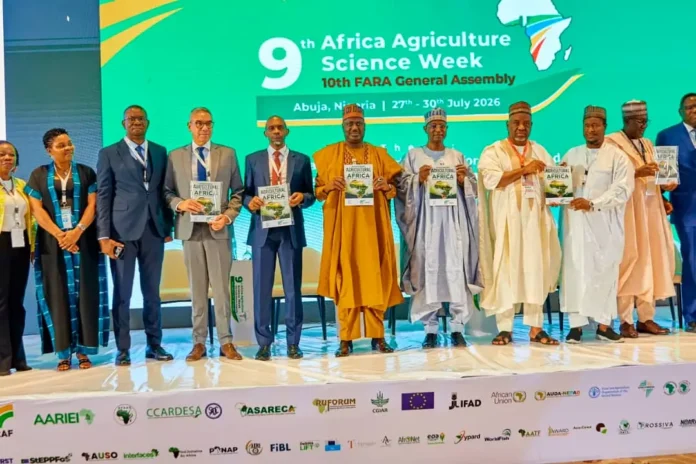
More than 500 African leaders, ministers, policymakers, development finance institutions, research organisations, private-sector executives and development partners have endorsed the Abuja Clarion Call on Sustainable Financing for Agricultural Research, Development and Innovation (AR4D), signalling a major continental commitment to reshape the way Africa funds science, technology and innovation for food security, climate resilience and inclusive economic growth.
The declaration was adopted during the High-Level Ministerial Dialogue on Sustainable Financing for Agricultural Research, Development and Innovation, jointly hosted by the National Agricultural Development Fund (NADF) and the Forum for Agricultural Research in Africa (FARA) as part of the 9th Africa Agriculture Science Week (AASW9) held in Abuja.
The ministerial dialogue attracted a broad spectrum of stakeholders, including Honourable Senator Abubakar Kyari, Minister of Agriculture and Food Security of the Federal Republic of Nigeria; Ms Bongi Njobe, Chairperson of the Board of FARA; Dr Aggrey Agumya, Executive Director of FARA; Dr Mark Bagabe, former Honourable Minister of Agriculture of the Republic of Rwanda; Dr Dora Siliya, former Honourable Minister of Agriculture of the Republic of Zambia; Mr Mohammed Abu Ibrahim, Executive Secretary and Chief Executive Officer of the National Agricultural Development Fund (NADF); and Mr Ayodeji Oludare Sotinrin, Managing Director and Chief Executive Officer of the Bank of Agriculture.
Also in attendance were senior government officials, representatives of the Government of the Federative Republic of Brazil, the African Union Commission, AUDA-NEPAD, Regional Economic Communities, National Agricultural Research Systems, development finance institutions, academia, farmer organisations, private-sector representatives and development partners.
The dialogue focused on strengthening political commitment, mobilising strategic investments and building partnerships capable of delivering sustainable financing for agricultural research, development and innovation throughout Africa.
Discussions were anchored on the keynote paper, “The Investment Case for Sustainable Financing of Agricultural Research, Development and Innovation in Africa,” which presented evidence showing agricultural research to be one of the highest-return public investments available to governments.
According to the paper, Africa’s persistent food insecurity stems largely from chronic underinvestment in research, innovation and technology development rather than a shortage of natural resources. It also highlighted the decline in international donor funding, stressing the need for African countries to establish predictable, domestically driven financing systems capable of supporting long-term agricultural transformation.
Drawing from these findings, ministers and stakeholders agreed that the continent must move away from fragmented, donor-dependent financing models and embrace predictable, African-led investment in agricultural research, development and innovation. Such a transition, they noted, is essential to achieving the goals outlined in the Kampala CAADP Declaration, Agenda 2063 and the Sustainable Development Goals (SDGs).
The Abuja Clarion Call sets out six key commitments aimed at strengthening sustainable financing for agricultural research across Africa. These include progressively increasing predictable domestic financing for agricultural research and innovation, establishing or strengthening Agricultural Development Funds and other sustainable financing mechanisms, championing an African-led resource mobilisation process that includes the creation of a continental endowment fund to sustainably finance agricultural research while strengthening continental coordination through FARA, expanding public-private partnerships to accelerate technology commercialisation and innovation, scaling innovative financing instruments such as blended finance and impact investment, and deepening collaboration among FARA, the African Union, AUDA-NEPAD, Regional Economic Communities, National Agricultural Research Systems and development partners.
One of the dialogue’s landmark outcomes was the agreement that Nigeria, through the Federal Ministry of Agriculture and Food Security, will spearhead an African-led resource mobilisation process to establish sustainable financing mechanisms, including a continental endowment fund designed to strengthen agricultural research, innovation and continental coordination through FARA.
Participants also underscored that financing agricultural research should be viewed as a strategic investment in Africa’s future rather than a recurring expenditure. They noted that increased investment in science, technology and innovation would support the development of improved technologies, climate-smart farming systems, resilient seed systems, competitive value chains, youth employment opportunities and stronger food and nutrition security across the continent.
The dialogue further urged development finance institutions, commercial banks, philanthropic organisations and private investors to collaborate with governments in mobilising blended finance and other innovative financing instruments capable of reducing investment risks while accelerating research commercialisation and technology adoption throughout Africa.
At the close of the meeting, participants reaffirmed that Africa’s agricultural transformation ultimately depends on the continent’s readiness to invest in its own scientific capacity.
The Abuja Clarion Call therefore establishes a continental framework for moving beyond declarations by translating political commitments into sustained investments that strengthen African institutions and enable them to develop African solutions for African agriculture.
The declaration concluded by drawing inspiration from President John F. Kennedy’s vision that led to the Moon landing, stating that the Abuja Clarion Call similarly challenges Africa to pursue an ambitious future by financing its own agricultural science, unlocking innovation and securing long-term prosperity for future generations.
Source: The Authority
Do you want to share your impact stories or pitch the coverage of your CSR event to us? E-mail: editor@impactwatch.net or *Phone +234-806-795-0250 (Whatsapp &Text)


