

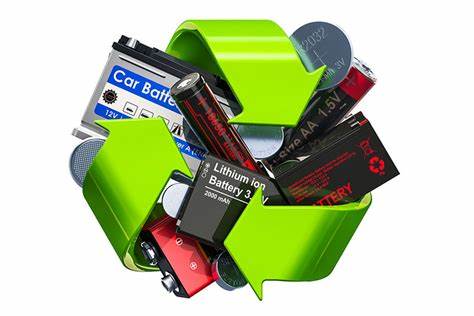
A collaboration between Nigeria and Germany is set to create an initiative tagged: Partnership for Responsible Battery and Metal recycling (ProBaMet) project.
The partnership is set to improve battery recycling in Nigeria, raise labour and environmental standards, and establish sustainable trade flows for these raw materials.
The new project will see partners from Nigerian civil society, the metal processing industry and the solar industry working together with the Oeko-Institut to develop a cooperative approach to the responsible recycling of lead-acid batteries.
A researcher on “Circular Economy and Recycling” at the Oeko-Institut, Frederick Adjei emphasized thus: “As the largest economy and most populous country in Africa, Nigeria is also central to battery recycling. Nowhere else on the African continent is the volume of used batteries as high.”
“At the same time, the expansion of decentralized solar power solutions is leading to an increase in demand for batteries, all of which will have to be recycled properly at some point”, Adjei added.
To this end, the project is liaising closely with the Nigerian Federal Ministry of Environment and the environmental enforcement agency, Nigeria Standards and Regulations Enforcement Agency (NESREA).
It was also revealed that the project is being funded by the Federal Ministry for Economic Cooperation and Development (BMZ) and supported by the Deutsche Gesellschaft für Internationale Zusammenarbeit (GIZ) GmbH.
The aim of the joint project is to also share experiences for the modernization of the recycling sector in Nigeria.
The partners are using a three-pronged approach: the Oeko-Institut and the industrial partners are providing knowledge on environmental protection and occupational safety for recycling plants and training plant managers to improve environmental performance and plant safety.
In addition, the partners are developing concepts for how Nigerian regulatory authorities might introduce and monitor binding standards for environmental protection and occupational health and safety and implement them together with local companies.
There will also be cooperation with other sectors like the Nigerian solar industry, which requires environmentally sound solutions for used batteries.
The German and international metals industry is as well highly interested in responsible supply chains for secondary raw materials.
“We have been monitoring the recycling of used batteries with great concern for many years and have already worked with the Nigerian government on a battery policy.
“We see this project as an important continuation and practical implementation of that work,” Dr. Leslie Adogame of the Nigerian organisation Sustainable Research and Action for Environmental Development (SRADev) said.
Adding a practical perspective, the CEO of the Alliance for Rural Electrification (ARE), David Lecoque noted: “Our member companies are actively involved in the expansion of decentralized renewable energy in Africa. They are aware of the challenges associated with battery disposal and are keen to scale up high quality local recycling solutions”.
Franziska Weber from Plattform Blei, an initiative of the WirtschaftsVereinigung Metalle, emphasizes the benefits for the industry:
“Our member companies and partners are dependent on the import of raw materials and recycling streams are playing an increasingly important role in this context.
“But of course, we have to pay particular attention to environmental and labor standards with all our suppliers. Without the implementation of appropriate standards, the German economy cannot enter into supply relationships with players in Nigeria.”
Source: Environment Africa
Do you want to share your impact stories or pitch the coverage of your CSR event to us? E-mail: editor@impactwatch.net or *Phone +234-806-795-0250 (Whatsapp &Text)


