

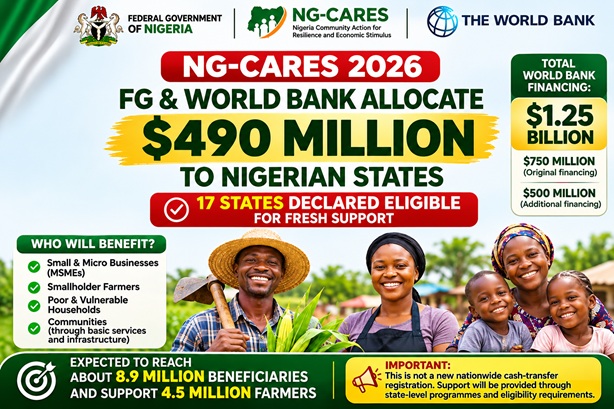
The Federal Government and the World Bank have announced an additional $490 million allocation to participating states under Nigeria’s Community Action for Resilience and Economic Stimulus (NG-CARES) programme, targeting vulnerable households, farmers and small businesses.
The allocation is part of a $500 million additional financing package approved by the World Bank, bringing its total funding for NG-CARES to $1.25 billion.
At the latest NG-CARES Additional Financing Technical Meeting in Abuja, the government disclosed that 17 states had met the required federal and World Bank assessment conditions to qualify for the new financing.
The National Coordinator of the NG-CARES Support Unit, Dr Abdulkarim Obaje, disclosed the state allocation during the meeting.
Although the development expands funding for livelihood and economic support, it does not introduce a new nationwide cash-transfer registration exercise. Implementation will take place through state governments, with access to assistance determined by individual state programmes and their application procedures.
What is NG-CARES?
NG-CARES, which stands for Nigeria Community Action for Resilience and Economic Stimulus, is a Federal Government programme supported by the World Bank and implemented through federal and state government structures.
Originally introduced to help poor and vulnerable Nigerians recover from the economic effects of the COVID-19 pandemic, the programme has expanded to address other challenges, including food insecurity, flooding, loss of livelihoods and difficulties facing small businesses.
Its interventions cover household support, agricultural inputs, micro and small business assistance, food security, community infrastructure, basic services and livelihood restoration.
$490 million allocated to participating states
The additional $500 million financing was approved by the World Bank in March 2025 and formally unveiled by President Bola Ahmed Tinubu in July 2026.
Of the additional funding, $490 million has been allocated to participating states. The remaining $10 million is not identified in the announcement as part of the state allocation.
The overall funding structure is as follows:
| Funding component | Amount |
|---|---|
| Original World Bank financing | $750 million |
| Additional World Bank financing | $500 million |
| Total World Bank financing | $1.25 billion |
| Additional allocation to states | $490 million |
The allocation is intended to strengthen state-level interventions, improve economic resilience and extend assistance to vulnerable communities.
However, an allocation does not mean the money has already been transferred to state governments or paid to beneficiaries.
17 states cleared for additional funding
Seventeen states have completed the reported eligibility and documentation process for the latest financing phase.
They are:
- Abia
- Adamawa
- Borno
- Cross River
- Ebonyi
- Enugu
- Gombe
- Kaduna
- Katsina
- Kebbi
- Kogi
- Kwara
- Nasarawa
- Ondo
- Osun
- Yobe
- Zamfara
Other participating states are at different stages of the clearance process, according to the presentation at the technical meeting.
| Eligibility status | States |
|---|---|
| Declared eligible | Abia, Adamawa, Borno, Cross River, Ebonyi, Enugu, Gombe, Kaduna, Katsina, Kebbi, Kogi, Kwara, Nasarawa, Ondo, Osun, Yobe and Zamfara |
| Screened by the Federal CARES Support Unit but not yet forwarded to the World Bank | Benue, Lagos, Niger, Plateau, Rivers and Taraba |
| Documentation ready, but subsidiary loan agreements pending | Bauchi and Bayelsa |
| Outstanding documentation | Akwa Ibom, Edo, Imo, Jigawa, Kano, Ogun, Oyo and Sokoto |
The Federal Ministry of Budget and Economic Planning also reported that 35 states and the Federal Capital Territory had joined the additional financing programme, while 33 states had submitted eligibility documents for review.
These figures represent different stages of participation and documentation, not the number of states that have received final clearance.
States that have been declared eligible can proceed with implementation arrangements, while others must address their outstanding requirements.
Who can benefit from NG-CARES?
The expanded programme targets poor and vulnerable households, farmers, micro and small businesses, and communities requiring essential services.
The World Bank expects the programme to reach approximately 8.9 million beneficiaries through safety nets and basic services, alongside about 4.5 million farmers.
The assistance is divided into several intervention areas:
1. Micro and small business owners
The business-support component is designed to help enterprises recover, maintain operations and improve their economic resilience.
Depending on state-level arrangements, eligible businesses may receive assistance to restore operations, access productive assets, strengthen business capacity, sustain livelihood activities and protect or restore employment.
This is particularly relevant to enterprises facing rising operating costs, limited access to finance and disruptions to their activities.
However, the latest announcement does not specify a standard grant amount for MSMEs or introduce a nationwide business grant application portal.
2. Smallholder farmers
Agricultural assistance and food security remain major components of NG-CARES. The expanded programme is expected to support approximately 4.5 million farmers.
Potential interventions include agricultural inputs, improved production capacity and assistance to strengthen farming livelihoods.
The programme also seeks to address challenges associated with high input costs, limited access to productive resources and disruptions to farming activities, while strengthening food supply chains.
3. Poor and vulnerable households
Households experiencing economic hardship are another target group.
Through state-level safety-net programmes, NG-CARES aims to improve access to livelihood assistance and essential services while strengthening social protection systems.
Improved social registers are also expected to help identify eligible households and reduce leakages.
4. Communities requiring basic services
The programme supports community infrastructure and access to essential services, helping communities recover from economic and environmental shocks.
The specific projects and beneficiaries will depend on the priorities and implementation arrangements established by individual states.
How can Nigerians access NG-CARES support?
NG-CARES does not operate through one nationwide application portal for individual beneficiaries. Registration procedures depend on the participating state and the particular intervention.
For instance, the requirements for agricultural assistance may differ from those for business support or household livelihood programmes.
Interested Nigerians should:
- Check whether their state is participating and its current eligibility status.
- Identify the relevant intervention for their category, whether as a farmer, business owner or vulnerable household.
- Monitor announcements from their state government and authorised implementing agencies.
- Confirm the specific eligibility conditions before applying.
- Use only official registration portals or procedures announced by the responsible state agency.
Applicants should avoid individuals or websites demanding registration fees in exchange for guaranteed approval or access to NG-CARES funding.
For general programme information, visit the official NG-CARES website.
What the additional financing means for Nigerian MSMEs
Micro, small and nano businesses provide livelihoods for millions of Nigerians but continue to face challenges such as limited access to finance, weak infrastructure, rising production costs and economic shocks.
The additional financing provides a framework for state governments to strengthen business-support interventions, helping eligible enterprises restore operations, improve productivity and protect livelihoods.
However, the entire $490 million allocation is not exclusively reserved for MSMEs. It covers several intervention areas, including agriculture, household assistance, food security and community infrastructure.
The amount ultimately directed towards business support will depend on the implementation and allocation arrangements established under the programme.
NG-CARES has reached more than 17.6 million Nigerians
The additional financing builds on the results of the original programme.
At the latest technical meeting, the World Bank’s NG-CARES Task Team Leader, Dr Lire Ersado, disclosed that the initiative had reached more than 17.6 million direct beneficiaries across Nigeria.
Initially introduced to address the economic consequences of COVID-19, NG-CARES subsequently supported responses to other challenges, including the 2022 floods.
Its interventions have covered social protection, food security, agriculture, small businesses and institutional strengthening.
The additional financing is intended to build on these achievements and strengthen state governments’ capacity to deliver targeted assistance.
World Bank emphasises verification and accountability
The successful implementation of the additional financing will also depend on proper beneficiary identification, monitoring and compliance with eligibility requirements.
The World Bank Country Director for Nigeria, Matthew Verghis, called for accelerated engagement of an independent verification agency and completion of outstanding state eligibility requirements.
The programme is also expected to strengthen social registers to improve the identification of vulnerable beneficiaries.
These measures are intended to address challenges such as inaccurate beneficiary records, duplicate entries, weak monitoring and diversion of funds, while improving transparency and ensuring assistance reaches its intended recipients.
NG-CARES and NERSI: What is the difference?
NG-CARES should not be confused with the NERSI ₦50,000 relief grant. Although both are government-supported interventions targeting vulnerable Nigerians, they have different funding structures, objectives and implementation arrangements.
| Feature | NG-CARES | NERSI |
|---|---|---|
| Main purpose | Livelihoods, agriculture, MSMEs and community resilience | Emergency relief for vulnerable households |
| Funding | World Bank-supported programme | Federal Government relief intervention |
| Implementation | State-level programmes | National programme |
| Assistance | Livelihood, business and household support | ₦50,000 cash grant |
| Application | Depends on state and intervention | No general public application |
| Beneficiary selection | Programme-specific state processes | Verified beneficiary records |
The ₦50,000 NERSI relief grant is separate from the additional NG-CARES financing and should not be presented as part of the $500 million package.
Frequently asked questions about NG-CARES
How much is the new NG-CARES funding?
The World Bank approved an additional $500 million, of which $490 million has been allocated to participating states.
What is the total World Bank financing for NG-CARES?
The total stands at $1.25 billion, comprising the original $750 million and the additional $500 million.
Can Lagos residents benefit from NG-CARES?
Lagos was among the states screened by the Federal CARES Support Unit, but its documents had not yet been forwarded to the World Bank for clearance at the latest technical meeting. Residents should monitor announcements from the Lagos State Government.
Can small business owners and farmers receive assistance?
Yes. Both groups are covered by the programme. However, available assistance and application requirements will depend on the relevant state intervention. The expanded programme is expected to support about 4.5 million farmers.
Is NG-CARES offering free cash to every Nigerian?
No. The programme provides different forms of livelihood and economic assistance. It does not establish an automatic nationwide cash payment for every Nigerian under the latest financing announcement.
Is NG-CARES a grant or a loan?
It is a World Bank-supported programme that includes grants and other forms of livelihood and economic assistance. The nature of support depends on the specific intervention.
When will beneficiaries receive assistance?
The latest announcement does not provide a nationwide payment date. Timing will depend on state eligibility, implementation arrangements, beneficiary selection and the relevant intervention.
How can Nigerians check their state’s participation status?
Residents can consult the NG-CARES official website and follow announcements from their state governments and relevant implementing agencies.
The additional financing marks a new phase in the programme, but its impact will depend on how effectively participating states translate the allocations into assistance for eligible households, farmers, businesses and communities.
SOURCE: ngcares.gov.ng
Do you want to share your impact stories or pitch the coverage of your CSR event to us? E-mail: editor@impactwatch.net or *Phone +234-806-795-0250 (Whatsapp &Text)


